Choosing between CCNA and SD-WAN is one of the most common dilemmas for aspiring network engineers today. As we look toward the 2026 job market, the landscape of IT infrastructure is shifting rapidly toward automation, cloud integration, and software-defined architectures.
If you're just starting, you might wonder: should you stick to the fundamentals or jump straight into the latest technology? The truth is, it’s not always an "either-or" choice. This guide will break down both paths to help you build a foolproof career roadmap for the coming years.
What is CCNA?
CCNA (Cisco Certified Network Associate) is a foundational technical certification that validates your knowledge of networking basics. It's widely considered the "gold standard" for anyone entering the world of IT networking.
In 2026, CCNA remains the most requested entry-level certification by hiring managers. It covers:
- IP Connectivity: Routing protocols and subnetting.
- Network Access: VLANs, spanning tree protocols, and wireless access.
- IP Services: NAT, DHCP, and NTP.
- Security Fundamentals: VPNs, access control lists (ACLs), and basic device hardening.
- Automation Basics: Introduction to programmable networks.
Why CCNA Still Matters
- Universal Language: The concepts you learn in CCNA (like the OSI model) apply to every vendor, from Cisco to Juniper.
- Prerequisite Knowledge: You can't manage a software-defined network (SD-WAN) if you don't understand how basic routing and switching work.
- Broad Job Opportunities: It qualifies you for roles like NOC Technician, Junior Network Administrator, and IT Support Specialist.
What is SD-WAN?
SD-WAN (Software-Defined Wide Area Network) is a mid-level networking specialization that uses software to manage and operate wide-area networks. While CCNA teaches you how to configure individual "boxes" (routers/switches), SD-WAN teaches you how to manage an entire network through a centralized controller.

SD-WAN is a technology that decouples the network hardware from its control mechanism. It's the modern solution for companies moving their workloads to the cloud (AWS, Azure, GCP).
Key Features of SD-WAN
- Centralized Management: You control the entire network from a single dashboard (the "Single Pane of Glass").
- Application-Aware Routing: The network automatically chooses the best path (Broadband, LTE, or MPLS) for specific apps like Zoom or Office 365.
- Zero-Touch Provisioning: You can ship a router to a branch office, and it will self-configure once plugged in.
- Enhanced Security: Integrated features like SASE (Secure Access Service Edge) and automated encryption.
The Comparison: Before vs. After
To understand the value of SD-WAN, you have to look at the "Problem vs. Solution" framework that modern enterprises face.
| Feature | Traditional Networking (CCNA Focus) | SD-WAN Networking (Advanced Focus) |
|---|---|---|
| Configuration | Manual, CLI-based (one device at a time). | Automated, GUI-based (entire network at once). |
| Traffic Flow | Static; relies on preset routing tables. | Dynamic; adjusts in real-time based on link health. |
| Cloud Readiness | Difficult to integrate with AWS/Azure. | Native integration for high-speed cloud access. |
| Cost | Expensive; relies heavily on MPLS circuits. | Cost-effective; utilizes standard internet/LTE. |
Career Roadmap 2026: How to Choose Your Path
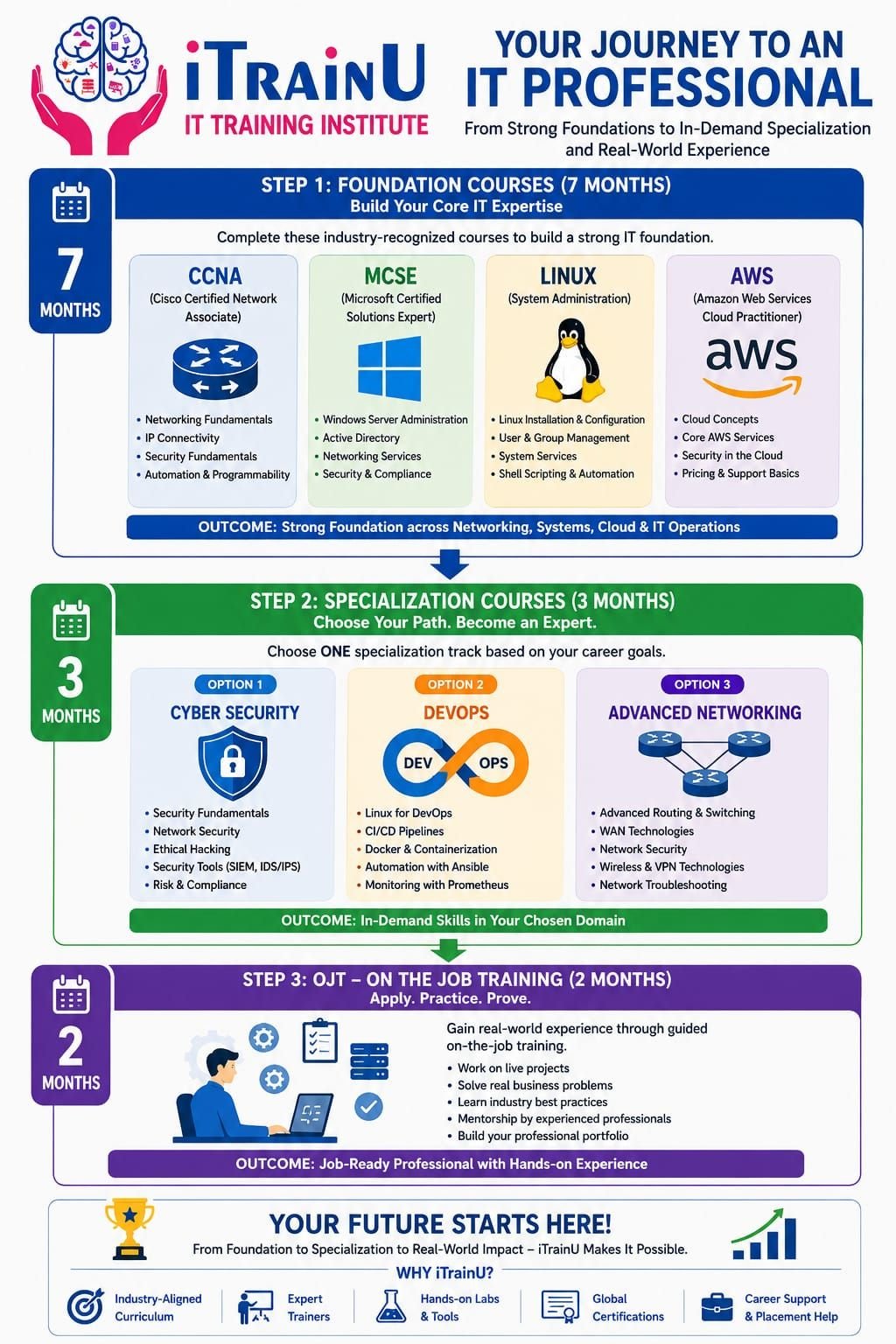
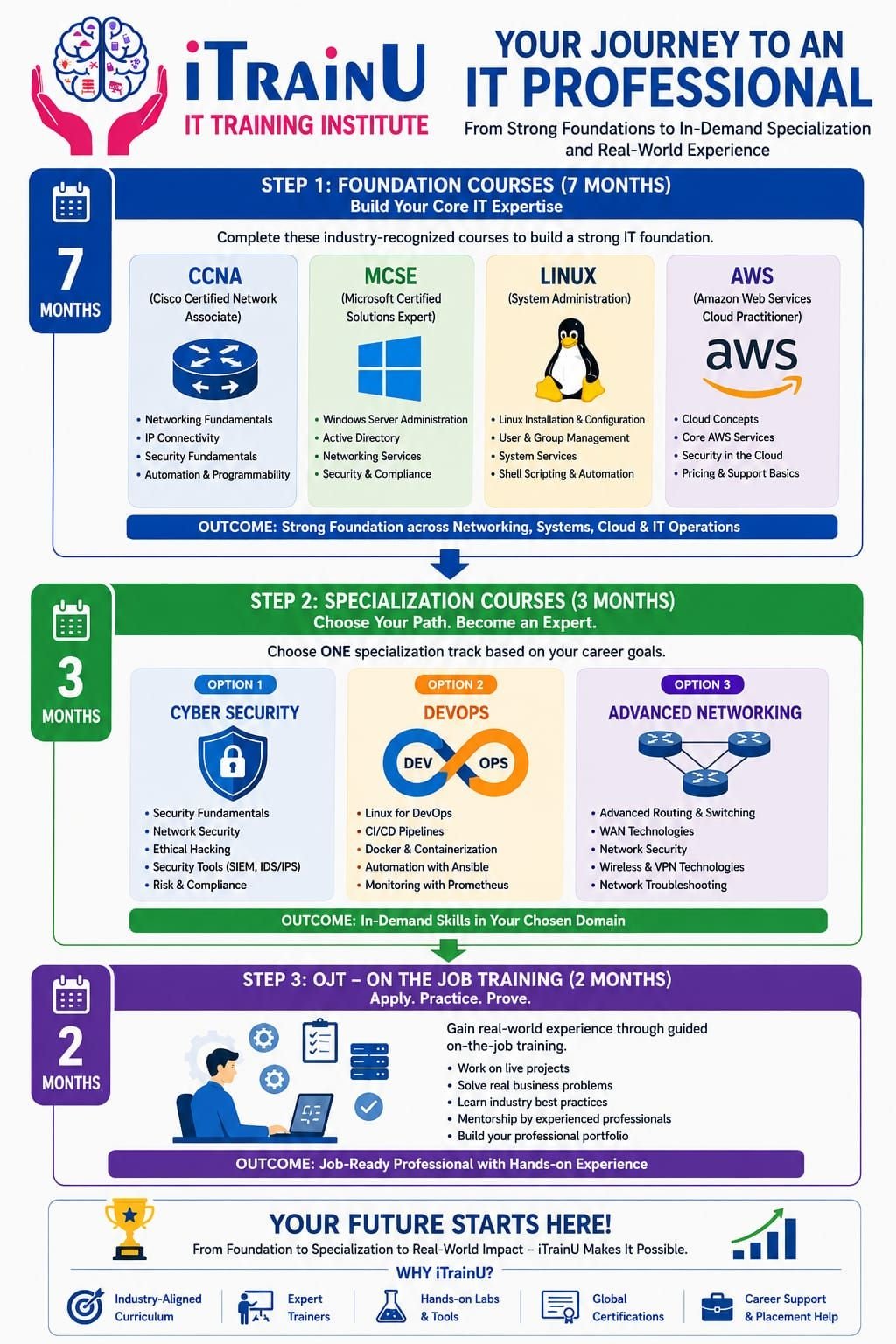
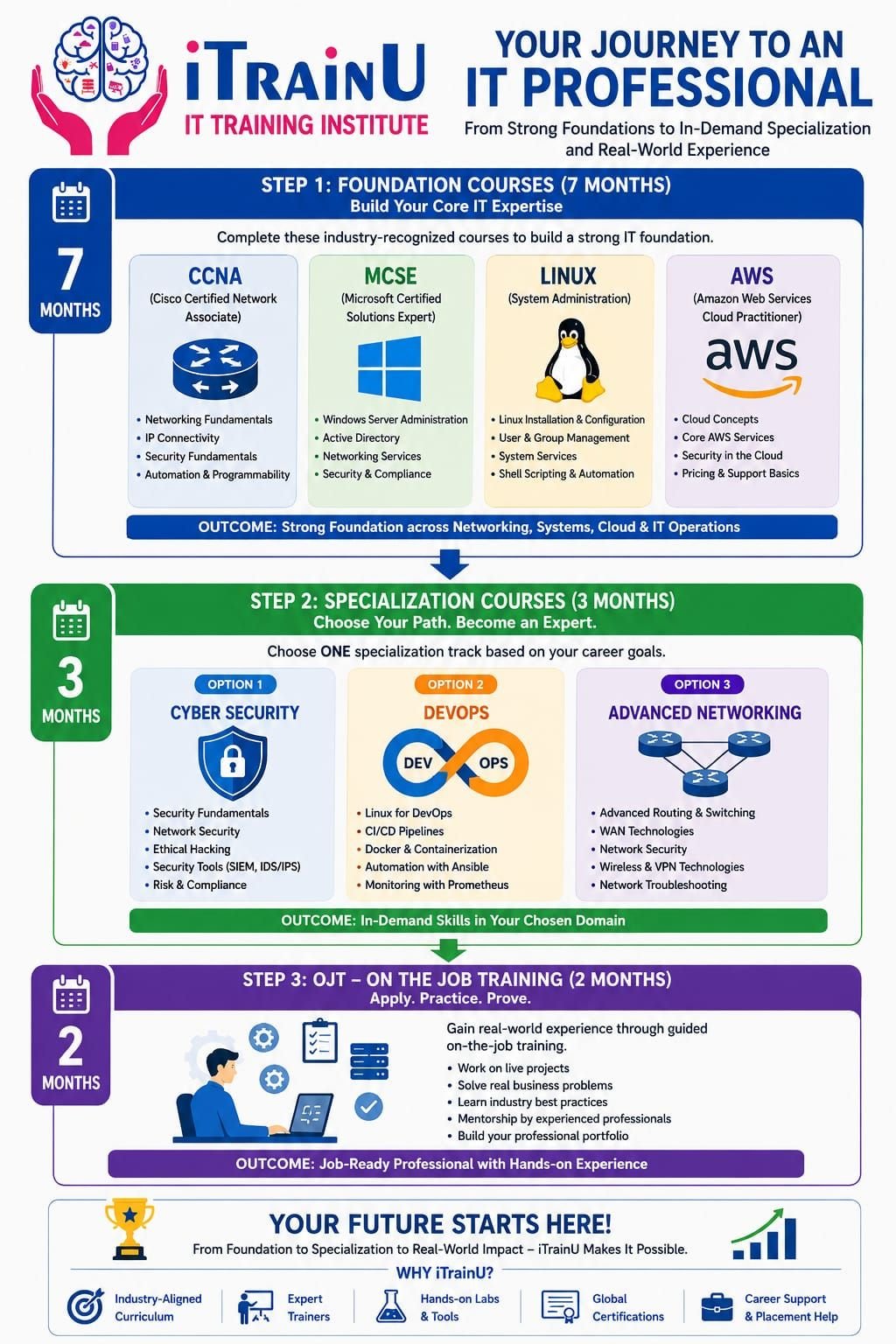
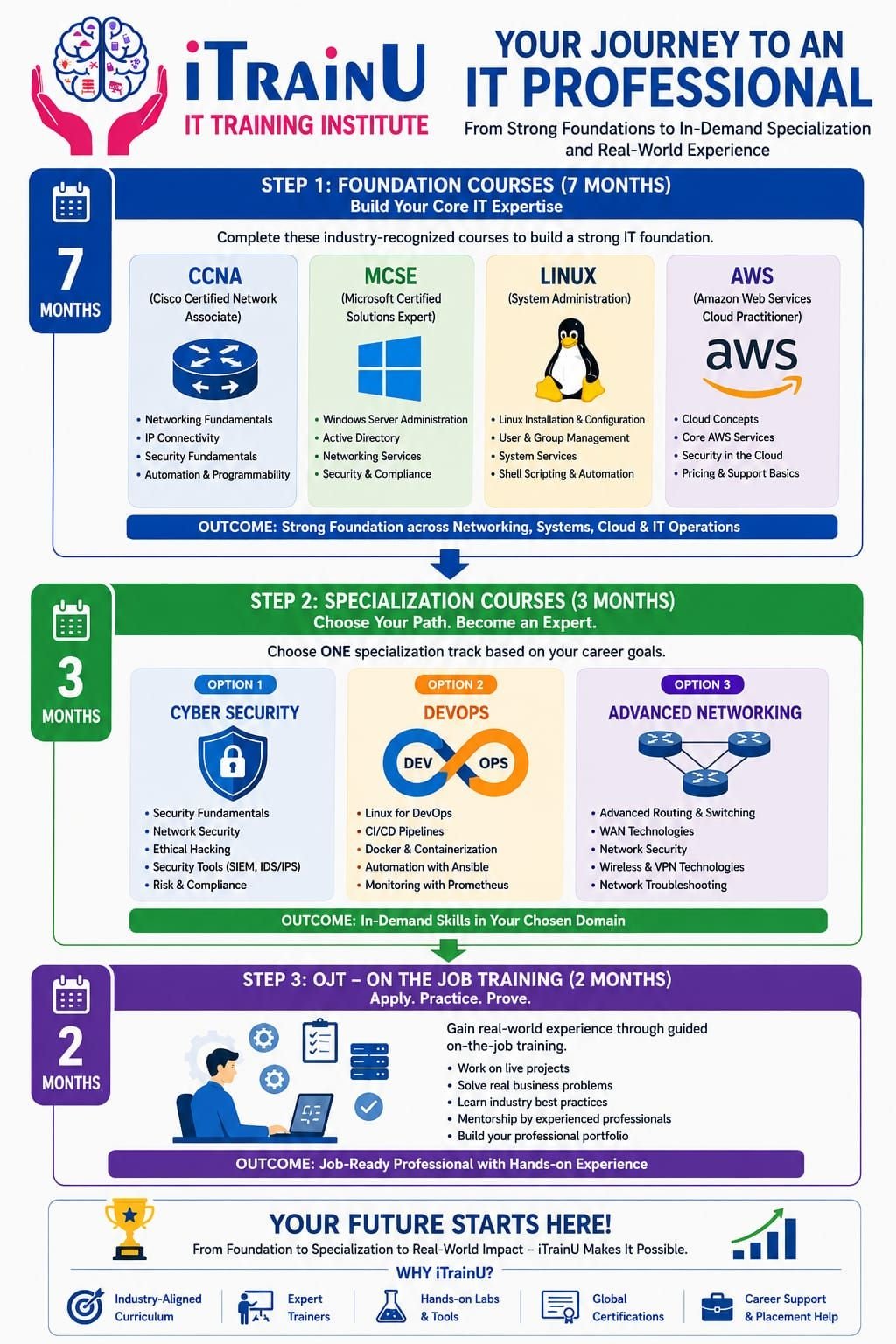
By 2026, the industry won't just look for "Network Admins": it will look for "Network Architects" and "NetDevOps Engineers." Here is how you should structure your learning at iTrainU.

Stage 1: The Foundation (Months 0–6)
If you're a beginner, start with CCNA. Do not skip this step. Even if you want to become a full stack developer, understanding how data moves through a network is essential.
- Goal: Pass the CCNA 200-301 exam.
- Job Roles: Junior Network Engineer, Desktop Support.
Stage 2: The Specialization (Months 6–18)
Once you have the basics, specialize in SD-WAN or Network Automation. This is where the salary jump happens. Companies are desperately looking for engineers who can handle Cisco Viptela or VeloCloud environments.
- Goal: Learn Python for Networking and SD-WAN architecture.
- Complementary Path: This is also a great time to look into a cyber security course in Indore with placement to understand how to secure these new software-defined perimeters.
Stage 3: The Multi-Cloud Era (Months 18+)
Modern networking is cloud-based. You should aim to be a Cloud Network Expert.
- Key Skill: Use an AWS Solution Architect study guide 2026 to master cloud networking.
- NetDevOps: Learn how to become a DevOps engineer from scratch to automate your SD-WAN configurations using Ansible or Terraform.
What You Control vs. What the Provider Manages
Understanding service models is vital for the 2026 roadmap. In an SD-WAN environment, the management overhead shifts.
What You Control:
- Policy Creation: Deciding which apps get priority.
- Security Rules: Defining firewall and encryption policies.
- SLA Monitoring: Checking if the network is meeting performance goals.
What the Provider Manages:
- The Controller Infrastructure: The "brain" of the SD-WAN often lives in the cloud (managed by Cisco or the vendor).
- Underlay Hardware: The physical lines (Fiber/LTE) are managed by ISPs, but monitored by your software.
Why Train with iTrainU?
At iTrainU, we don’t just teach you how to pass an exam; we prepare you for the day-to-day reality of an IT career.

- Hands-on Labs: We provide real-world project experience where you can configure actual Cisco routers and SD-WAN controllers.
- Industry Trainers: Our certified trainers bring years of field experience, ensuring you learn practical shortcuts, not just theory.
- Placement Support: Based in Indore? We offer a dedicated cyber security course in Indore with placement and extensive networking career support to help you land your first role.
- Internship Programs: Gain real workplace experience through our internship opportunities.
Pro Tips for 2026 Networking Success
- Learn Python Early: Even basic scripting skills will set you apart from 90% of CCNA candidates.
- Focus on SASE: Secure Access Service Edge is the future. It combines SD-WAN with cloud security.
- Lab Every Day: Theory is forgotten; muscle memory stays. Use tools like GNS3 or Cisco Packet Tracer daily.
Interview Questions to Prepare For
- Q: What is the main difference between a Control Plane and a Data Plane in SD-WAN?
- A: The control plane makes decisions about where traffic should go (centralized in SD-WAN), while the data plane actually moves the packets.
- Q: How does SD-WAN improve application performance?
- A: By using application-aware routing to direct latency-sensitive traffic (like VoIP) over the most stable link available.
- Q: Why is CCNA still relevant in an SD-WAN world?
- A: Because SD-WAN is built on top of traditional IP networking. Without understanding subnets, routing protocols, and the OSI model, troubleshooting SD-WAN is impossible.
Conclusion
So, which is better? For a beginner, CCNA is the essential starting point. It builds the foundation you need to understand why networking works. However, for those looking to maximize their salary and stay relevant in 2026, SD-WAN and automation are the ultimate destinations.
Ready to start your journey? Whether you want a full stack developer roadmap for beginners or want to dive deep into ethical hacking, iTrainU is here to guide you every step of the way.
Meta Title: CCNA vs SD-WAN: Choosing the Best Networking Career Path 2026
Meta Description: Compare CCNA and SD-WAN for your 2026 IT career roadmap. Learn why CCNA is the foundation and how SD-WAN specialization leads to higher-paying NetDevOps roles.
#Networking #CCNA #SDWAN #ITCareers #iTrainU #CloudNetworking