Greater Noida brings together a large student community, education hubs such as Knowledge Park, the Pari Chowk area, and a growing industrial belt. For students, fresh graduates, career switchers, and working professionals, this creates several possible directions in IT: from network support and system administration to cloud, DevOps, and cyber security.
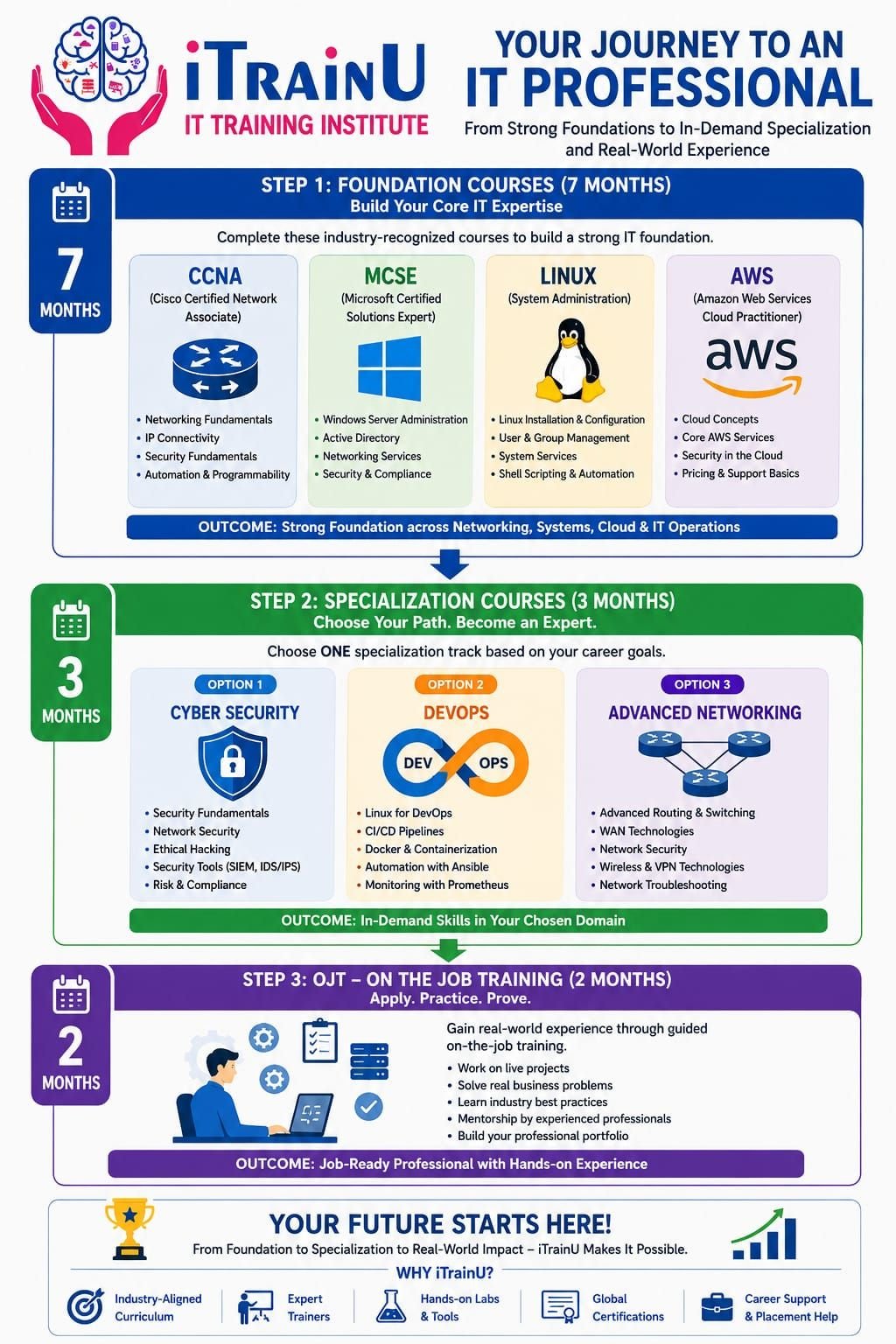
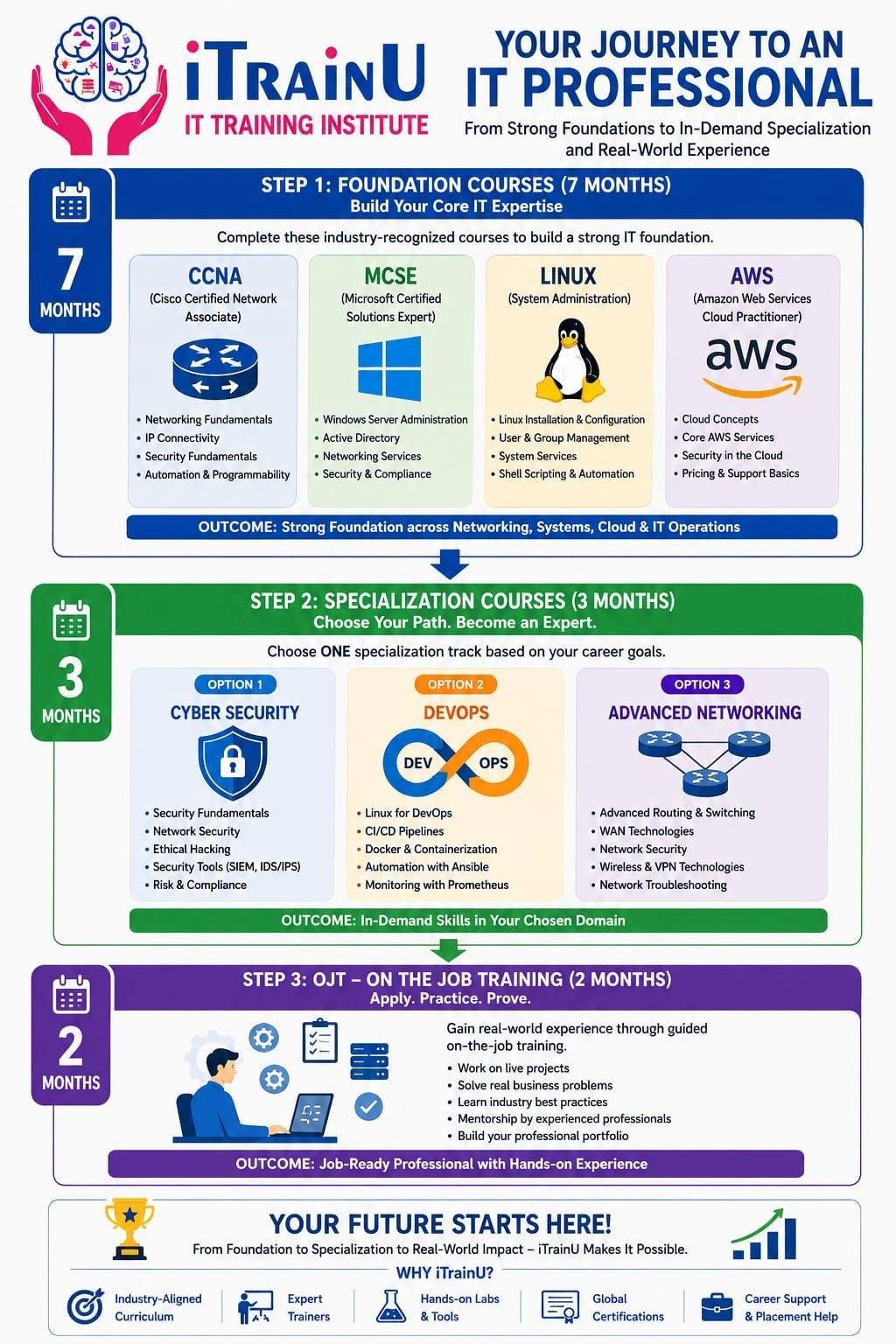
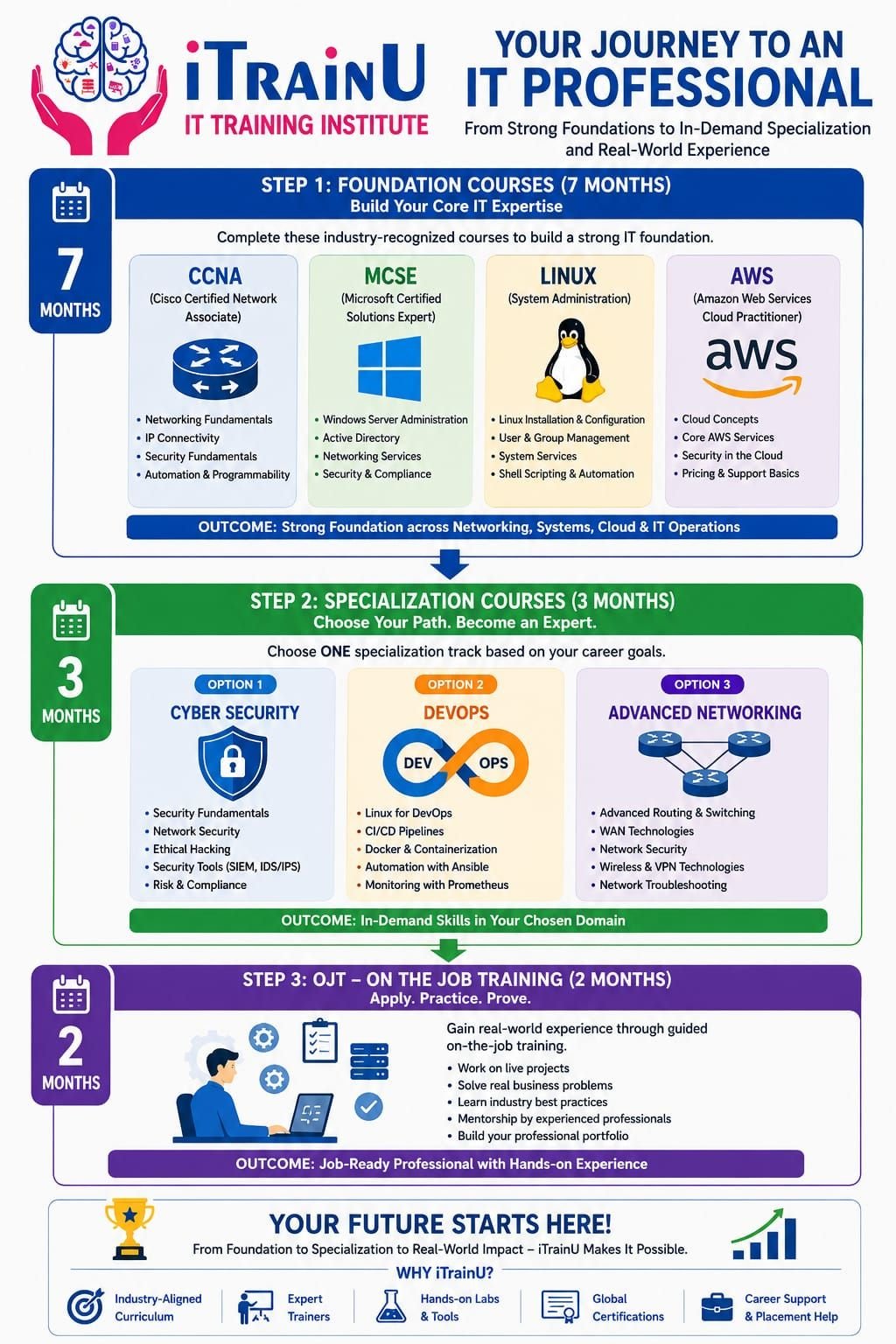
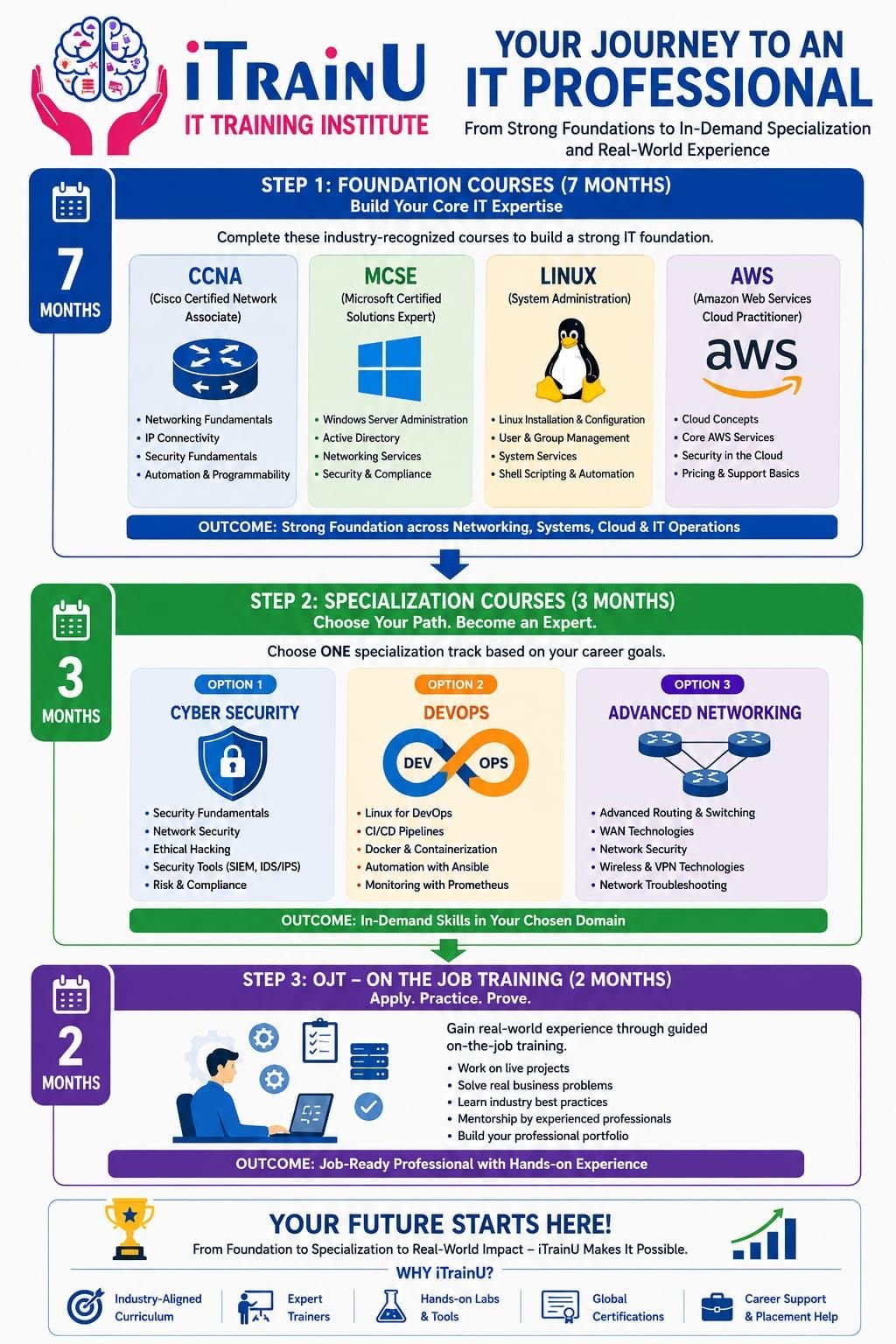
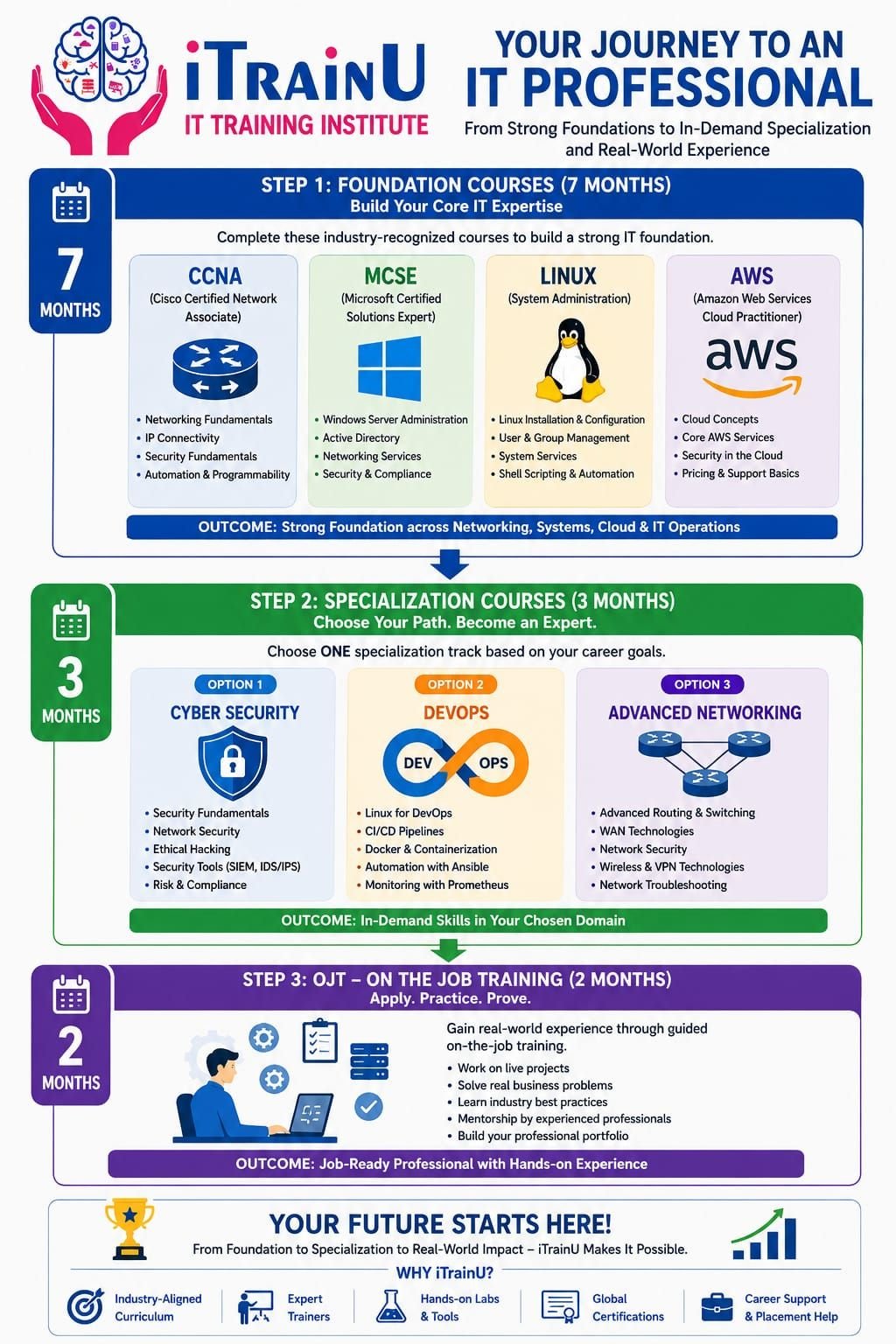
Choosing an IT course is only the first step. You’ll also need a strong foundation, repeated lab practice, a focused specialization, workplace exposure, and support preparing for interviews. iTrainU’s 12-month career pathway is structured in three stages: seven months of foundational training, three months in a specialization track, and two months of on-the-job training (OJT) at Fluke Infotech.
Contact iTrainU: 🌐 Website · ✉️ Email · 💬 WhatsApp · 💼 LinkedIn · 📸 Instagram · ▶️ YouTube
Why a practical IT roadmap matters in Greater Noida
An IT career roadmap is a step-by-step learning plan that takes you from core technical concepts to role-focused experience. In a region with educational, business, and industrial activity, IT skills can be useful in many settings, not only software companies. Depending on your experience and interests, potential entry-level directions include IT support, network operations, system administration, cloud support, and security operations.
Greater Noida’s Knowledge Park is known for its educational institutions, while local industrial and business areas add to the region’s varied technology needs. Local industrial development and reporting on the wider district’s data-centre growth provide examples of the area’s changing business landscape. These signals don’t guarantee a particular job, but they make it useful to build transferable skills in networking, operating systems, cloud, and security.
Before and after a structured learning path
Before: You may study tools separately, practise little, and finish with a list of course names but few projects to discuss.
After: You can connect networking, systems, and cloud concepts, build a portfolio, choose a specialization, and practise explaining your work to an interviewer.

The iTrainU 12-month career pathway
Months 1–7: Build your foundation
The foundation stage brings together CCNA, Linux, MCSE-related Microsoft administration, AWS fundamentals, and English communication. These skills support several IT roles and help you understand how business technology works as a system.
- CCNA and networking: CCNA-level study introduces how devices connect and communicate. You’ll work toward understanding IP addressing, subnetting, switching, routing, VLANs, and troubleshooting. These fundamentals are useful in network support and NOC roles.
- Linux administration: Linux is widely used for servers, cloud infrastructure, and development tools. Practise managing files, users, permissions, services, processes, and logs from the command line.
- Microsoft administration: The roadmap includes MCSE-related learning. MCSE is a retired Microsoft certification designation, so check the current syllabus and certification names before enrolling. The underlying administration concepts (such as Windows Server, Active Directory, DNS, DHCP, and Group Policy) remain relevant in many IT environments.
- AWS fundamentals: Learn the purpose of cloud services such as virtual servers, storage, identity and access management, and virtual networks. Cloud skills build on your understanding of systems and networking.
- English communication: Practise explaining technical issues, writing clear incident updates, and documenting your work. These skills help you collaborate with users and technical teams.
Example: If a user can’t access an internal application, a support professional might check the user’s account, confirm network connectivity, and review whether the relevant service is running. The foundation subjects help you understand each part of that investigation.
Months 8–10: Choose one specialization
The three-month specialization helps you focus your learning on a career direction. Choose a track based on the work you want to do, not simply the number of tools listed in a course.
- Cloud and DevOps: Learn how teams build, deploy, and maintain applications. Depending on the syllabus, this can include Linux, version control, CI/CD pipelines, containers, automation, and monitoring. Explore iTrainU’s DevOps training.
- Cyber Security and Ethical Hacking: Learn how to identify and reduce security risks in authorised environments. Topics can include security fundamentals, vulnerability assessment, ethical testing, and incident response. Any security testing should be performed only with permission. See iTrainU’s cyber security training.
- Advanced Networking: Build on routing and switching with topics such as SD-WAN, Aruba networking, and Fortigate firewalls. SD-WAN helps organisations manage wide-area connections across locations. Fortigate tools are used for functions such as firewall policies and VPNs.

Why cyber security and SD-WAN skills can add career value
Cyber security is important to organisations that manage customer information, employee accounts, applications, and network infrastructure. Learning the fundamentals can prepare you to work toward roles such as junior security analyst or security support specialist. These roles also require careful reporting, sound judgement, and ongoing learning.
SD-WAN and firewall skills can add depth to a networking profile because they connect network operations with security and site connectivity. These skills may support progression into more specialised roles, but higher pay isn’t automatic. Employers also consider your practical ability, experience, communication, and the responsibilities of a specific role.
Months 11–12: Apply your learning through OJT
The final two months are planned as on-the-job training at Fluke Infotech. OJT gives you an opportunity to practise workplace habits alongside technical tasks. Confirm the current schedule, eligibility, and OJT arrangements with iTrainU before enrolling.
During this stage, aim to practise:
- Following tickets and standard operating procedures.
- Recording troubleshooting steps and changes.
- Escalating issues clearly when they need additional support.
- Communicating progress with colleagues and users.
- Collecting examples of your work for a portfolio, without sharing confidential information.
Make your training practical
A training programme is more useful when you spend time doing the work, not only watching demonstrations. Ask how the course handles labs, projects, feedback, and interview preparation.
For example, a networking portfolio project could show a small office design with VLANs, IP addressing, a routing plan, and troubleshooting notes. A cloud project could document a simple virtual network, access controls, and a deployed test server. A security project could explain how you reviewed logs in an authorised lab and documented a finding.
When learning cloud services, remember the shared-responsibility idea: you control some parts of a cloud setup, while the provider manages others. The exact division depends on the service. For example, with a virtual machine, you may manage the operating system and access settings, while the cloud provider manages the physical data-centre infrastructure.

How to compare IT training institutes near Knowledge Park and Pari Chowk
When searching for the best IT training institute in Greater Noida, compare the learning experience and the support included. Don’t base your decision on a placement claim or certificate name alone.
- Review the syllabus: Check that it covers the skills and tools relevant to your target role.
- Ask about lab time: Find out whether you’ll configure systems yourself and receive feedback.
- Discuss projects: Ask what you’ll build and how you can demonstrate your work.
- Meet the trainer: A demo session can help you assess the teaching style and technical depth.
- Clarify career support: Ask whether resume reviews, mock interviews, or placement assistance are included. Placement assistance is support, not a guarantee of a job.
- Check delivery options: If you’re based in Greater Noida, confirm whether the course is available online, in person, or in a format that works with your commute and schedule.
- Get written details: Confirm fees, batch timings, attendance rules, course access, and OJT terms before making a decision.
iTrainU describes its training as industry-oriented and highlights practical learning and career support. Review the course options, placement assistance, and internship information, then ask the team which current learning format is available to Greater Noida learners.
Pro tips and common mistakes
Pro tips:
- Pick a target role, then connect each module to the tasks that role involves.
- Keep a learning log with lab steps, errors, and fixes.
- Practise explaining a technical problem in clear, simple English.
- Build projects as you learn instead of waiting until the course ends.
- Ask how the OJT experience will be supervised and documented.
Common mistakes to avoid:
- Memorising commands without understanding what they do.
- Trying to learn cloud, DevOps, networking, and security all at once.
- Listing a tool on your resume without being able to demonstrate it.
- Treating ethical hacking as permission to test real systems.
- Assuming a certificate or placement-support programme guarantees employment.
Interview questions to practise
- What’s the difference between a switch and a router?
- What is a VLAN, and why might an organisation use one?
- What steps would you take to troubleshoot a Linux service that isn’t running?
- What are DNS and DHCP used for?
- What does IAM help you control in a cloud environment?
- What problem does SD-WAN address?
- What information should you include when documenting a security incident?
Start with a clear next step
A job-ready IT foundation is built through connected knowledge and consistent practice. iTrainU’s proposed pathway moves from CCNA, Linux, Microsoft administration, AWS, and English to a specialization in Cloud and DevOps, Cyber Security and Ethical Hacking, or Advanced Networking with SD-WAN, Aruba, and Fortigate, followed by two months of OJT at Fluke Infotech.
If you’re in Greater Noida, compare the schedule and learning format with your goals, whether you’re studying near Knowledge Park, travelling through Pari Chowk, or balancing training with work. For course guidance, use the 🌐 website, ✉️ email, or 💬 WhatsApp links above. You can also follow iTrainU through the 💼 LinkedIn, 📸 Instagram, and ▶️ YouTube links.
#Bhopal #Raipur #Mumbai #NaviMumbai #Thane #Noida #Gurugram #Vashi #Andheri #Pithampur #VijayNagarIndore #Satna #Katni #Meghnagar #Mandideep #Dewas #SuperCorridorIndore #Jabalpur #GovindpuraBhopal #Gwalior #SanwerRoadIndore #Nasik #Nagpur #Dhar #Dhule #Pune #Jewar #GiftCity #Ahmedabad #Vadodara #Surat #Silvassa #Dholera #Dahod #Rajkot #Kolkata #Durgapur #Bhubaneshwar #Ranchi #Jamshedpur #Delhi #Hyderabad #Goa #Jaipur #Vapi #Lucknow #GreaterNoida #NewDelhi #Coimbatore #Chennai #Bengaluru #Gachibowli #Ameerpet #Vijayawada #Sholapur #Kolhapur #Gorakhpur #Sagar #Mohali #Chandigarh #Jodhpur #Patna #Gurgaon #Gandhinagar #Dehradun #GeetaBhawanIndore #ElectronicCity #Marathahalli #Jayanagar #Wakad #Hinjewadi #KarveNagar #CyberCity #DLF #HitechCity #Madhapur #Kondapur #Magarpatta #Kharadi #Aundh #Baner #Bandra #Airoli #Sholinganallur #Perungudi #BKC #Parel #Mahim #Borivali #NehruPalace #Satellite #SaltLakeCity #Newtown #Rajarhat #RajivGandhiTechnologyPark #ITPark #Whitefield #Koramangala #Sarjapur #Manipur #Bhadrak #Kurla #Indore #systems #business #technology #design #system #engineering #automation #innovation #productivity #businesssystems #entrepreneur #software #systemsthinking #solutions #softwares #industry #installation #security #businessdevelopment #routing #switching #cisco #firewall #paloalto #fortigate #fortinet #hp #aruba #cabling #datacenter #akcp #indore #Bhopal #India #cio #cto #itmanager #networkengineer #cloud #aws #best #intigrator #IT #vendor #provider #cctv #server #storage #project #itsm #itil