Katni is an important commercial and education centre in Madhya Pradesh. Students and fresh graduates from Katni, Jabalpur, Satna, Umaria, Rewa, and nearby areas are increasingly exploring careers in networking, cloud computing, DevOps, cybersecurity, and IT infrastructure.
However, completing a basic computer course may not be enough to qualify for modern IT roles. Employers usually look for practical knowledge, troubleshooting ability, communication skills, and experience with industry tools.
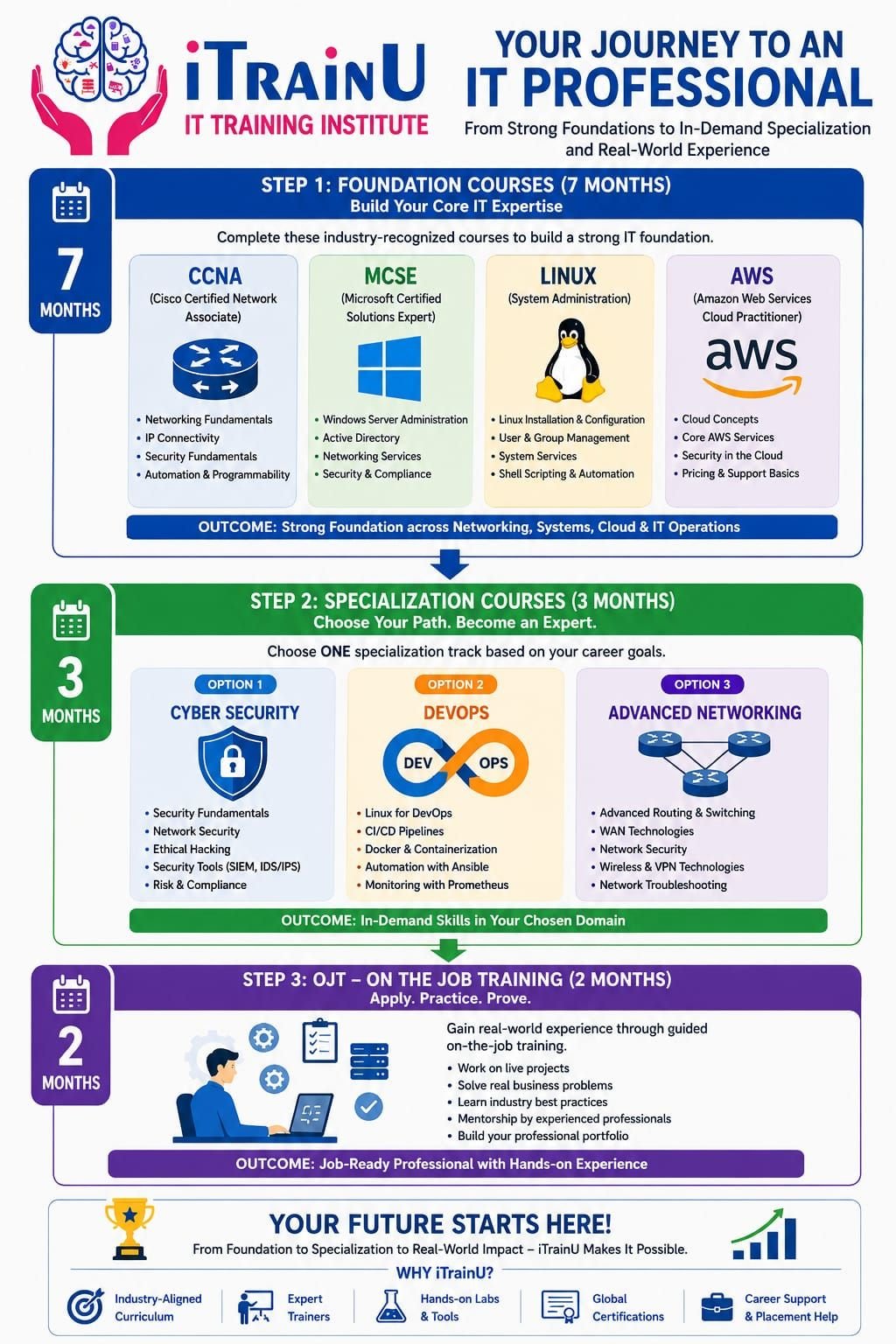
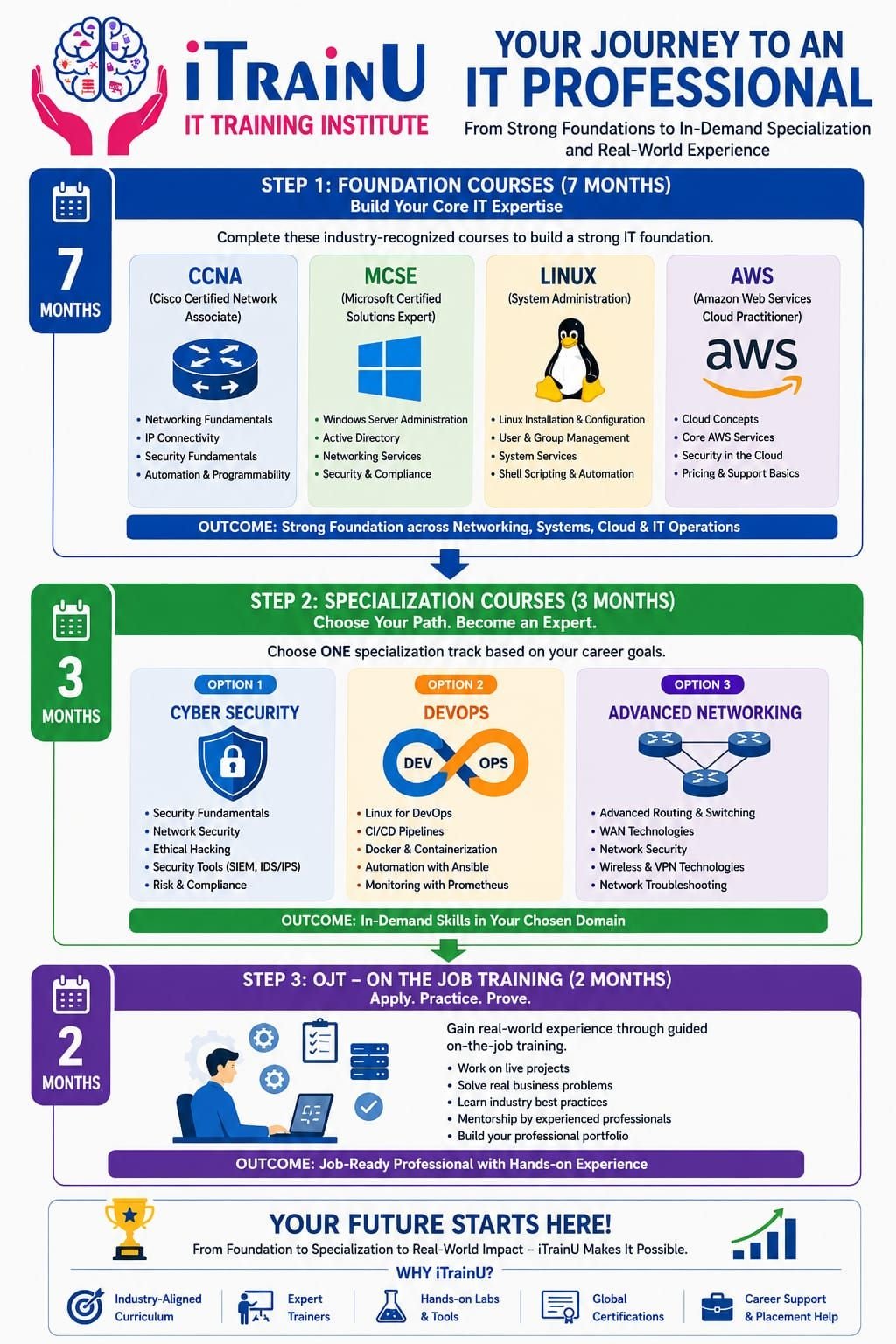
This guide explains how you can follow a structured 12-month IT career roadmap with iTrainU. The pathway includes CCNA, MCSE-aligned Microsoft technologies, Linux, AWS, English communication, specialization training, and two months of on-the-job training at Fluke Infotech.
What Makes a Good IT Training Institute in Katni?
A good IT training institute is a learning centre that combines technical concepts with practical labs, projects, trainer guidance, and career preparation.
Before choosing a course, check whether the institute provides:
- Live instructor-led sessions
- Hands-on labs and practice environments
- Real-world projects
- Experienced and certified trainers
- Resume and interview preparation
- Placement assistance
- Internship or on-the-job training
- Flexible learning options for students and professionals
You can explore the iTrainU classroom training, faculty information, and placement support pages before making a decision.
Why IT Skills Matter for Students and Freshers in Katni
Before: Learning Only Basic Computer Applications
Many beginners start with:
- MS Office
- Basic internet usage
- Typing
- General computer operations
- Simple programming concepts
These skills are useful, but they may not prepare you for roles such as:
- Network support engineer
- Linux administrator
- Cloud support associate
- SOC analyst
- DevOps trainee
- System administrator
- Firewall support engineer
After: Building a Job-Ready Technical Profile
A structured learning plan helps you develop:
- Networking fundamentals
- Operating system administration
- Cloud concepts
- Security awareness
- Automation skills
- Troubleshooting methods
- Professional communication
- Project experience
This combination can help you apply for entry-level IT roles in Katni, Jabalpur, Bhopal, Indore, Pune, Mumbai, Bengaluru, Hyderabad, Delhi-NCR, and other technology markets.
The iTrainU 12-Month IT Career Roadmap
The iTrainU pathway is divided into three stages:
- Foundation Level : 7 months
- Specialization Track : 3 months
- On-the-Job Training : 2 months
The total duration is 12 months.
Stage 1: Foundation Level : 7 Months
The Foundation Level is designed to help you build a broad understanding of IT infrastructure.

1. CCNA: Building Networking Fundamentals
CCNA is a networking foundation program that introduces you to how devices communicate across local and wide-area networks.
You learn concepts such as:
- OSI and TCP/IP models
- IPv4 and IPv6 addressing
- Subnetting
- VLANs and trunking
- Routing and switching
- Network security basics
- Wireless networking
- Network troubleshooting
- Automation and programmability basics
Why CCNA Matters
Every cloud, data centre, application, and security environment depends on networking. If you understand networks, you can troubleshoot issues more effectively and progress towards advanced infrastructure roles.
You should practise using tools such as:
- Cisco Packet Tracer
- GNS3
- EVE-NG
- Virtual routers and switches
2. Linux: Managing Servers and Applications
Linux is an operating system widely used in servers, cloud platforms, containers, and cybersecurity environments.
Important Linux topics include:
- File and directory management
- Users and groups
- Permissions
- Processes and services
- Package management
- SSH
- Networking commands
- Shell scripting
- Log monitoring
- Basic security hardening
For example, the following commands can help you inspect a Linux system:
# Display the current user
whoami

# Show the current directory
pwd

# List files with permissions
ls -la

# Display active network interfaces
ip addr

# Check running processes
ps aux
You can also read iTrainU’s beginner-friendly guide on what Linux is.
Why Linux Matters
Linux knowledge is useful for:
- Cloud support
- DevOps
- System administration
- Web hosting
- Container management
- Security operations
- Network automation
3. MCSE-Aligned Microsoft Technologies
MCSE traditionally refers to Microsoft Certified Solutions Expert skills related to Windows Server, enterprise systems, and Microsoft infrastructure.
Although Microsoft certification names and paths change over time, the underlying skills remain relevant. You should focus on:
- Windows Server administration
- Active Directory
- DNS and DHCP
- Group Policy
- User and access management
- File and storage services
- Microsoft security and compliance
- Hybrid cloud concepts
Why Microsoft Server Skills Matter
Many organisations still use Microsoft-based business environments. Understanding Windows Server and identity management can help you work in:
- IT help desks
- System administration
- Desktop support
- Infrastructure operations
- Enterprise support teams
4. AWS Cloud Fundamentals
AWS is a cloud computing platform that provides on-demand infrastructure and services over the internet.
During the foundation stage, you can learn:
- Cloud computing concepts
- Regions and availability zones
- Identity and access management
- Compute services
- Storage services
- Databases
- Virtual networks
- Monitoring
- Security and billing basics
Cloud skills are valuable because companies increasingly use cloud platforms instead of managing every physical server themselves. For a simple explanation, see iTrainU’s guide to what cloud computing is.
5. English and Professional Communication
Technical knowledge is only one part of an IT career. You also need to explain problems clearly to users, team members, and managers.
Communication training can cover:
- Technical introductions
- Email writing
- Incident reporting
- Interview answers
- Team discussions
- Customer communication
- Workplace vocabulary
Stage 2: Choose a 3-Month Specialization Track
After completing the foundation stage, you choose a specialization based on your interests and career goals.
Track 1: Cloud and DevOps
DevOps is a set of practices that brings development and IT operations closer together.
You may study:
- Linux for DevOps
- Git and version control
- CI/CD pipelines
- Docker
- Ansible
- Cloud deployment
- Monitoring with Prometheus
- Infrastructure automation
A suitable beginner project is a simple application deployment pipeline:
git clone https://example.com/sample-project.git
cd sample-project
docker build -t sample-app .
docker run -d -p 8080:8080 sample-app
Use sample repositories and training environments for practice. Never run commands against production systems without permission.
Track 2: Cybersecurity and Ethical Hacking
Cybersecurity is the practice of protecting systems, networks, applications, and data from unauthorised access or damage.

Companies need cybersecurity professionals because business operations depend on digital systems. A security incident can affect customer data, finances, compliance, and reputation.
You can learn:
- Security fundamentals
- Network security
- Vulnerability assessment
- Ethical hacking methodology
- Security monitoring
- SIEM concepts
- IDS and IPS
- Incident response
- Risk and compliance
Why Cybersecurity Is a Long-Term Career Option
Cybersecurity is not limited to one industry. Banks, hospitals, software companies, manufacturing units, schools, and government organisations all need security controls.
Possible entry-level roles include:
- SOC analyst
- Security support associate
- Vulnerability assessment trainee
- Network security administrator
- Incident response trainee
All ethical hacking activities must be performed in authorised lab environments.
Track 3: Advanced Networking with SD-WAN and FortiGate
SD-WAN is a software-defined approach to managing wide-area network connections. It helps organisations control connectivity between offices, data centres, cloud services, and remote users.
FortiGate is a network security firewall platform from Fortinet. It is used for functions such as traffic filtering, VPN connectivity, access control, and security monitoring.
You can study:
- Advanced routing and switching
- WAN technologies
- VPNs
- Firewall policies
- Network address translation
- Secure remote access
- SD-WAN concepts
- Network troubleshooting
- Security monitoring
Why SD-WAN and FortiGate Skills Can Improve Earning Potential
Basic networking is a useful starting point. Advanced networking and security skills can help you target more specialised responsibilities.
Employers may value professionals who can:
- Configure secure branch connectivity
- Troubleshoot VPN issues
- Manage firewall rules
- Monitor network traffic
- Connect offices through SD-WAN
- Support hybrid cloud networks
Your earning potential depends on experience, certifications, project quality, location, and interview performance. No course can replace consistent practice and real workplace exposure.
Stage 3: Two-Month OJT at Fluke Infotech
On-the-job training is a supervised period where you apply classroom learning to practical work.
The iTrainU pathway includes two months of OJT at Fluke Infotech, where learners can strengthen their professional habits and technical confidence.
OJT may help you practise:
- Ticket handling
- Documentation
- Network troubleshooting
- User support
- Monitoring
- Escalation procedures
- Team communication
- Project reporting

A useful OJT record should include:
- The problem you received
- The checks you performed
- The solution you applied
- The tools you used
- The result
- What you learned
Placement Assistance and Career Preparation
Training should continue beyond technical classes. iTrainU provides placement assistance to help learners prepare for employment.
Career support may include:
- Resume preparation
- Mock interviews
- Technical interview practice
- Communication guidance
- Job-readiness sessions
- Profile improvement
- Interview referrals
You can also review the iTrainU internship page and refer-and-earn programme.
Common Mistakes to Avoid
-
Studying only theory
- Build labs and practise troubleshooting.
-
Collecting too many certificates
- Focus on skills, projects, and understanding.
-
Skipping subnetting and Linux commands
- These fundamentals support cloud, DevOps, and security work.
-
Using hacking tools without authorisation
- Practise only in legal training environments.
-
Ignoring communication skills
- IT professionals must explain technical issues clearly.
-
Expecting immediate placement
- Placement assistance improves preparation, but your results also depend on performance and consistency.
Pro Tips for Learners in Katni
- Create a weekly lab schedule.
- Maintain a technical learning journal.
- Practise subnetting regularly.
- Learn basic Python for automation.
- Build a small portfolio on GitHub.
- Document every lab as a project.
- Join technical communities and webinars.
- Prepare a one-minute professional introduction.
- Compare course content, lab access, trainers, and support before enrolling.
- Contact iTrainU through the official Contact Us page for current batches, delivery modes, and course details.
Interview Questions to Practise
Networking
- What’s the difference between a switch and a router?
- What’s a VLAN?
- How does subnetting help network design?
- What’s the purpose of a default gateway?
- How would you troubleshoot a device that can’t access the network?
Linux
- What’s the difference between a process and a service?
- How do Linux file permissions work?
- What does SSH do?
- How would you check disk and memory usage?
- What’s the purpose of shell scripting?
Cloud and DevOps
- What’s cloud computing?
- What’s the difference between a virtual machine and a container?
- What’s a CI/CD pipeline?
- Why is identity and access management important?
- How can cloud costs be controlled?
Cybersecurity and Firewalls
- What’s the difference between authentication and authorisation?
- What’s a firewall policy?
- What’s the purpose of a VPN?
- What’s the difference between IDS and IPS?
- Why must ethical hacking be performed with written permission?
FAQs
Is iTrainU suitable for beginners from Katni?
Yes. The roadmap starts with foundation subjects before moving to advanced specialization. Beginners should still be ready to practise regularly and complete assignments.
Do I need an engineering degree to start IT training?
Not necessarily. Students, fresh graduates, working professionals, and career switchers can explore IT training. Your eligibility may depend on the specific programme and role.
Which specialization should I choose?
Choose Cloud and DevOps if you enjoy automation and deployment. Choose Cybersecurity if you’re interested in risk, investigation, and protection. Choose Advanced Networking if you prefer routing, firewalls, SD-WAN, and infrastructure.
Is MCSE still relevant in 2026?
The MCSE brand is associated with earlier Microsoft certification paths. The practical skills behind it: Windows Server, Active Directory, identity, networking, and security: remain useful. Ask the institute how its current Microsoft curriculum maps to modern Microsoft technologies.
Does the programme include practical labs?
The iTrainU learning model focuses on hands-on labs, real-world projects, live sessions, and industry-oriented training. Confirm the current lab structure and batch details with iTrainU before enrolling.
How can I contact iTrainU?
Visit the official iTrainU website or use the Contact Us page for current information about courses, schedules, delivery modes, and admissions.
Conclusion
The best IT training institute in Katni should help you move from basic computer knowledge to practical, job-ready skills. A strong roadmap begins with CCNA, Linux, Microsoft technologies, AWS, and English communication. You can then build a focused career through Cloud and DevOps, Cybersecurity and Ethical Hacking, or Advanced Networking with SD-WAN and FortiGate.
With hands-on labs, real-world projects, placement assistance, and two months of OJT at Fluke Infotech, the iTrainU 12-month pathway provides a structured route for students and freshers who want to enter the IT industry.
#Bhopal #Raipur #Mumbai #NaviMumbai #Thane #Noida #Gurugram #Vashi #Andheri #Pithampur #VijayNagarIndore #Satna #Katni #Meghnagar #Mandideep #Dewas #SuperCorridorIndore #Jabalpur #GovindpuraBhopal #Gwalior #SanwerRoadIndore #Nasik #Nagpur #Dhar #Dhule #Pune #Jewar #GiftCity #Ahmedabad #Vadodara #Surat #Silvassa #Dholera #Dahod #Rajkot #Kolkata #Durgapur #Bhubaneshwar #Ranchi #Jamshedpur #Delhi #Hyderabad #Goa #Jaipur #Vapi #Lucknow #GreaterNoida #NewDelhi #Coimbatore #Chennai #Bengaluru #Gachibowli #Ameerpet #Vijayawada #Sholapur #Kolhapur #Gorakhpur #Sagar #Mohali #Chandigarh #Jodhpur #Patna #Gurgaon #Gandhinagar #Dehradun #GeetaBhawanIndore #ElectronicCity #Marathahalli #Jayanagar #Wakad #Hinjewadi #KarveNagar #CyberCity #DLF #HitechCity #Madhapur #Kondapur #Magarpatta #Kharadi #Aundh #Baner #Bandra #Airoli #Sholinganallur #Perungudi #BKC #Parel #Mahim #Borivali #NehruPalace #Satellite #SaltLakeCity #Newtown #Rajarhat #RajivGandhiTechnologyPark #ITPark #Whitefield #Koramangala #Sarjapur #Manipur #Bhadrak #Kurla #Indore #systems #business #technology #design #system #engineering #automation #innovation #productivity #businesssystems #entrepreneur #software #systemsthinking #solutions #softwares #industry #installation #security #businessdevelopment #routing #switching #cisco #firewall #paloalto #fortigate #fortinet #hp #aruba #cabling #datacenter #akcp #indore #Bhopal #India #cio #cto #itmanager #networkengineer #cloud #aws #best #intigrator #IT #vendor #provider #cctv #server #storage #project #itsm #itil