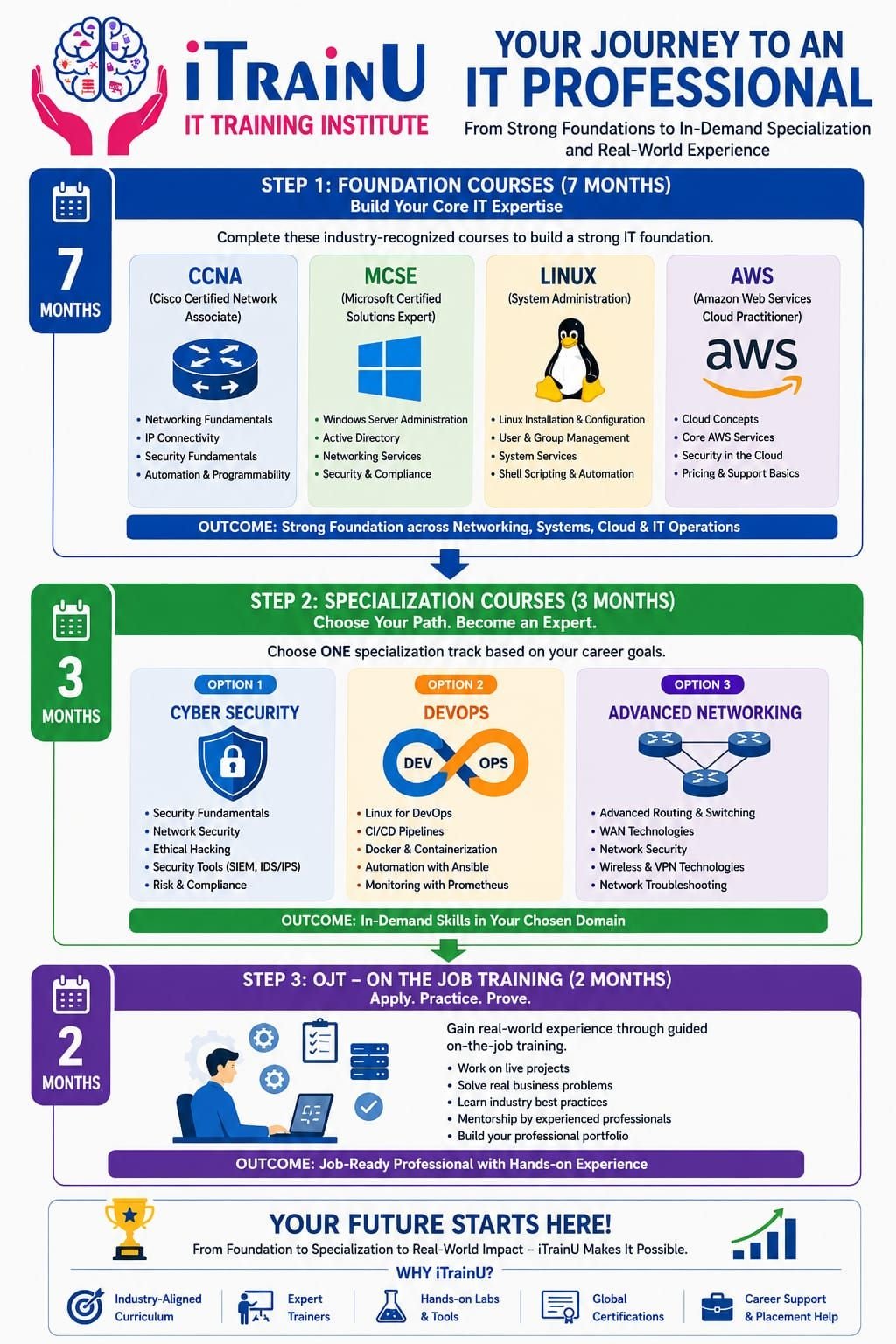
If you've been looking at the tech landscape lately, you know that the cloud isn't just a trend, it's the backbone of the global economy. As we move through 2026, the demand for professionals who can design secure and scalable cloud systems has reached an all-time high. Whether you're curious about a full stack developer roadmap for beginners or you're already in the industry, earning your AWS Certified Solutions Architect – Associate (SAA-C03) is the single most effective way to skyrocket your career.
In this guide, we'll break down exactly what this certification entails, the key services you need to master, and how iTrainU provides the hands-on experience you need to pass on your first attempt.
What is the AWS Solution Architect Associate Certification?
AWS Certified Solutions Architect – Associate is a professional-level credential that validates your ability to design and deploy well-architected solutions on the Amazon Web Services (AWS) platform. It's not just about knowing which buttons to click; it's about understanding the "why" behind architectural decisions.
In 2026, the exam (currently SAA-C03) focuses heavily on four key pillars:
- Design Secure Architectures (30%)
- Design Resilient Architectures (26%)
- Design High-Performing Architectures (24%)
- Design Cost-Optimized Architectures (20%)
Why this certification matters in 2026
Companies are no longer just "moving to the cloud", they are building complex AI-driven applications and serverless microservices. If you want to know how to become a devops engineer from scratch, mastering AWS is your first major milestone. This certification proves to employers that you can handle real-world challenges, from securing data to optimizing monthly bills.

Domain 1: Designing Secure Architectures
Security is the top priority for AWS, making up nearly a third of the exam. You'll need to understand how to protect data and infrastructure from unauthorized access.
Key Concepts to Master:
- Identity and Access Management (IAM): This is the foundation of AWS security. You must know how to use roles, policies, and Multi-Factor Authentication (MFA) to enforce the principle of least privilege.
- Virtual Private Cloud (VPC) Security: Understanding the difference between Security Groups (stateful firewalls for instances) and Network ACLs (stateless firewalls for subnets) is critical.
- Data Encryption: You need to be comfortable with AWS KMS (Key Management Service) for encrypting data at rest in S3, EBS, and RDS.
Pro Tip: The Shared Responsibility Model
One of the most common exam topics is the Shared Responsibility Model.
- What you control: Security in the cloud (data, IAM, guest OS, firewall configuration).
- What AWS manages: Security of the cloud (physical hardware, global infrastructure, managed services).
Domain 2: Designing Resilient Architectures
A resilient architecture is one that can recover from failures without losing data or going offline.
1. High Availability with Multi-AZ
Always design your applications to run across multiple Availability Zones (AZs). If one data center goes down due to a power outage, your application should keep running in another.
2. Decoupling Applications
Use services like Amazon SQS (Simple Queue Service) and Amazon SNS (Simple Notification Service) to break your application into smaller, independent pieces. If one part fails, the rest of the system remains functional.
3. Disaster Recovery (DR)
You should know the four main DR strategies:
- Backup and Restore: Cheapest, but slow recovery.
- Pilot Light: Core data is kept up to date; other resources are started only during a disaster.
- Warm Standby: A scaled-down version of your environment is always running.
- Multi-Site Active-Active: Most expensive, but provides near-zero downtime.

Domain 3: High-Performing Architectures
In 2026, performance isn't just about speed; it's about choosing the right tool for the job.
Compute and Scaling
You'll need to decide between EC2 (virtual servers), Lambda (serverless functions), and ECS/Fargate (containers). For the exam, focus on Auto Scaling Groups (ASG) and Elastic Load Balancing (ELB) to ensure your compute power grows as your traffic increases.
Modern Networking with VPC Lattice
A newer topic appearing in 2026 is VPC Lattice. It simplifies service-to-service communication across different VPCs and accounts without needing complex networking configurations.
Code Example: Creating a Simple S3 Bucket via AWS CLI
While the exam is mostly scenario-based, knowing the CLI helps you understand the underlying mechanics.
# Create a new S3 bucket in a specific region
aws s3api create-bucket --bucket my-itrainu-2026-demo --region us-east-1

# Enable versioning to protect against accidental deletes
aws s3api put-bucket-versioning --bucket my-itrainu-2026-demo --versioning-configuration Status=Enabled
Domain 4: Cost-Optimized Architectures
Cloud costs can spiral out of control if you're not careful. This domain tests your ability to keep the CFO happy.
- S3 Storage Classes: Use S3 Intelligent-Tiering for data with unknown access patterns, and S3 Glacier Deep Archive for long-term backups you rarely need.
- EC2 Pricing Models: Use Spot Instances for stateless, interruptible workloads to save up to 90%. Use Savings Plans for predictable, long-term workloads.
- Managed Services: Often, using a managed service like RDS is cheaper than managing your own database on EC2 because it reduces the "human cost" of maintenance.
How iTrainU Makes You Job-Ready
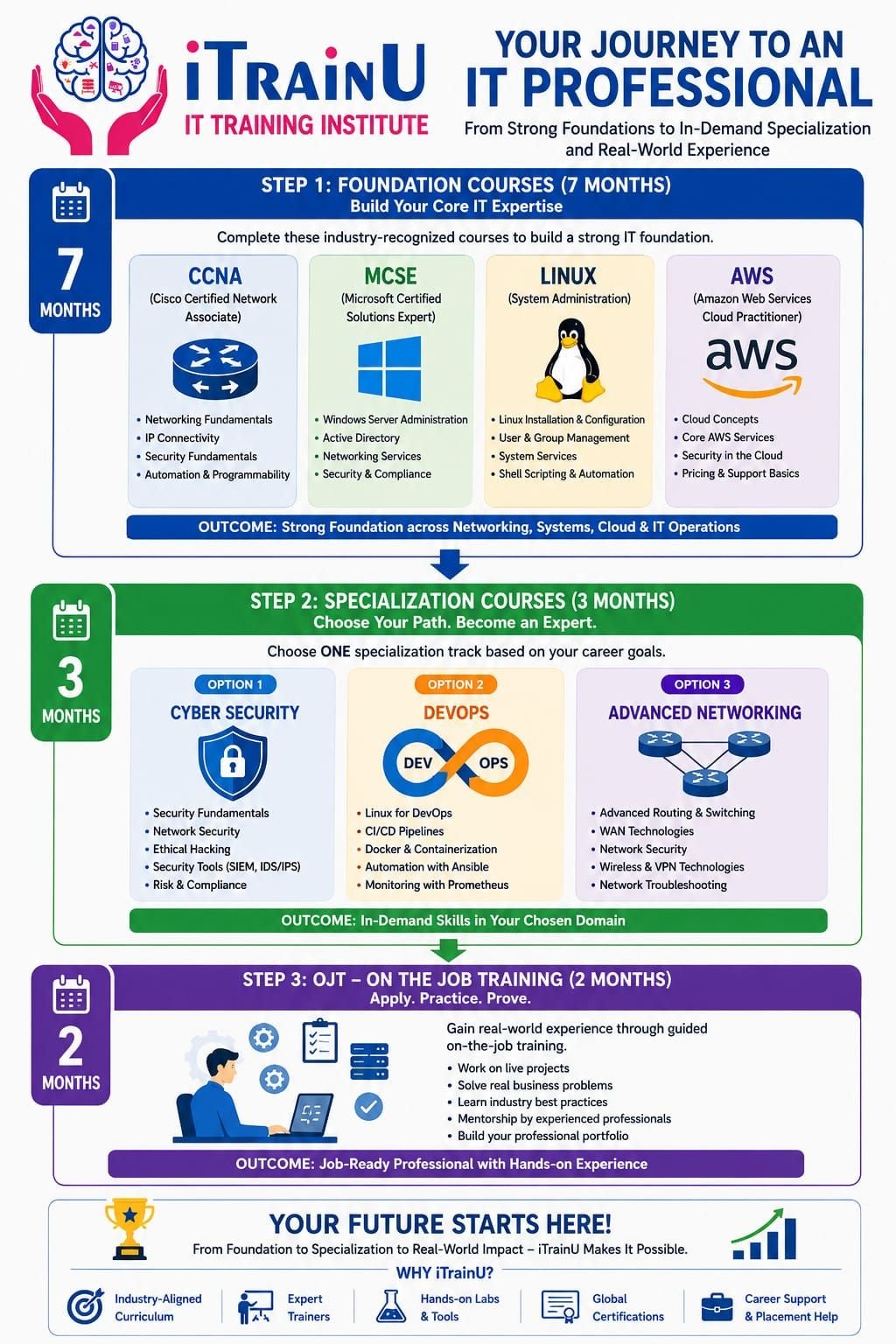
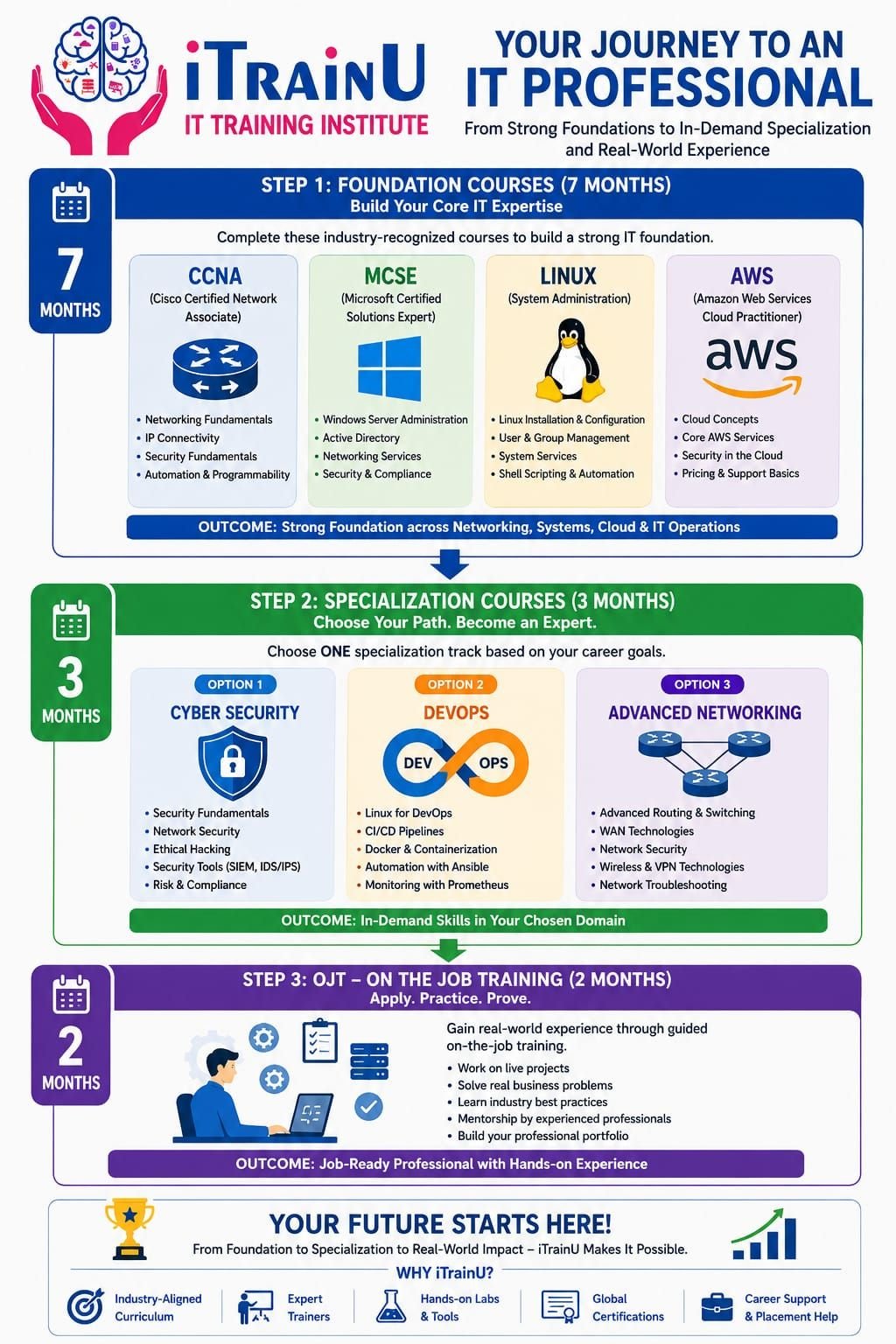
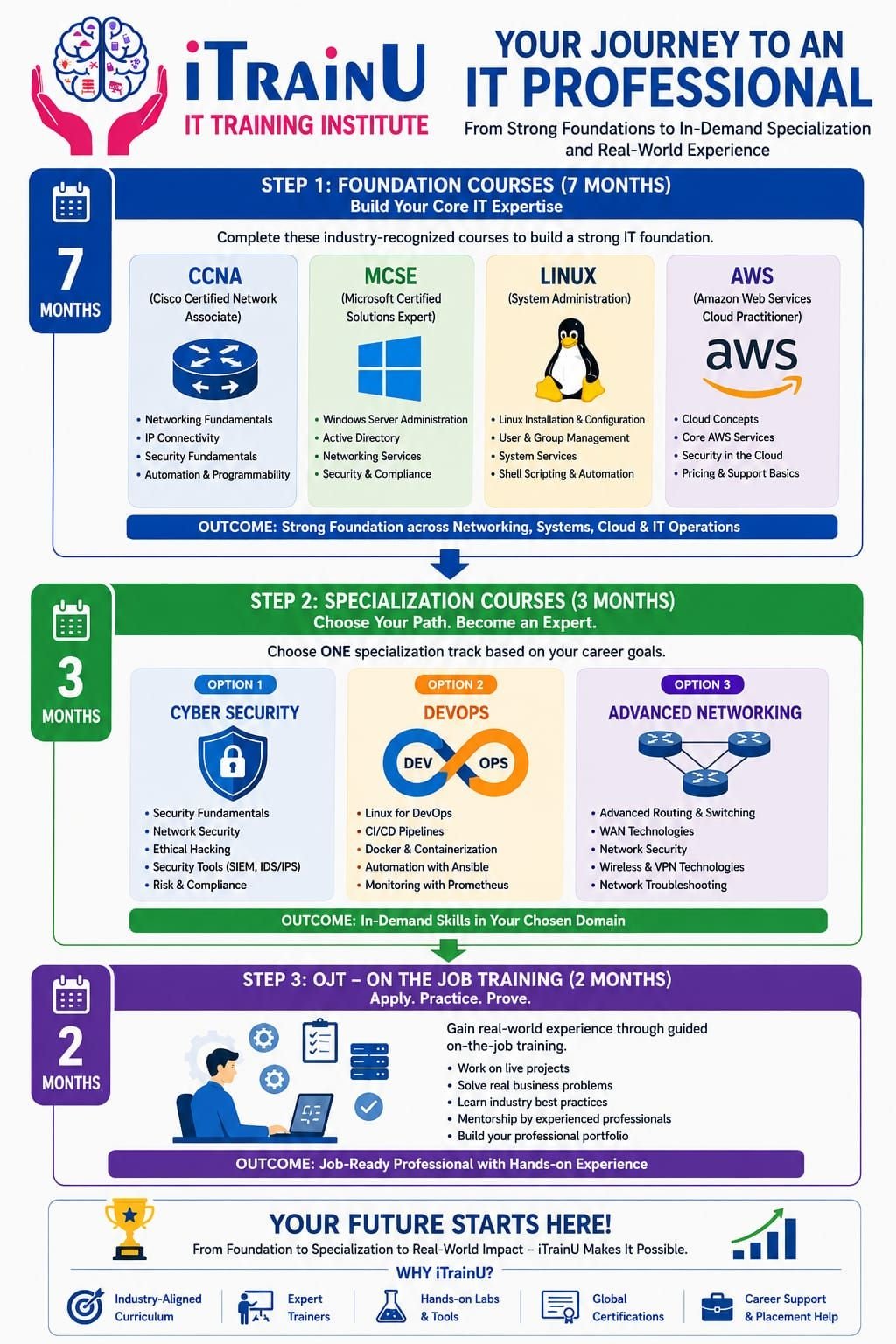
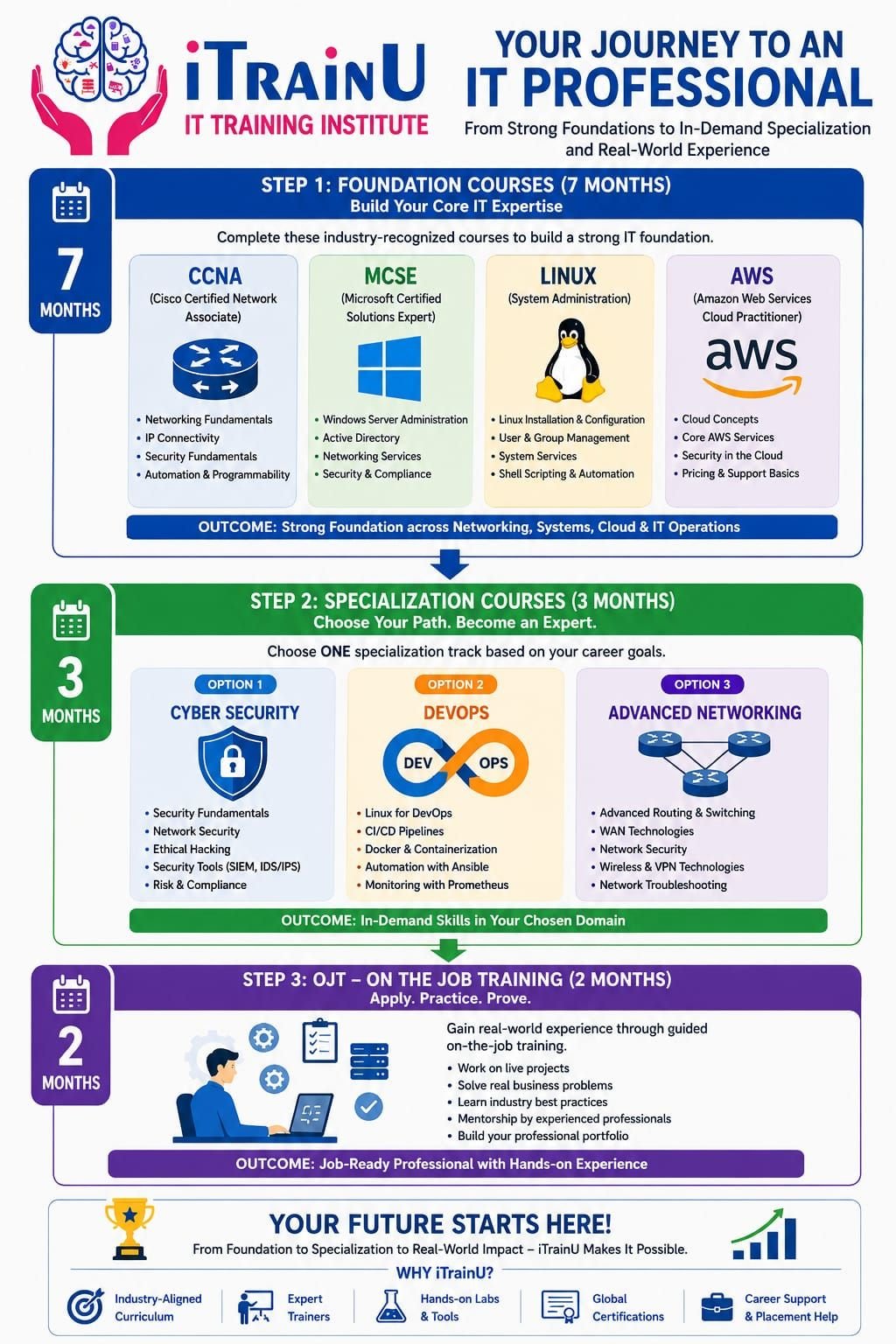
Studying for a certification is one thing; being ready for a job is another. At iTrainU, we don't just teach you to pass the test, we teach you to excel in the industry.
- Hands-on Labs: We provide 1 hour of dedicated lab practice every single day. You won't just read about VPCs; you'll build them.
- Certified Trainers: Our courses are led by industry veterans, including Mrs. Nisha Chauhan, the first Indian woman CCIE and an AWS certified expert.
- Placement Support: We offer 100% placement assistance. Whether you're looking for an AWS job or a cyber security course in indore with placement, our network of hiring partners is here for you.
- Real-Time Projects: Work on actual industry scenarios, from migrating on-premise servers to the cloud to setting up automated CI/CD pipelines.

AWS Solution Architect Study Guide 2026: Step-by-Step
If you're starting today, follow this roadmap:
- Get the Basics Right: Start with the What is Cloud Computing guide to understand the fundamentals.
- Learn the Core Services: Spend 2 weeks mastering EC2, S3, VPC, and IAM.
- Build a Project: Deploy a high-availability website using an Auto Scaling Group and an RDS database.
- Master Security: Deep dive into KMS, WAF, and Shield.
- Take Practice Exams: Use SAA-C03 practice tests to get used to the scenario-based questions.
Interview Questions to Prepare For
When you sit for your first cloud interview after completing your training at iTrainU, expect these common questions:
- Question: What is the difference between a Public Subnet and a Private Subnet?
- Answer: A public subnet has a route to an Internet Gateway, allowing resources to communicate with the internet. A private subnet does not have a direct route to the internet and usually requires a NAT Gateway for outbound traffic.
- Question: How would you design a cost-effective storage solution for logs that must be kept for 7 years but are rarely accessed?
- Answer: I would use S3 with a lifecycle policy that moves the objects to S3 Glacier Deep Archive after 30 days.
- Question: What is the benefit of using an Amazon CloudFront distribution?
- Answer: CloudFront is a Content Delivery Network (CDN) that caches content at edge locations closer to users, reducing latency and improving performance.
Conclusion
The AWS Solution Architect Associate certification is more than just a piece of paper; it's your ticket to a high-paying, future-proof career. By combining official AWS theory with the practical, hands-on approach at iTrainU, you'll be well-equipped to handle the challenges of 2026 and beyond.
Ready to start your journey? Check out our AWS Training Program and join over 5,000 students who have transformed their careers with us.

FAQs
1. Does AWS require coding skills?
Basic usage is done via the console, but for automation and advanced DevOps roles, knowledge of Python or JSON/YAML (for CloudFormation) is very helpful.
2. How long does it take to prepare?
With iTrainU's structured 45-day program, most students are ready for the exam in about 6 to 8 weeks.
3. Can I retake the exam if I fail?
Yes, you can retake the exam after a 14-day waiting period, though you'll need to pay the registration fee again.
4. Is the SAA-C03 exam hard for beginners?
It is challenging because it focuses on scenarios rather than definitions. However, our hands-on labs make these concepts much easier to grasp.
5. What is the average salary of an AWS Architect in 2026?
Certified professionals can expect entry-level salaries ranging from ₹6 LPA to ₹12 LPA, depending on their hands-on skills and location.
#Hashtags
#AWS #CloudComputing #SolutionArchitect #iTrainU #AWSGuide2026 #ITTrainingIndore #CloudCareer #DevOps