Mandideep is one of Madhya Pradesh’s important industrial areas, located close to Bhopal. Its manufacturing units, warehouses, service providers, and industrial offices need reliable IT support, networking, system administration, cloud, and cybersecurity professionals.
For students, fresh graduates, and working professionals in the Mandideep industrial belt, the right training plan can create a practical path into IT. iTrainU’s 12-month career pathway combines networking, systems, Linux, cloud, cybersecurity, DevOps, and workplace experience.

Why IT training matters in Mandideep
IT support is important in industrial environments because companies depend on:
- Stable networks between offices, plants, and warehouses
- Secure access to business applications
- Windows and Linux servers
- Cloud-based backups and applications
- Firewalls, VPNs, and endpoint security
- Monitoring and troubleshooting systems
- Reliable communication between vendors and departments
The problem
A learner may complete a degree but still lack practical skills. Employers often expect you to understand both theory and daily IT operations.
The solution
A job-focused program should help you:
- Build a technical foundation
- Practise using real tools and labs
- Choose a high-demand specialization
- Complete projects and workplace training
- Prepare for interviews and placement opportunities
For local learners, iTrainU offers live sessions, hands-on labs, industry-oriented projects, certified trainers, and placement assistance. You can learn more through the iTrainU About Us page and placement support page.
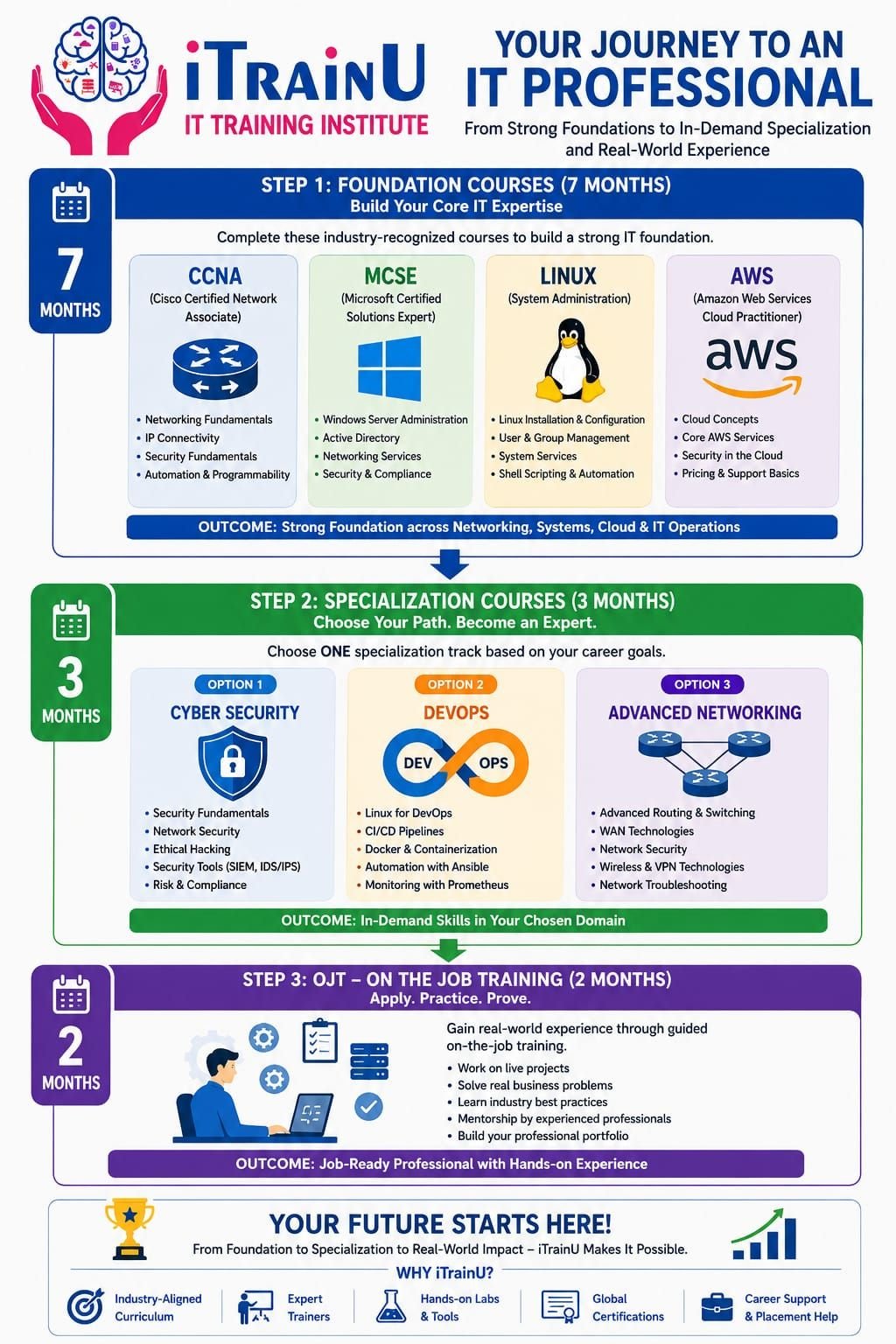
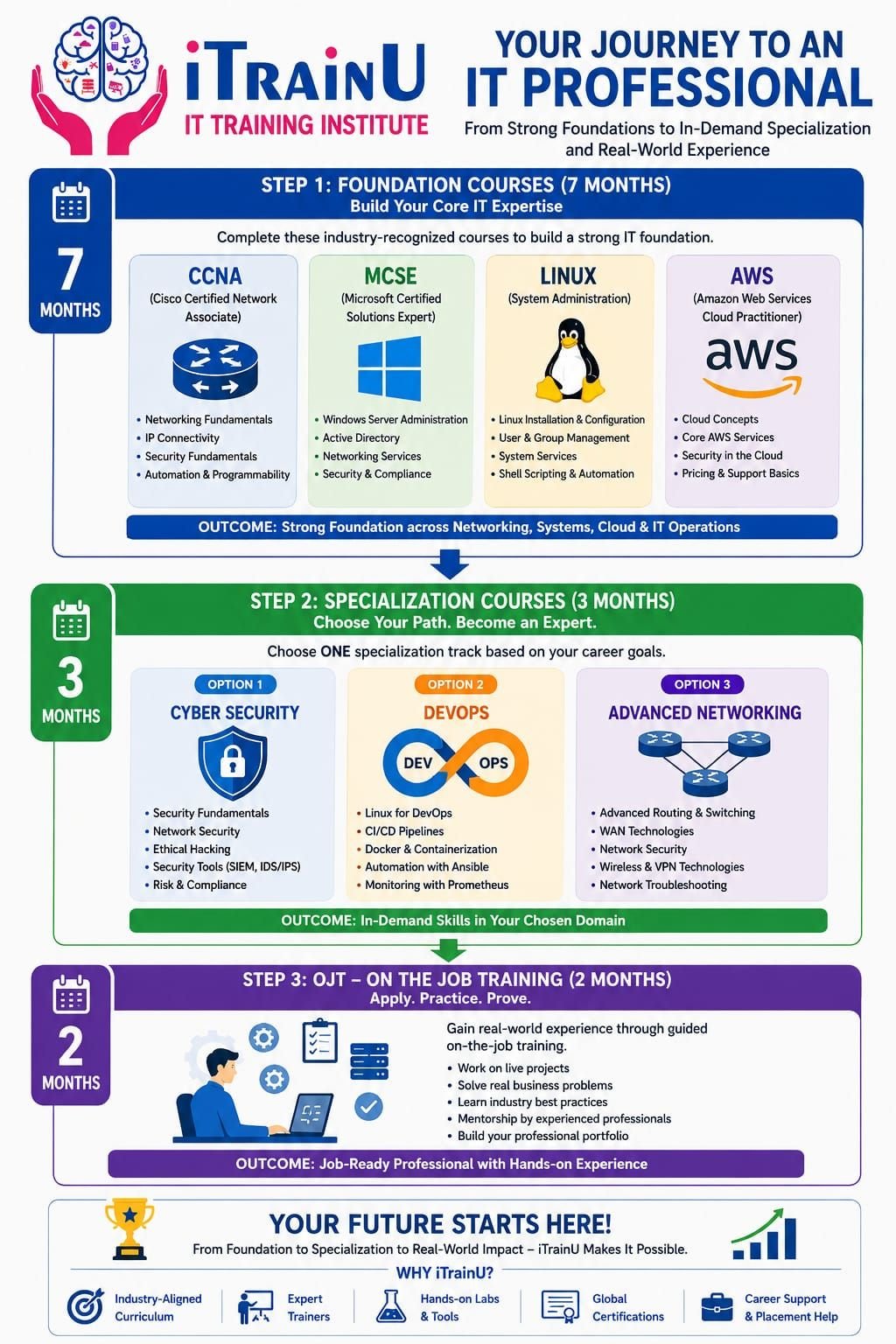
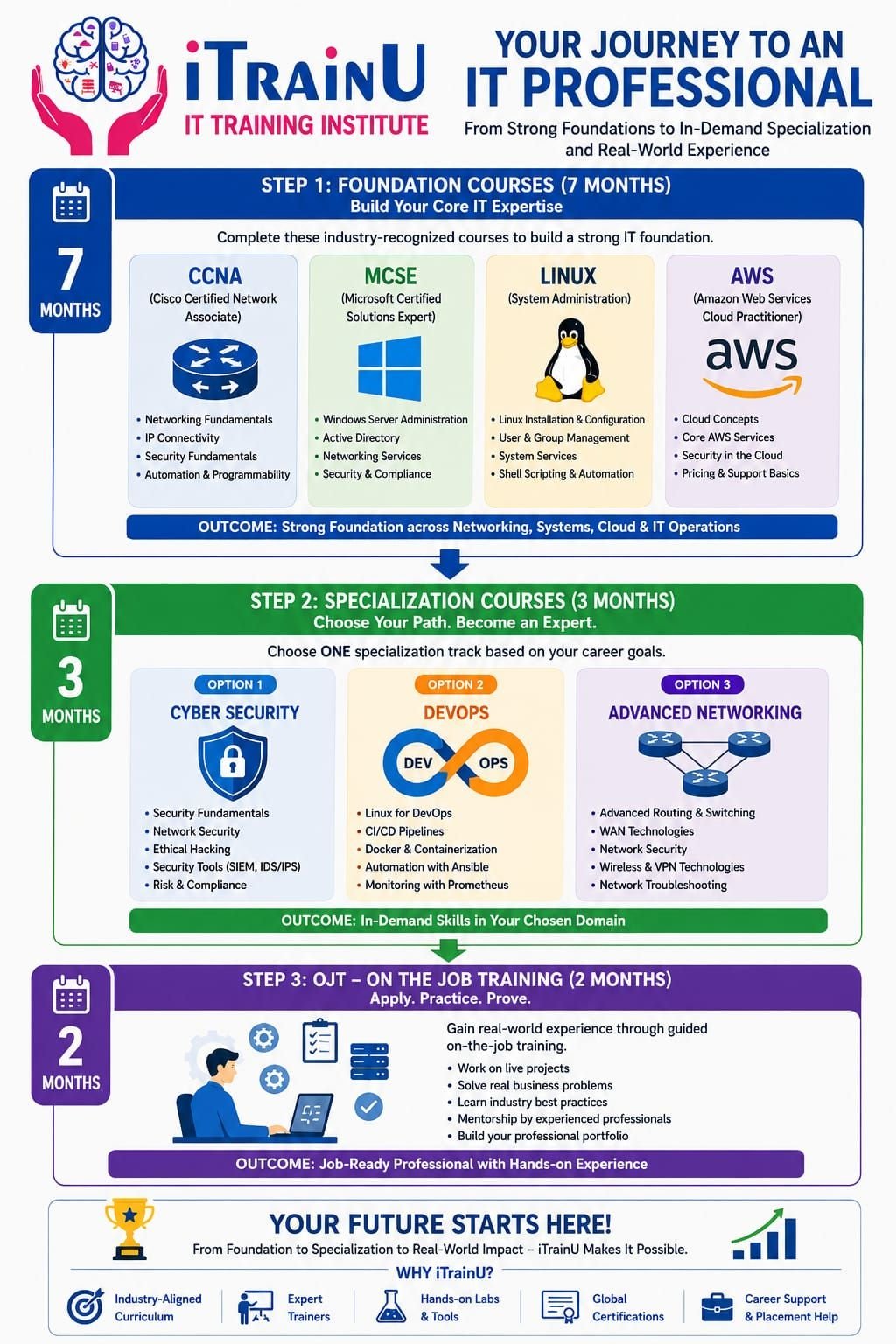
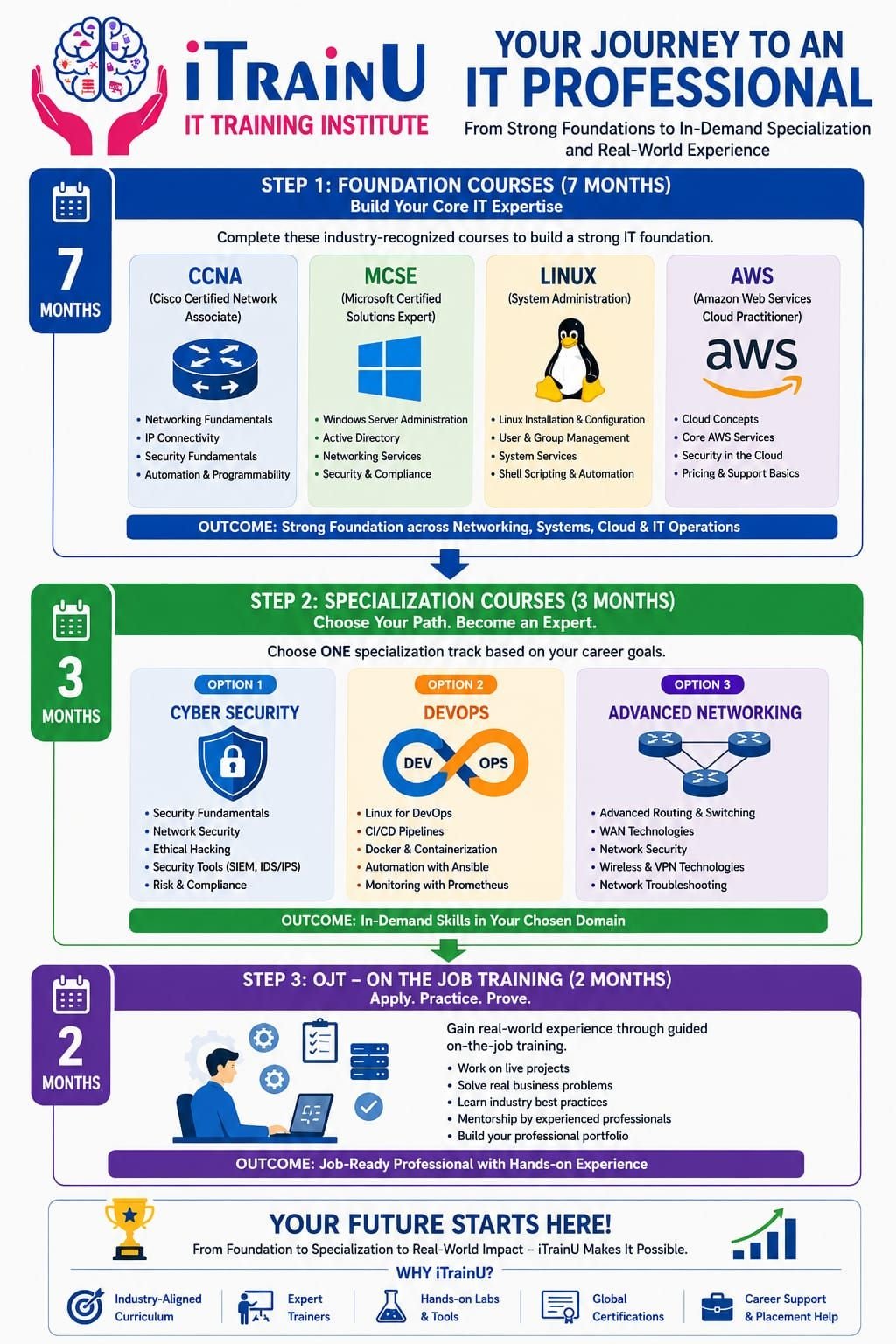
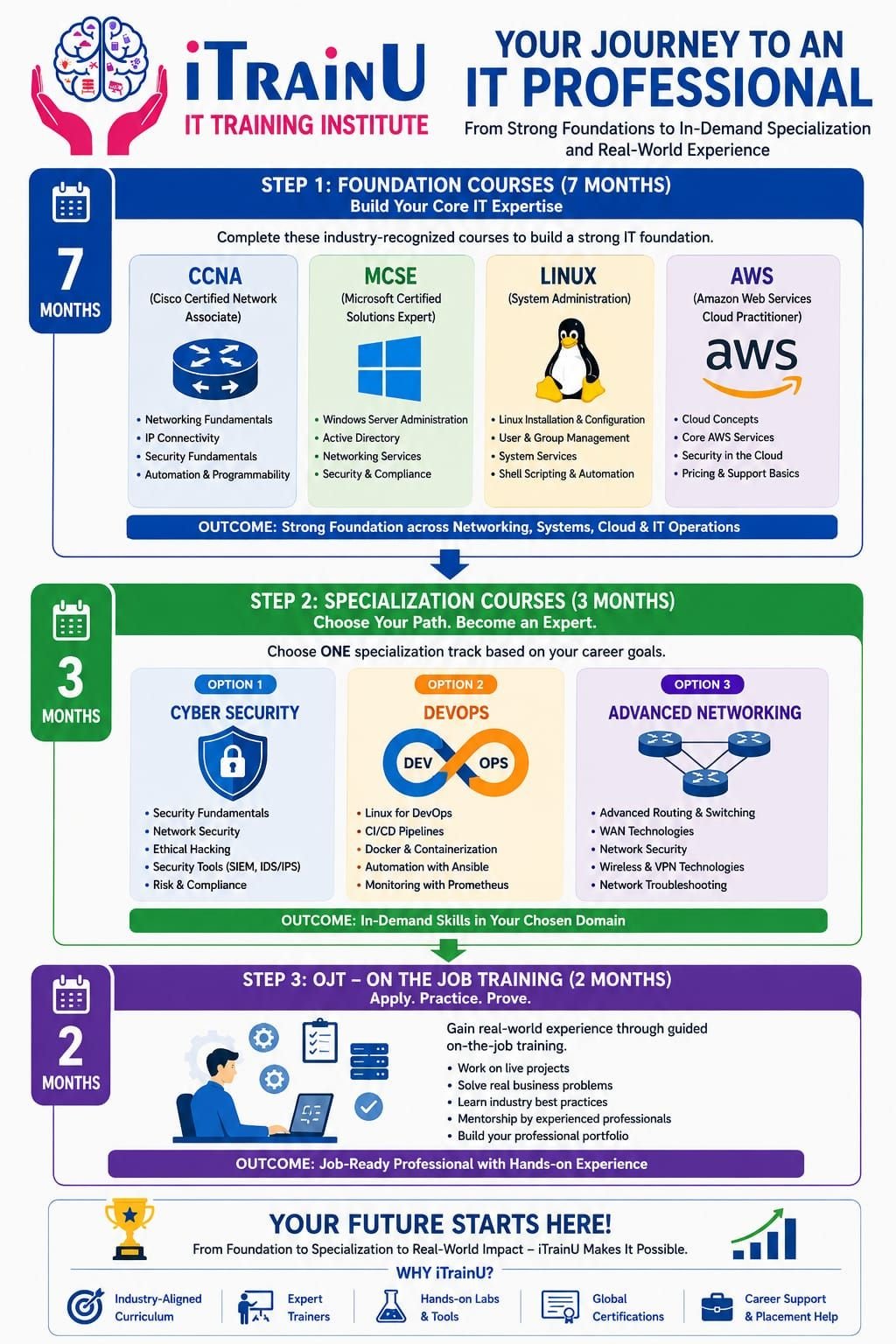
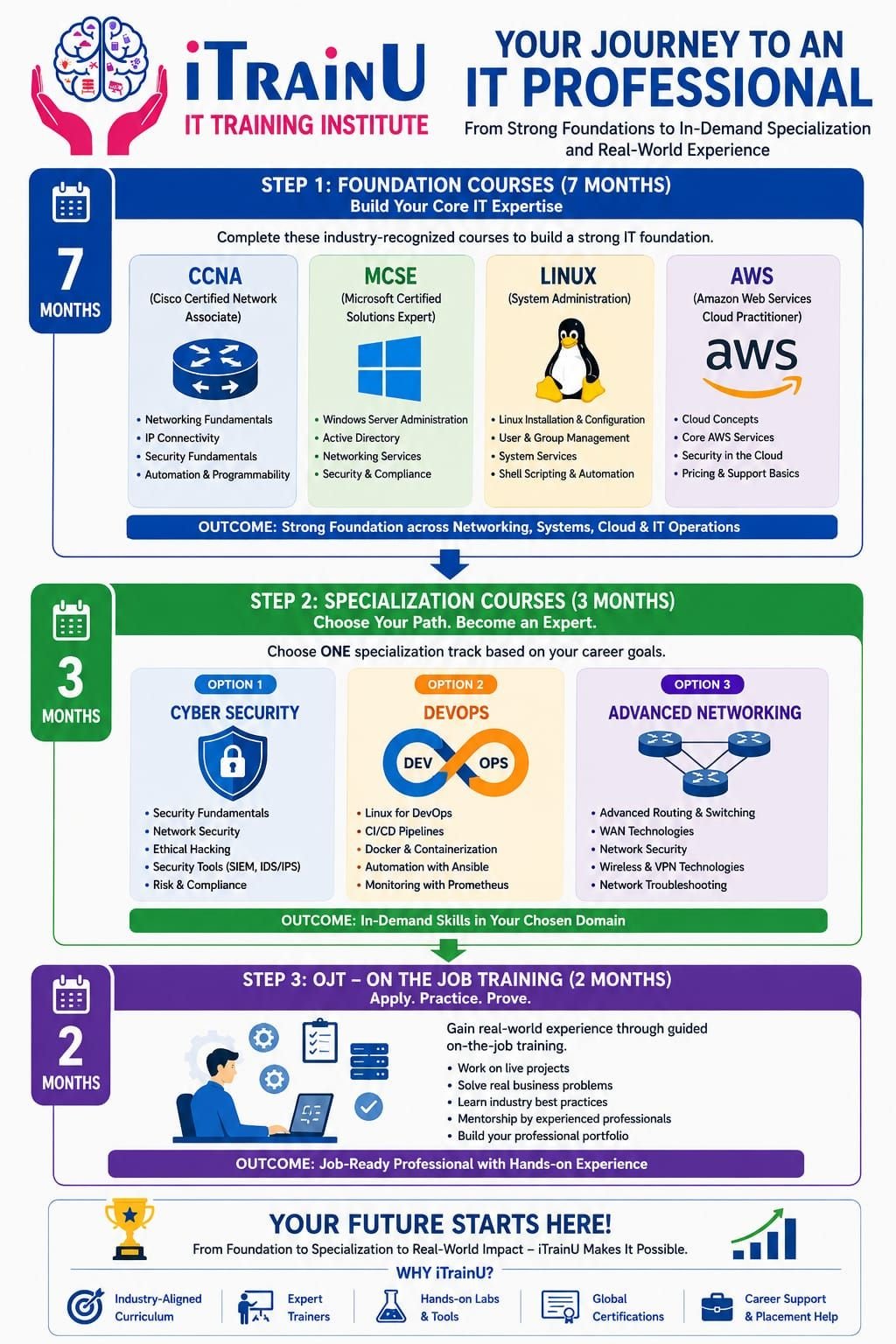
iTrainU’s 12-month IT career roadmap
The program is divided into three stages. Each stage builds on the previous one.
Stage 1: Seven-month Foundation Level
The Foundation Level is designed to help beginners understand core IT infrastructure. It includes CCNA, MCSE, Linux, AWS, and English communication.
1. CCNA and networking
CCNA is a networking foundation that teaches how devices communicate across local and wide-area networks.
You learn:
- IP addressing and subnetting
- Switching and VLANs
- Routing and OSPF
- Wireless networking
- DHCP, NAT, DNS, and SSH
- Network troubleshooting
- Basic security and access control
These skills are useful in Mandideep factories, offices, warehouses, and managed service companies. They can support roles such as:
- Network Support Engineer
- Network Technician
- NOC Engineer
- Technical Support Engineer
- Junior Network Administrator
Explore the iTrainU CCNA training course for the detailed syllabus and lab structure.

2. Linux system administration
Linux is an operating system widely used for servers, cloud platforms, containers, security tools, and networking services.
You learn:
- Linux installation and configuration
- Users, groups, permissions, and storage
- Processes and system services
- Network configuration
- Shell commands and scripting
- Server troubleshooting
- Basic automation
Linux matters because many cloud and DevOps environments run on Linux. It also supports cybersecurity and network monitoring roles.
Read What Is Linux? to understand why Linux remains important for modern IT professionals.
3. MCSE and Microsoft systems
MCSE-based learning introduces Microsoft server and enterprise administration concepts.
The foundation typically includes:
- Windows Server administration
- Active Directory
- User and group management
- DNS and DHCP services
- File and print services
- Security and access policies
- Microsoft-based troubleshooting
Even when organisations use cloud services, Microsoft administration skills remain useful. Many industrial companies still use Windows systems, domain environments, shared storage, and Microsoft-based applications.
4. AWS cloud fundamentals
AWS is a cloud platform that provides computing, storage, networking, databases, security, and monitoring services.
You learn:
- Cloud concepts
- Compute and storage services
- Identity and access management
- Virtual networks
- Security basics
- Pricing and support concepts
Cloud knowledge helps you move from traditional IT support toward cloud support, cloud operations, and DevOps roles. You can review the iTrainU AWS training option.
5. English and professional communication
Technical knowledge is only one part of an IT career. You also need to explain issues clearly, write support updates, participate in meetings, and answer interview questions.
The Foundation Level helps you practise:
- Professional introductions
- Incident reporting
- Email writing
- Technical explanations
- Interview communication
- Customer and team interaction
Why CCNA, Linux, and MCSE are important for every IT professional
These three areas cover the basic layers of IT infrastructure.
-
CCNA builds network understanding
- You learn how devices connect and communicate.
- You can troubleshoot connectivity and routing issues.
-
Linux develops server and command-line skills
- You gain experience with systems used in cloud and DevOps.
- You can automate repetitive administration tasks.
-
MCSE concepts explain enterprise systems
- You understand users, policies, servers, and organisational access.
- You become more useful in Windows-based workplaces.
Together, they create a stronger foundation than learning only one tool. A cloud engineer needs networking. A cybersecurity analyst needs operating system knowledge. A system administrator needs communication and troubleshooting skills.
Stage 2: Three-month Specialization Track
After the foundation, you choose one specialization.
Option 1: Cloud and DevOps
This track is suitable if you want to work with deployment, automation, and cloud infrastructure.
You may study:
- Git and GitHub
- CI/CD pipelines
- Docker
- Kubernetes concepts
- Ansible automation
- Cloud deployment
- Monitoring and logging
View the iTrainU DevOps training course to explore the course direction.
Option 2: Cybersecurity and ethical hacking
Cybersecurity protects systems, networks, identities, applications, and data from unauthorised access and attacks.
Cybersecurity is becoming mandatory for many companies. Industrial businesses also need to protect production networks, employee accounts, customer data, and connected devices.
You may learn:
- Security fundamentals
- Ethical hacking methodology
- Vulnerability assessment
- Network security
- Security tools
- Incident response concepts
- Cloud security
- Risk and compliance

Explore the iTrainU Cyber Security training course.
Option 3: Advanced Networking with SD-WAN, Aruba, and Fortigate
SD-WAN is a software-defined approach to managing wide-area network connections.
This specialization can include:
- Advanced routing and switching
- SD-WAN concepts
- Aruba networking
- Fortigate firewall administration
- VPNs and security policies
- WAN troubleshooting
- Network monitoring
- High-availability concepts
These skills can lead to better-paying opportunities because they combine networking with security and modern WAN technologies. Employers often value professionals who can manage connectivity, firewalls, remote sites, and secure access together.
Stage 3: Two-month OJT at Fluke Infotech
The final stage is a two-month On-the-Job Training program at Fluke Infotech, as part of the stated iTrainU career pathway.
OJT helps you:
- Apply classroom concepts
- Follow workplace processes
- Work with tickets and documentation
- Practise troubleshooting
- Understand professional communication
- Build project evidence for your resume
- Gain exposure to real IT operations
This stage is important because employers look for evidence that you can use your knowledge in practical situations.
Best practices for learners in Mandideep
- Practise labs every week instead of only reading notes.
- Maintain a troubleshooting journal.
- Build a small portfolio with network diagrams, Linux tasks, and cloud exercises.
- Learn subnetting until you can solve common problems confidently.
- Use ethical hacking tools only in authorised lab environments.
- Document every project with the problem, solution, tools, and result.
- Prepare a technical resume before completing the course.
- Ask trainers for interview feedback.
Common mistakes to avoid
- Choosing a course only because it promises a quick certificate
- Ignoring Linux while learning cloud or cybersecurity
- Memorising commands without understanding the problem
- Skipping lab practice
- Using scanning or hacking tools against systems without permission
- Failing to learn communication and documentation
- Expecting placement support to replace personal preparation
Pro Tips for building your 2026 IT career
- Start with infrastructure basics. Networking and operating systems make advanced topics easier.
- Learn one cloud platform properly. AWS fundamentals are a useful starting point.
- Combine security with networking. This combination is valuable in industrial and enterprise environments.
- Create proof of work. A project portfolio is stronger than a list of course names.
- Use OJT seriously. Treat it like your first professional assignment.
- Keep learning after placement. Technology changes, so your skills must also develop.
For course enquiries, you can connect with iTrainU through these official channels:
- 🌐 Website: itrainu.in
- ✉️ Email: info@itrainu.in
- 💬 WhatsApp: +91 74155 41833
- 📞 Phone: +91 76111 75111
- in LinkedIn: iTrainU Institute
- 📸 Instagram: @itrainu
- ▶️ YouTube: iTrainU Institute
Interview questions to practise
- What is the difference between a switch and a router?
- How does subnetting help in network design?
- What are the main uses of Linux in cloud environments?
- What is Active Directory?
- What is the difference between a public and private cloud?
- Why is cybersecurity important for an industrial company?
- What is SD-WAN, and how is it different from traditional WAN?
- What is the purpose of a Fortigate firewall policy?
- How would you troubleshoot a user who cannot access the network?
- What did you learn during your OJT project?
Final summary
For students and professionals in Mandideep, a structured IT program can provide a practical route into networking, systems, cloud, DevOps, and cybersecurity. iTrainU’s 12-month pathway combines seven months of foundation training, three months of specialization, and two months of OJT at Fluke Infotech.
CCNA, Linux, and MCSE concepts give you a strong base. Cybersecurity creates a long-term career direction. SD-WAN, Aruba, and Fortigate skills can help you target advanced networking and better-paying technical roles.
To begin, review the iTrainU course options or contact the institute for current batches, eligibility, and learning formats.
Frequently Asked Questions
Is iTrainU suitable for beginners in Mandideep?
Yes. The Foundation Level is designed to introduce networking, systems, Linux, AWS, Microsoft technologies, and communication skills in a structured order.
Do I need an engineering degree to start?
A technical degree can help, but practical IT training is also suitable for fresh graduates, career switchers, diploma holders, and working professionals. Confirm current eligibility with iTrainU.
Why should I learn cybersecurity for an industrial career?
Industrial companies manage networks, endpoints, applications, and sensitive information. Cybersecurity skills help protect these systems and create opportunities in security operations, network security, and ethical hacking.
Can SD-WAN and Fortigate improve my career prospects?
They can strengthen your profile because they combine modern WAN management with firewall and network security knowledge. Your opportunities will also depend on lab practice, projects, communication, and interview performance.
Does iTrainU provide placement assistance?
iTrainU provides placement assistance and career support. Ask the institute about the current process, eligibility requirements, interview preparation, and available opportunities.
#Bhopal #Raipur #Mumbai #NaviMumbai #Thane #Noida #Gurugram #Vashi #Andheri #Pithampur #VijayNagarIndore #Satna #Katni #Meghnagar #Mandideep #Dewas #SuperCorridorIndore #Jabalpur #GovindpuraBhopal #Gwalior #SanwerRoadIndore #Nasik #Nagpur #Dhar #Dhule #Pune #Jewar #GiftCity #Ahmedabad #Vadodara #Surat #Silvassa #Dholera #Dahod #Rajkot #Kolkata #Durgapur #Bhubaneshwar #Ranchi #Jamshedpur #Delhi #Hyderabad #Goa #Jaipur #Vapi #Lucknow #GreaterNoida #NewDelhi #Coimbatore #Chennai #Bengaluru #Gachibowli #Ameerpet #Vijayawada #Sholapur #Kolhapur #Gorakhpur #Sagar #Mohali #Chandigarh #Jodhpur #Patna #Gurgaon #Gandhinagar #Dehradun #GeetaBhawanIndore #ElectronicCity #Marathahalli #Jayanagar #Wakad #Hinjewadi #KarveNagar #CyberCity #DLF #HitechCity #Madhapur #Kondapur #Magarpatta #Kharadi #Aundh #Baner #Bandra #Airoli #Sholinganallur #Perungudi #BKC #Parel #Mahim #Borivali #NehruPalace #Satellite #SaltLakeCity #Newtown #Rajarhat #RajivGandhiTechnologyPark #ITPark #Whitefield #Koramangala #Sarjapur #Manipur #Bhadrak #Kurla #Indore #systems #business #technology #design #system #engineering #automation #innovation #productivity #businesssystems #entrepreneur #software #systemsthinking #solutions #softwares #industry #installation #security #businessdevelopment #routing #switching #cisco #firewall #paloalto #fortigate #fortinet #hp #aruba #cabling #datacenter #akcp #indore #Bhopal #India #cio #cto #itmanager #networkengineer #cloud #aws #best #intigrator #IT #vendor #provider #cctv #server #storage #project #itsm #itil