If you're looking to break into the tech industry in 2026, there's no role more vital, or more rewarding, than a DevOps Engineer. As companies move away from traditional software silos and toward lightning-fast deployment cycles, the "DevOps bridge" has become the backbone of modern business.
But how do you start when you've got zero experience? The world of "Infrastructure as Code," "Kubernetes," and "CI/CD" can feel like a mountain of jargon. Don't worry. This guide is your step-by-step roadmap to going from a total beginner to a job-ready professional.
What is DevOps?
DevOps is a professional framework that combines software development (Dev) and IT operations (Ops). Its primary goal is to shorten the systems development life cycle and provide continuous delivery with high software quality.
Think of it like this: In the old days, developers wrote code and "threw it over the wall" to the operations team to run it. If it broke, they blamed each other. DevOps breaks that wall down. You aren't just writing code or just managing servers; you're building automated systems that handle both.
Why DevOps Matters in 2026
In 2026, companies don't just want to "be on the cloud", they want to be "cloud-native." With the rise of AI-driven automation, the role of a DevOps engineer has shifted from manually fixing servers to architecting smart, self-healing systems.
Whether you are looking for an AWS Solution Architect study guide 2026 or exploring a Full Stack Developer roadmap for beginners, understanding DevOps is the "secret sauce" that makes you indispensable to any tech team.
Step 1: Master the Foundations (Linux & Networking)
Before you touch a single cloud tool, you need to understand the ground it sits on. Most of the world’s servers and cloud infrastructure run on Linux.
Key Areas to Learn:
- The Linux Command Line: You don't need to be a kernel developer, but you must be comfortable with the terminal. Learn how to navigate files, manage permissions, and monitor system processes.
- Networking Fundamentals: You can't secure a system if you don't know how it talks. Learn about IP addresses, DNS, HTTP/S, and Ports.
- Scripting (Python or Bash): Automation is the heart of DevOps. You need to be able to write scripts that tell computers what to do so you don't have to do it manually.
Pro Tip: Don't just read about Linux. Install a distribution like Ubuntu on a virtual machine and try to break it. Fixing it is where the real learning happens.
Step 2: Version Control with Git
Git is a distributed version control system that tracks changes in your code. In DevOps, we don't just use Git for app code; we use it for our infrastructure instructions too.
- Repository Management: Learn how to use GitHub or GitLab.
- Branching Strategies: Understand how multiple people can work on the same project without deleting each other's work.
- Pull Requests: Master the art of code reviews and collaboration.
Step 3: Cloud Computing (AWS, Azure, or GCP)
By 2026, "the cloud" is where almost all DevOps work happens. While there are three major players, AWS, Microsoft Azure, and Google Cloud Platform (GCP), we recommend starting with one and mastering it.
The Responsibility Framework: What You Control vs. What the Provider Manages
When you work in the cloud, it's essential to understand the Shared Responsibility Model.
| Feature | What You Control | What the Provider Manages |
|---|---|---|
| Hardware | Nothing | Servers, Storage, Power, Cooling |
| Networking | Virtual Private Clouds (VPC), Subnets | Physical Cables, Routers, Switches |
| OS Patching | Updating the Linux/Windows kernel | The Hypervisor (if using Serverless/PaaS) |
| Data Security | Encryption, Identity Access (IAM) | Security of the Data Center |
At iTrainU, our Cloud Computing training focus on these real-world distinctions so you aren't just clicking buttons, but actually architecting secure environments.

Step 4: Containers and Kubernetes (The 2026 Standard)
If you're learning how to become a DevOps engineer from scratch, you cannot skip Docker and Kubernetes.
- Docker is a tool used to "package" an application and all its dependencies into a container. This ensures the app runs the same way on your laptop as it does on a production server.
- Kubernetes (K8s) is a container orchestration platform. If Docker builds the containers, Kubernetes is the captain of the ship, deciding where they go and how they scale.
Example Use Case:
Imagine a retail website during a Black Friday sale. Instead of a human manually turning on new servers, Kubernetes detects the traffic spike and automatically launches 50 new containers to handle the load. When the sale ends, it shuts them down to save money.
Step 5: Infrastructure as Code (IaC)
In the modern era, we don't click around the AWS console to build a database. We write code that describes the database, and a tool builds it for us. This is Infrastructure as Code.
Top Tools to Learn:
- Terraform: The industry standard for provisioning cloud resources.
- Ansible: Great for configuring software once the server is running.
Simple Terraform Example:
# This code creates a basic server in AWS
resource "aws_instance" "my_devops_server" {
  ami           = "ami-0c55b159cbfafe1f0"
  instance_type = "t2.micro"

  tags = {
    Name = "ITrainU-Practice-Server"
  }
}
Step 6: CI/CD Pipelines (The Heart of DevOps)
CI/CD is a method to frequently deliver apps to customers by introducing automation into the stages of app development.
- Continuous Integration (CI): Every time a developer saves code, it’s automatically tested for bugs.
- Continuous Deployment (CD): If the tests pass, the code is automatically sent to the live website.
At iTrainU, our students work on live projects where they build their own Jenkins or GitHub Actions pipelines. This hands-on experience is exactly what employers look for during placement support.
Common Mistakes to Avoid
- Chasing Tools, Not Concepts: Don't just memorize how to use Jenkins. Understand why we need CI/CD.
- Ignoring Security: Security isn't an "afterthought." In 2026, we call it DevSecOps. Learn how to scan your code for vulnerabilities as you write it.
- Skipping Linux: Many beginners try to learn Cloud or DevOps without knowing Linux. This is like trying to build a house on sand.
Pro Tips for 2026
- Use AI as a Co-pilot: Tools like ChatGPT or GitHub Copilot are great for writing initial Bash scripts or Terraform templates. Use them to learn, but make sure you understand every line they generate.
- Build a Portfolio: Don't just list skills on a resume. Host a project on GitHub that shows a full CI/CD pipeline deploying a website to AWS.
- Get Certified: While skills matter most, certifications like the AWS Solutions Architect or Certified Kubernetes Administrator (CKA) help you get past HR filters.
Interview Questions You Should Know
- What is the difference between a Container and a Virtual Machine?
- Answer: Containers share the host OS kernel and are lightweight; VMs include a full guest OS and are more resource-heavy.
- Explain the "Blue-Green Deployment" strategy.
- Answer: It's a way to update software by having two identical environments (Blue and Green). You route traffic to Blue while updating Green, then switch traffic to Green once it's ready.
- What is Idempotency in Ansible?
- Answer: It means that running a script multiple times will always result in the same state, without making unnecessary changes.
Summary: Your Path Forward
Becoming a DevOps engineer from scratch is a journey of 9 to 12 months for most dedicated learners. You start with the basics of Linux, move into Cloud, and eventually master Automation.
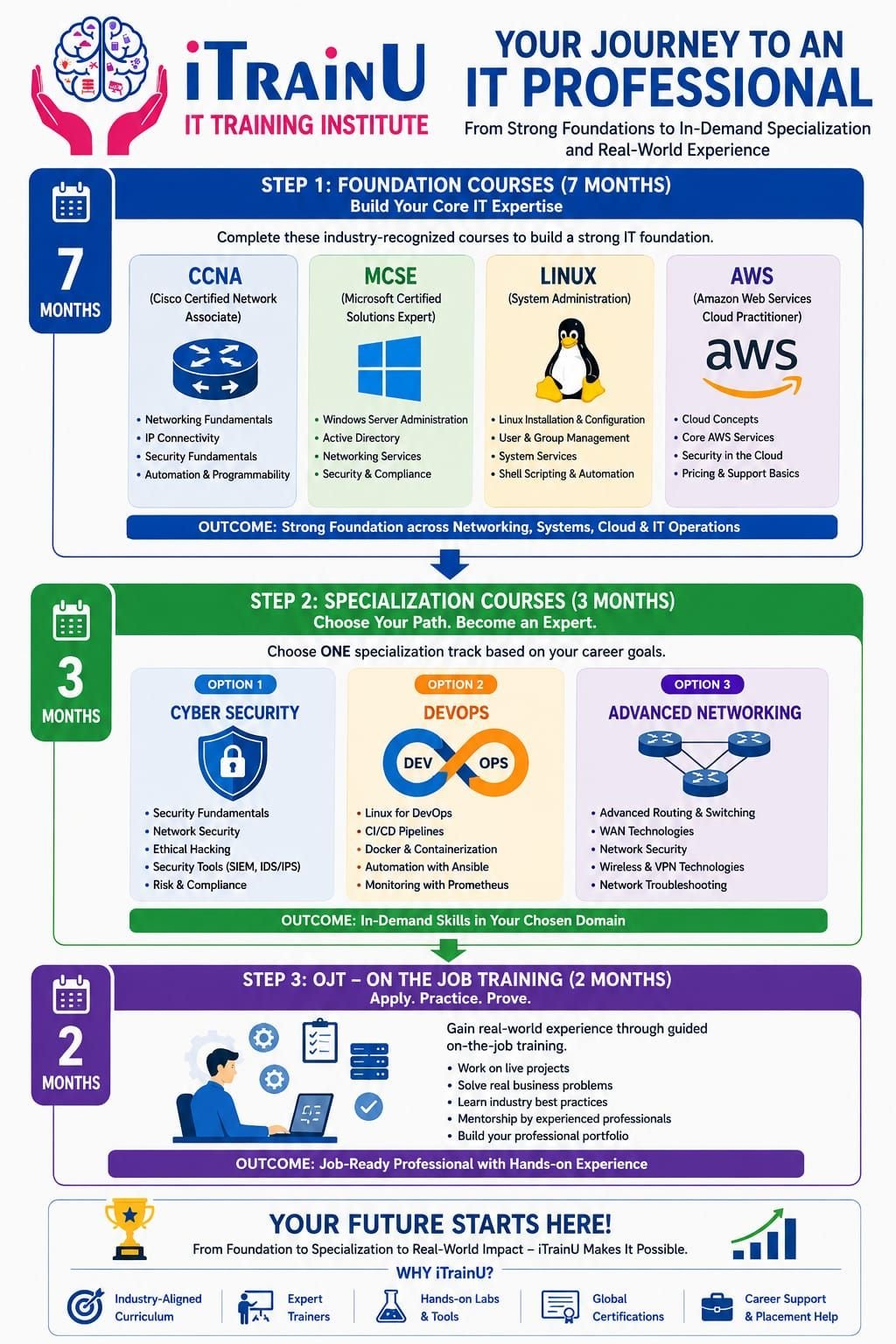
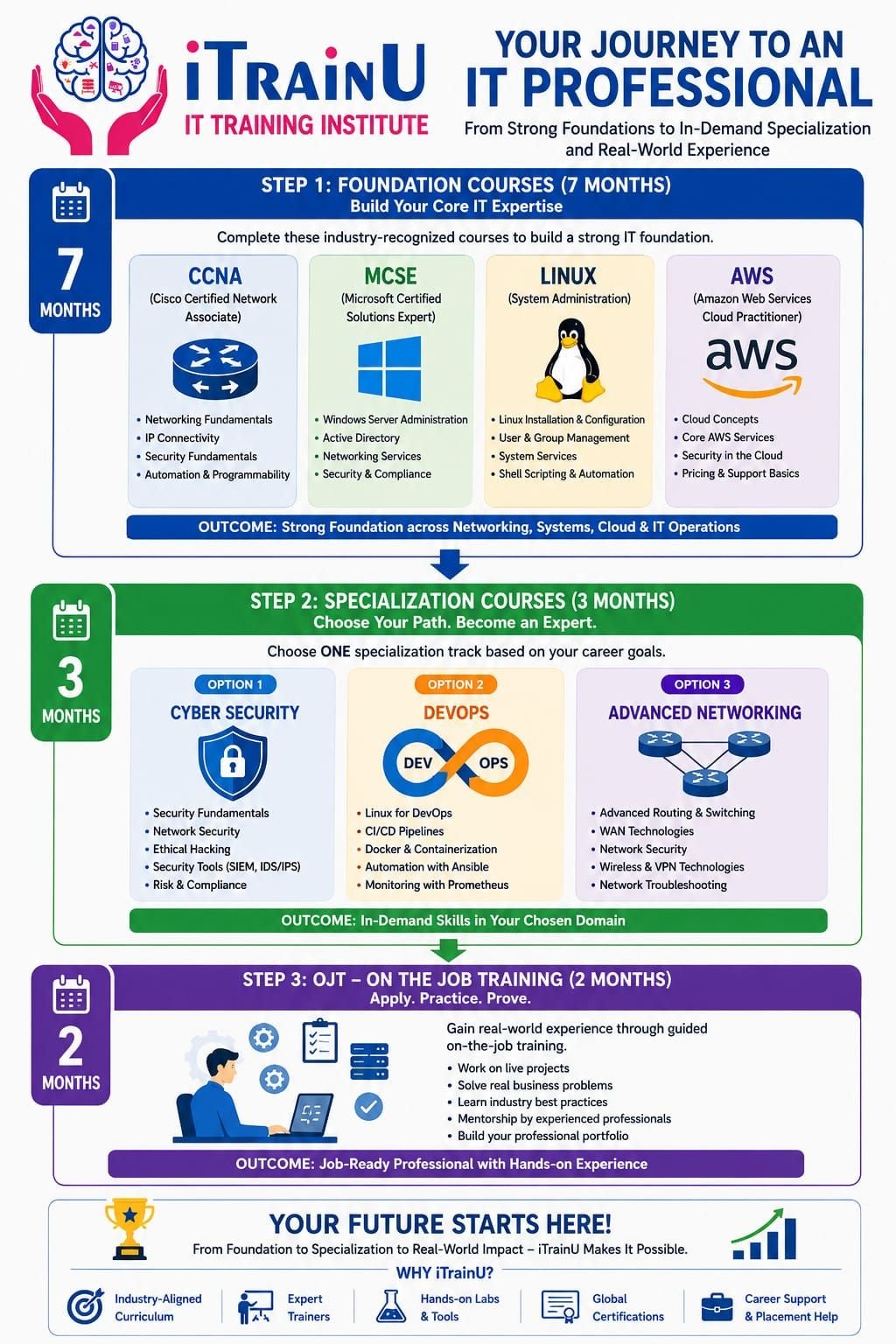
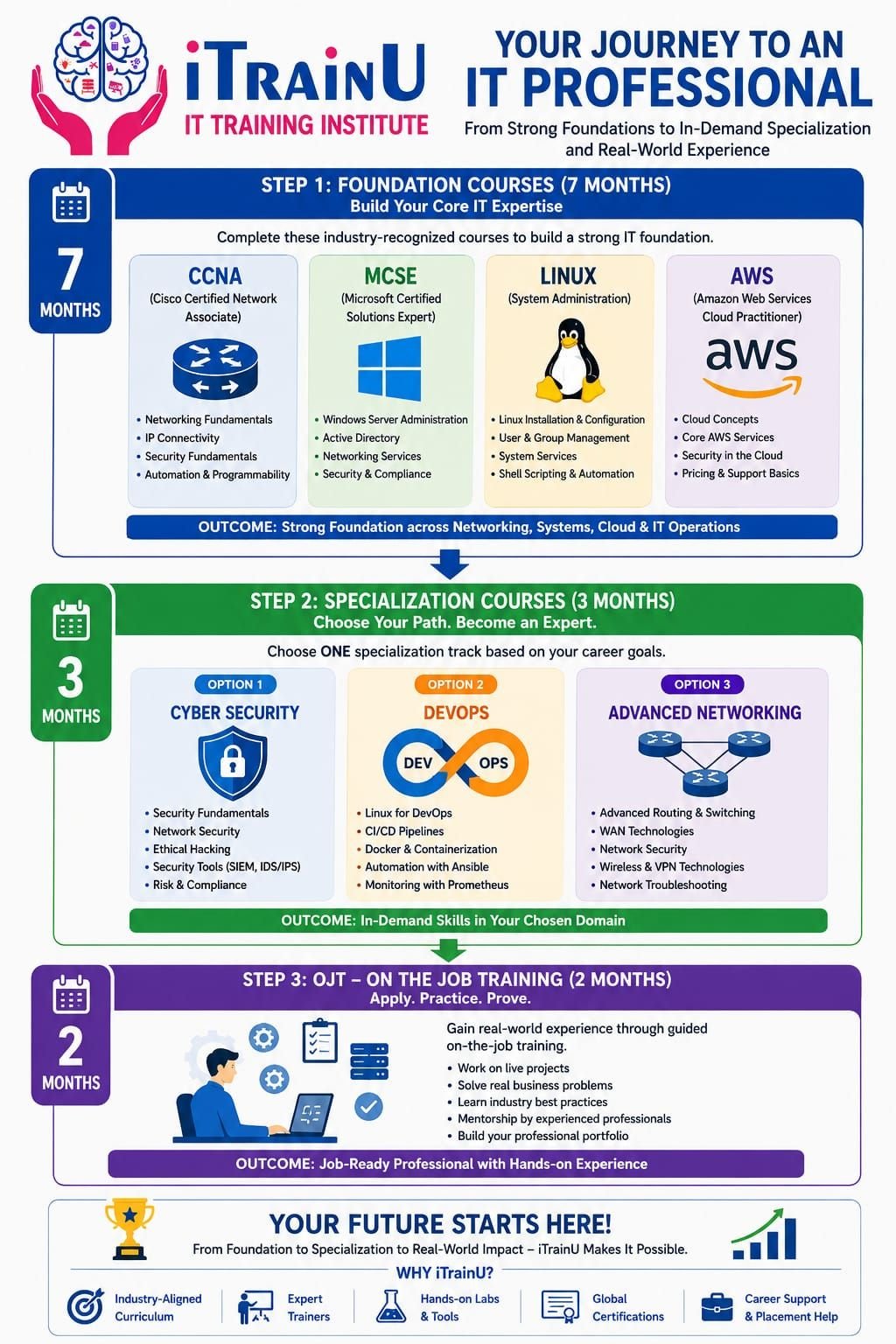
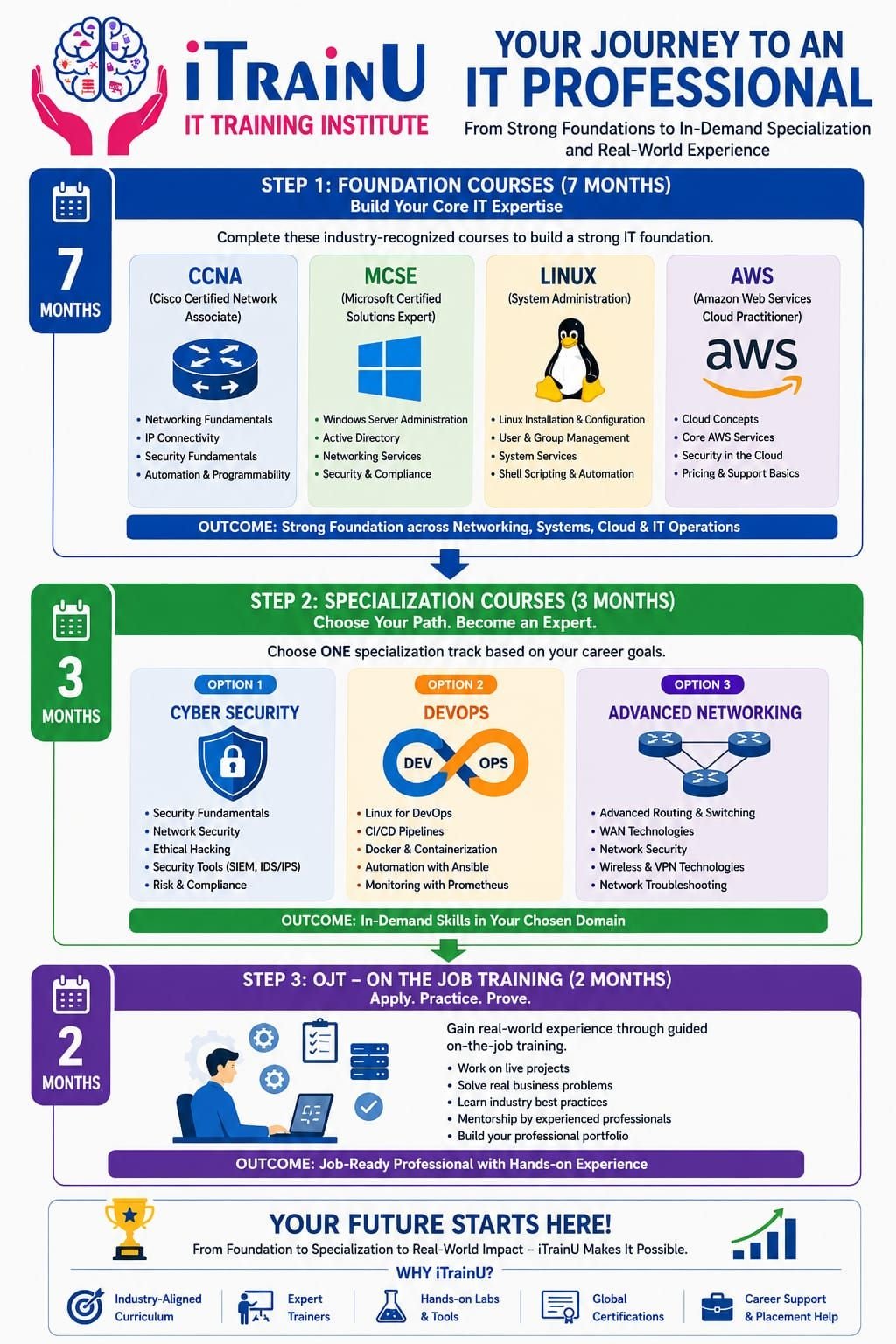
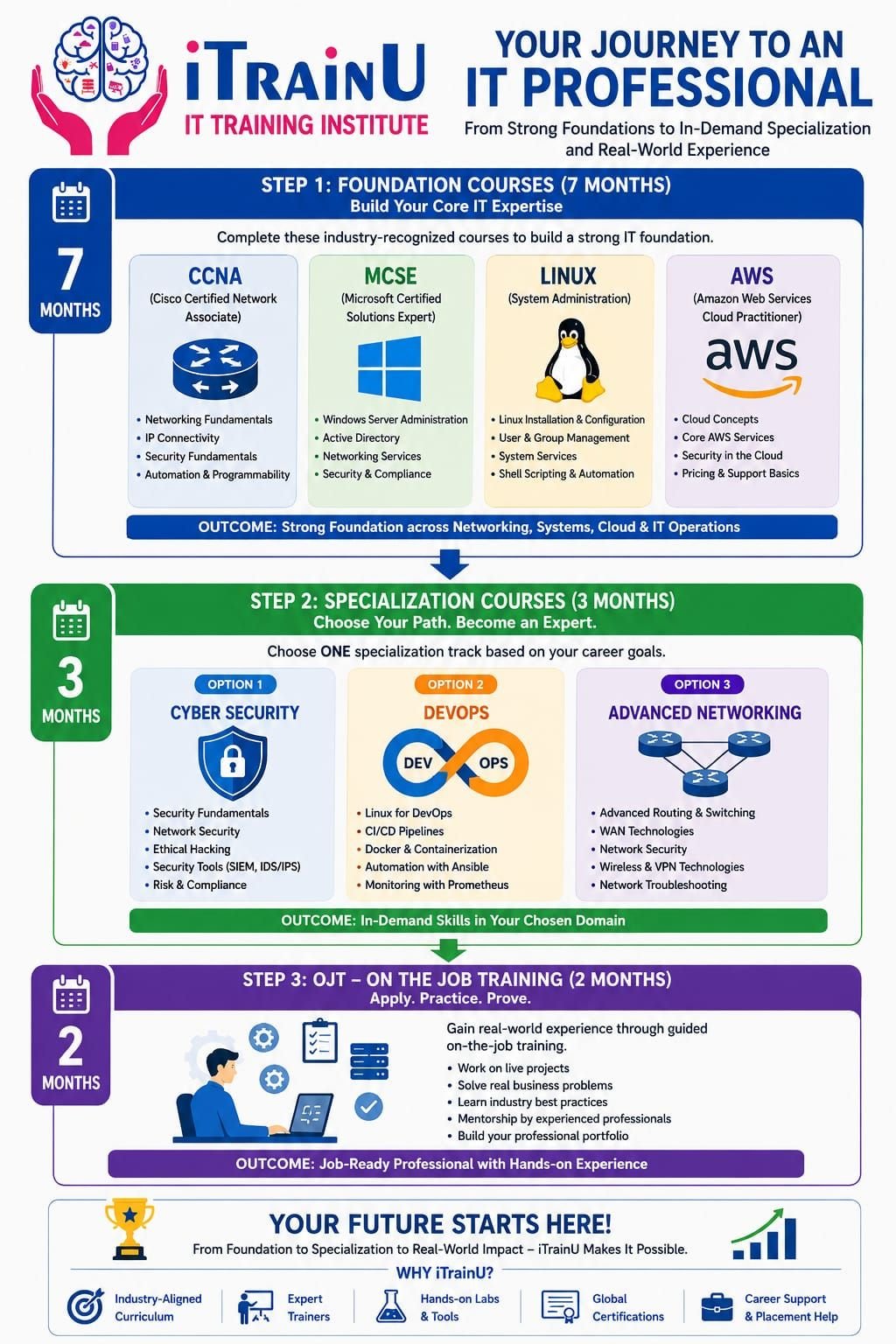
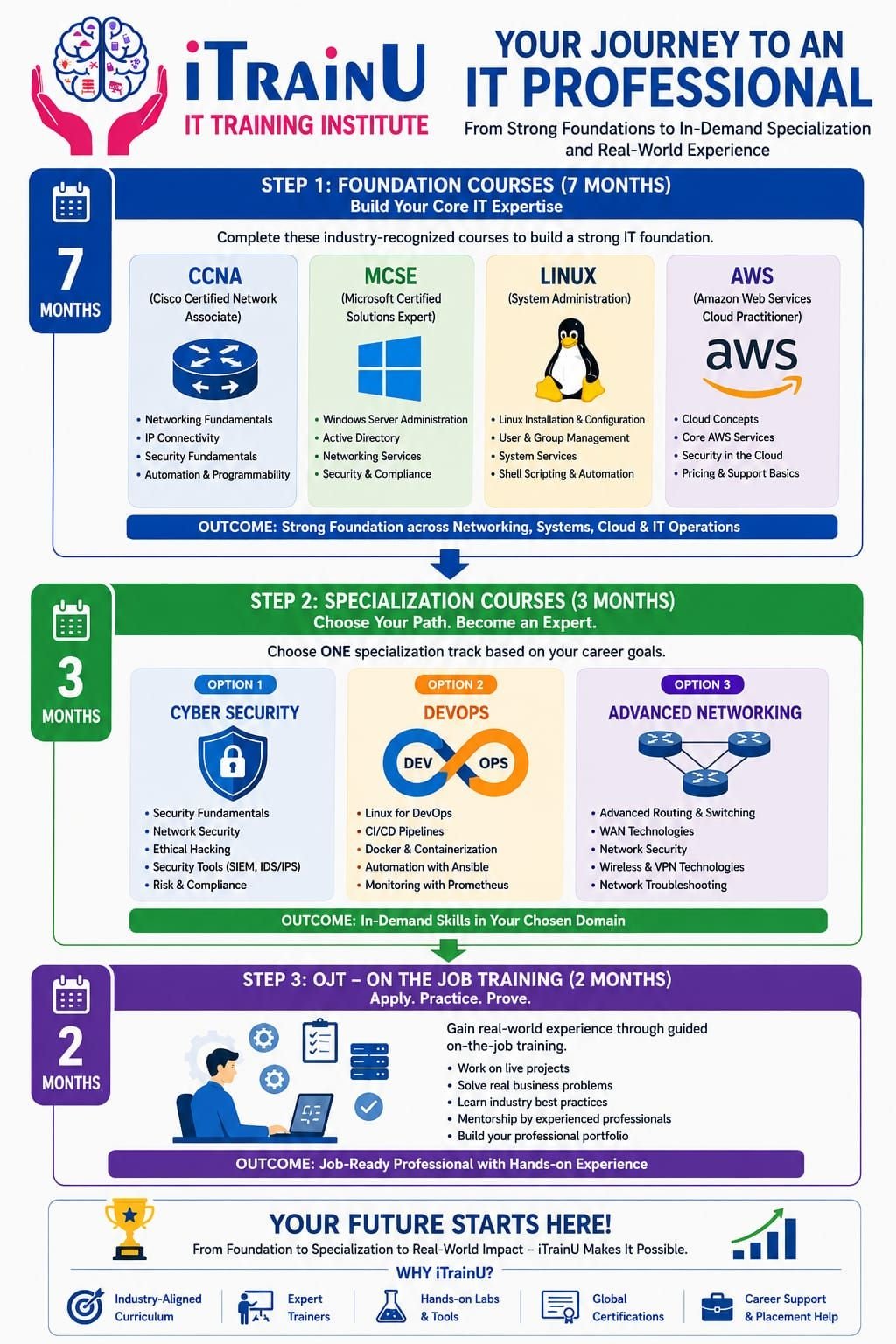
If you are looking for a structured path, iTrainU offers industry-oriented training with hands-on labs and certified trainers who have real-world experience. Whether you're looking for a Cyber Security course in Indore with placement or a comprehensive DevOps roadmap, we provide the environment you need to succeed.

Find the Best DevOps and IT Training Near You
iTrainU is committed to providing world-class education across the globe. Find our programs in your city:
Best Training Institute for DevOps in:
Agra, Ahmedabad, Allahabad, Arlington, Atlanta, Augusta, Aurangabad, Austin, Australia, Bangalore / Bengaluru, Belfast, Bhopal, Bhubaneswar, Birmingham, Boston, Bristol, Calgary, Cambridge, Canterbury, Cardiff, Chandigarh, Charlotte, Chennai, Chicago, Cleveland, Coimbatore, Columbus, Coventry, Dallas, Dehradun, Delhi, Denver, Detroit, Dubai, Durham, Edinburgh, Edmonton, Fresno, Ghaziabad, Glasgow, Gurgaon / Gurugram, Guwahati, Houston, Hyderabad, Imphal, Indore, Jacksonville, Jaipur, Jammu, Jodhpur, Kanpur, Kansas, Kochi, Kolkata, Las Vegas, Leeds, Liverpool, London, Los Angeles, Lucknow, Ludhiana, Madison, Manchester, Meerut, Miami, Mississauga, Montreal, Morrisville, Mountain View, Mumbai, Mysore, Nagpur, Nashville, New Jersey, New York City, Noida, Nottingham, Orlando, Oxford, Patna, Philadelphia, Phoenix, Pittsburgh, Pondicherry, Portland, Pune, Raipur, Raleigh, Ranchi, Redmond, Richmond, Rochester, Sacramento, San Antonio, San Diego, San Francisco, San Jose, Seattle, Sheffield, Singapore, Southampton, Sunderland, Sunnyvale, Surat, Swansea, Tampa, Thane, Thiruvananthapuram, Tirupati, Toronto, Turner, Udaipur, Vadodara, Vancouver, Vijayawada, Visakhapatnam, Washington, New Delhi, Rajkot, Gandhinagar, Jabalpur, Gwalior, Navi Mumbai, Nashik, Kuwait, Bahrain, Oman, Malaysia.
Azure & AWS Training in:
Agra, Ahmedabad, Allahabad, Arlington, Atlanta, Augusta, Aurangabad, Austin, Australia, Bangalore / Bengluru, Belfast, Bhopal, Bhubaneswar, Birmingham, Boston, Bristol, Calgary, Cambridge, Canterbury, Cardiff, Chandigarh, Charlotte, Chennai, Chicago, Cleveland, Coimbatore, Columbus, Coventry, Dallas, Dehradun, Delhi, Denver, Detroit, Dubai, Durham, Edinburgh, Edmonton, Fresno, Ghaziabad, Glasgow, Gurgaon / Gurugram, Guwahati, Houston, Hyderabad, Imphal, Indore, Jacksonville, Jaipur, Jammu, Jodhpur, Kanpur, Kansas, Kochi, Kolkata, Las Vegas, Leeds, Liverpool, London, Los Angeles, Lucknow, Ludhiana, Madison, Manchester, Meerut, Miami, Mississauga, Montreal, Morrisville, Mountain View, Mumbai, Mysore, Nagpur, Nashville, New Jersey, New York City, Noida, Nottingham, Orlando, Oxford, Patna, Philadelphia, Phoenix, Pittsburgh, Pondicherry, Portland, Pune, Raipur, Raleigh, Ranchi, Redmond, Richmond, Rochester, Sacramento, San Antonio, San Diego, San Francisco, San Jose, Seattle, Sheffield, Singapore, Southampton, Sunderland, Sunnyvale, Surat, Swansea, Tampa, Thane, Thiruvananthapuram, Tirupati, Toronto, Turner, Udaipur, Vadodara, Vancouver, Vijayawada, Visakhapatnam, Washington, New Delhi, Rajkot, Gandhinagar, Jabalpur, Gwalior, Navi Mumbai, Nashik, Kuwait, Bahrain, Oman, Malaysia, USA, UK.
Meta Title: How to Become a DevOps Engineer from Scratch: 2026 Guide | iTrainU
Meta Description: Start your DevOps journey in 2026. Learn Linux, Cloud (AWS/Azure), Docker, and Kubernetes with iTrainU's hands-on roadmap and placement support.
FAQs
1. Can I learn DevOps without a CS degree?
Yes! Most DevOps engineers care more about your skills, certifications, and portfolio than your degree. Structured training like our internship programs can bridge the gap.
2. Which programming language is best for DevOps?
Python is the most recommended language for beginners due to its readability and massive library support for automation. Go (Golang) is also highly valued for cloud-native tools.
3. How long does it take to get a DevOps job?
With focused study and hands-on practice, you can become job-ready in 6 to 12 months.
4. Does iTrainU provide placement support?
Absolutely. We offer dedicated placement support, resume building, and mock interviews to help our students land roles in top IT firms.
5. What is the average salary of a DevOps engineer in 2026?
While it varies by region, junior DevOps engineers can expect competitive starting salaries, often ranging from $80k to $110k annually in global markets, and ₹6L to ₹12L in India.
#DevOpsRoadmap #CloudComputing #ITrainU #TechCareers2026 #LearnToCode