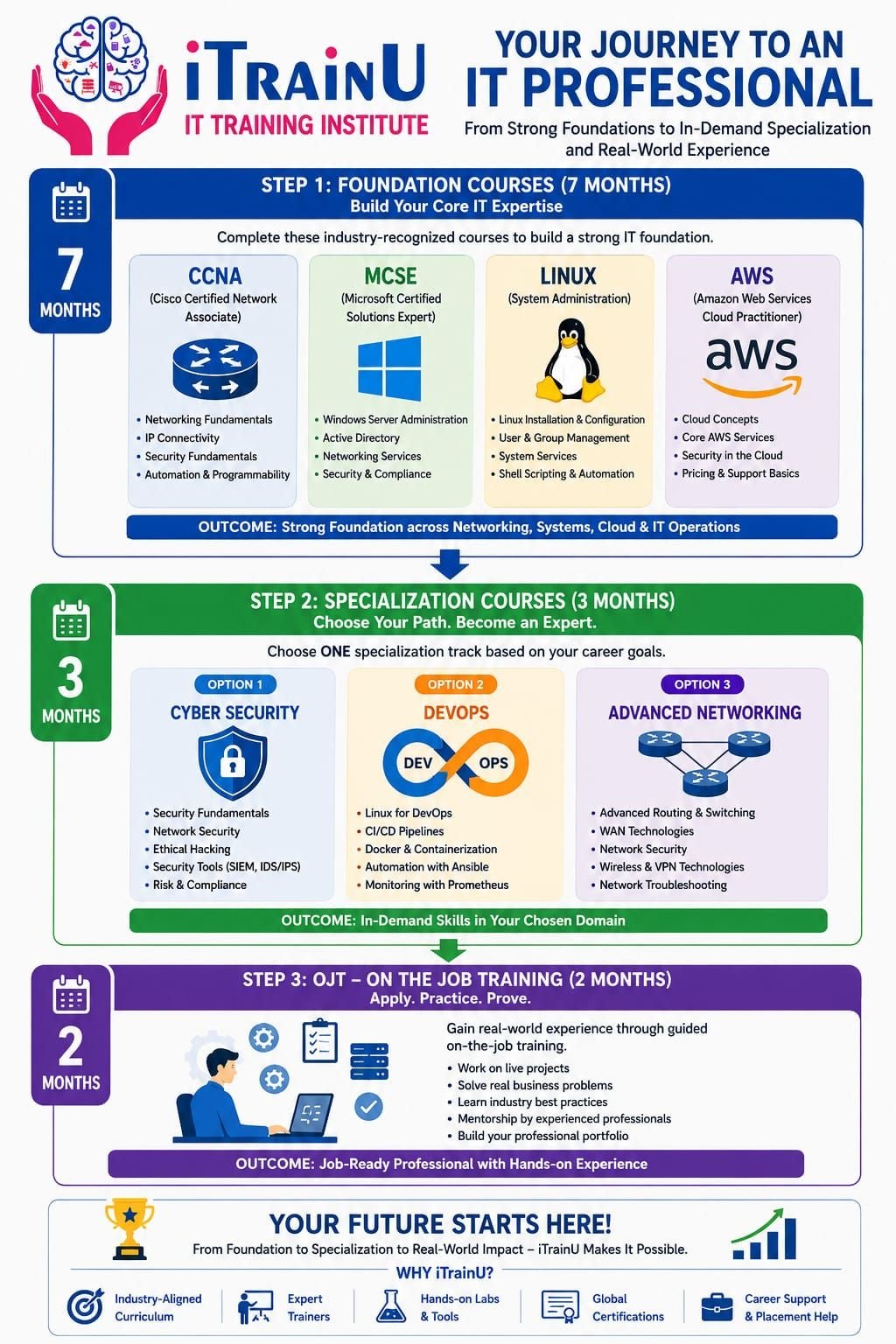
Starting a career in DevOps can feel like trying to drink from a firehose. There are dozens of tools to learn, complex cloud architectures to master, and a mindset shift that's quite different from traditional software development. However, by 2026, DevOps has evolved from a "nice-to-have" skill into the backbone of the entire tech industry.
If you're wondering how to become a devops engineer from scratch, you've come to the right place. This guide breaks down the journey into manageable phases, ensuring you build a solid foundation before moving on to advanced automation and AI-driven operations.
Why DevOps Matters in 2026
DevOps is a methodology that combines software development (Dev) and IT operations (Ops) to shorten the systems development life cycle and provide continuous delivery with high software quality. In 2026, this isn't just about automation; it's about speed, security, and using AI to manage complex cloud environments.
Companies no longer want siloed teams. They need professionals who understand the entire lifecycle of an application, from the first line of code to the final deployment in the cloud. Whether you're looking for an aws solution architect study guide 2026 or want to jump into full stack developer roadmap for beginners, DevOps is the bridge that connects it all.
Phase 1: Building the Technical Foundation (Months 0-3)
You can't automate what you don't understand. Before touching fancy tools like Kubernetes, you need to master the basics of how computers and networks actually work.
1. Master the Linux Command Line
Most servers in the world run on Linux. You'll need to be comfortable navigating the terminal without a mouse.
- Key Skills: File permissions, process management, SSH, and shell scripting (Bash).
- Goal: Be able to set up a web server manually on a Linux machine.
2. Networking and Security Basics
Networking is a fundamental requirement for any cloud role. You need to understand how data moves from point A to point B.
- Concepts: TCP/IP, DNS, HTTP/S, Load Balancers, and Firewalls.
- Security: Learn basic "least privilege" principles. If you're interested in deeper protection, checking out a cyber security course in indore with placement can give you an edge in DevSecOps.
3. Learn a Programming Language
DevOps involves a lot of scripting. You don't need to be a software architect, but you must be able to read and write code to automate tasks.
- Top Picks: Python or Go.
- Task: Write a script that automatically backs up a folder and uploads it to a storage bucket.
Phase 2: The DevOps Toolchain (Months 3-6)
Once you understand the "Ops" side (Linux/Networking) and the "Dev" side (Programming), it's time to learn the tools that bring them together.

4. Version Control with Git
Git is the standard for tracking code changes. In DevOps, we don't just track application code; we track infrastructure code too.
- Focus: Branching strategies, pull requests, and merge conflict resolution.
5. Containers and Docker
Containers are a way to package an application with all its dependencies so it runs reliably in any environment.
- Key Tasks: Writing Dockerfiles, managing images, and using Docker Compose.
6. Continuous Integration & Continuous Deployment (CI/CD)
This is the heart of DevOps. CI/CD pipelines automate the testing and deployment of code.
- Tools: GitHub Actions, GitLab CI, or Jenkins.
- Example Pipeline Flow:
- Developer pushes code to Git.
- Pipeline triggers a "Build" (e.g., creates a Docker image).
- Pipeline runs "Tests" (e.g., unit tests).
- Pipeline "Deploys" the code to a staging environment.
Phase 3: Cloud & Infrastructure as Code (Months 6-9)
In 2026, DevOps engineers rarely click buttons in a dashboard to create servers. We write code to do it for us.
7. Pick a Cloud Provider
Focus on one major provider first. Most skills are transferable.
- AWS: The market leader. Look for an aws solution architect study guide 2026 to structure your learning.
- Azure: Preferred by many large enterprises.
- GCP: Popular in data-heavy and AI startups.
8. Infrastructure as Code (IaC)
IaC is a practice where you manage your cloud infrastructure using configuration files.
- Primary Tool: Terraform.
- Benefit: You can tear down and rebuild an entire data center in minutes with a single command.
Service Model Framework: What You Manage vs. The Provider
| Feature | You Control | Cloud Provider Manages |
|---|---|---|
| Physical Hardware | Nothing | Servers, Storage, Cooling |
| Networking | Subnets, IP ranges | Physical cables, Switches |
| Operating System | Patching, Configuration | Underlying Virtualization |
| Application Code | 100% of the Logic | Nothing |
Phase 4: Advanced Orchestration and AI (Months 9-12+)
Now you're entering the big leagues. This is where you handle scale and reliability.

9. Kubernetes (Orchestration)
If Docker is a single container, Kubernetes is the fleet commander. It manages thousands of containers across multiple servers, handling scaling and self-healing automatically.
10. Observability and Monitoring
You can't fix what you can't see. Use tools like Prometheus and Grafana to track the health of your systems. In 2026, AI-driven observability tools now predict failures before they happen by analyzing log patterns.
11. SRE and AI-Ops
SRE (Site Reliability Engineering) is a discipline that applies software engineering mindsets to operations. In 2026, we use AI Copilots to help write Terraform scripts and AI-driven monitoring to reduce "alert fatigue."
Real-World Example: Problem vs. Solution
The Problem: A startup releases an update that crashes their website every Friday night. The developers blame the servers, and the operations team blames the buggy code. It takes 4 hours to roll back the changes manually.
The DevOps Solution:
- Automated Testing: The CI/CD pipeline catches the bug before it reaches production.
- Infrastructure as Code: The staging environment is a perfect clone of production, making bugs easier to find.
- Blue-Green Deployment: The new update is deployed alongside the old one. If it fails, traffic is switched back to the old version instantly.
A Simple Code Example: Your First Dockerfile
To get started, try containerizing a simple Python app. Save this as a file named Dockerfile:
# Step 1: Use an official Python image
FROM python:3.9-slim

# Step 2: Set the working directory inside the container
WORKDIR /app

# Step 3: Copy your code into the container
COPY . /app

# Step 4: Install dependencies
RUN pip install -r requirements.txt

# Step 5: Tell the container how to run your app
CMD ["python", "app.py"]
Pro Tips for DevOps Success
- Document Everything: In a DevOps role, your documentation is as important as your code.
- Fail Fast, Learn Faster: Use labs to break things. That's where the real learning happens.
- Build a Portfolio: Host your project code on GitHub. Employers want to see your Terraform files and CI/CD yaml configs.
- Focus on Fundamentals: Tools change every year (remember Chef and Puppet?), but Linux and Networking are forever.
Common Mistakes to Avoid
- Learning Too Many Tools at Once: Don't try to learn AWS, Azure, and GCP simultaneously. Pick one and get good at it.
- Ignoring the "Culture" Part: DevOps isn't just tools; it's about communication between teams.
- Skipping Fundamentals: You'll struggle with Kubernetes if you don't understand how Linux namespaces work.
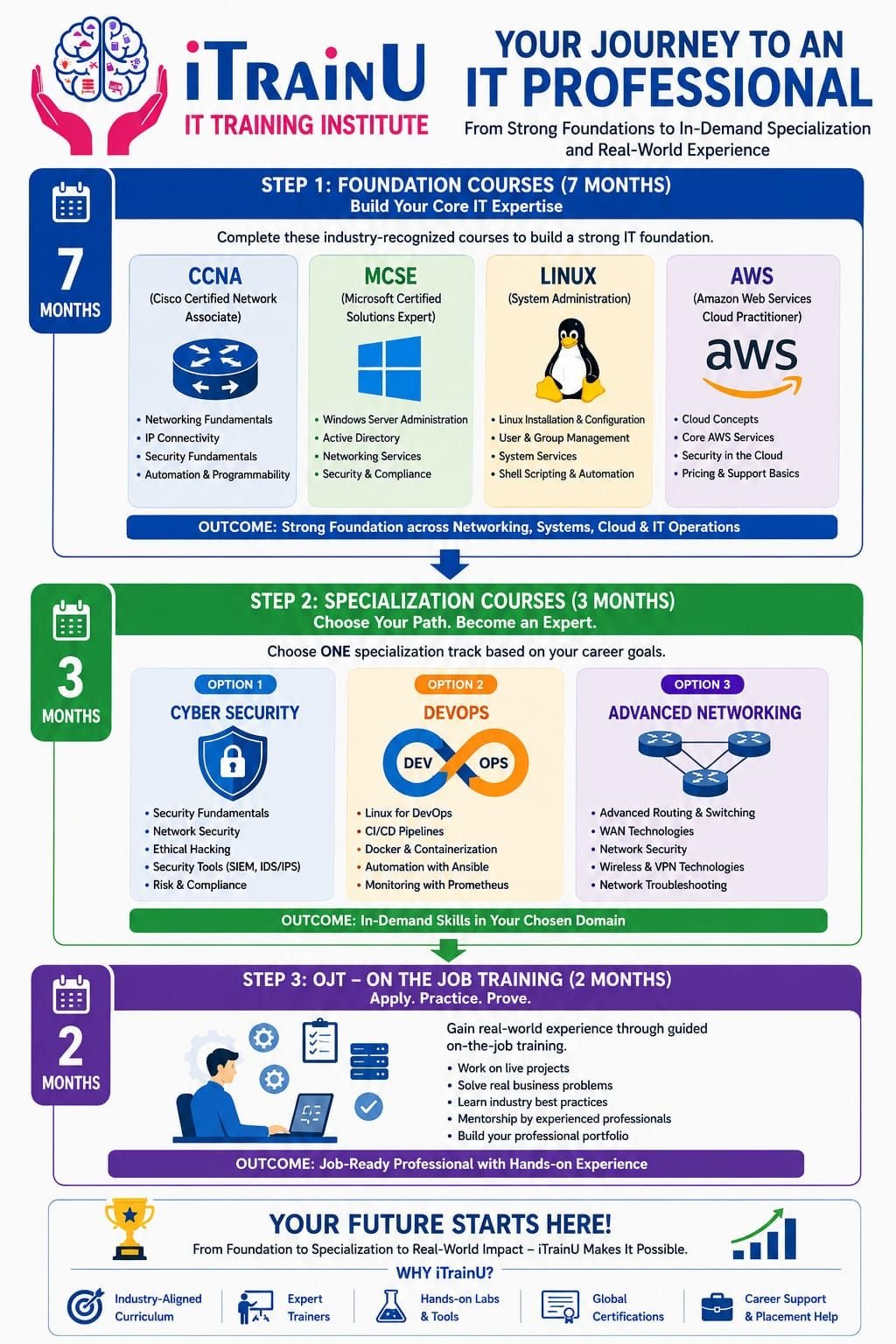
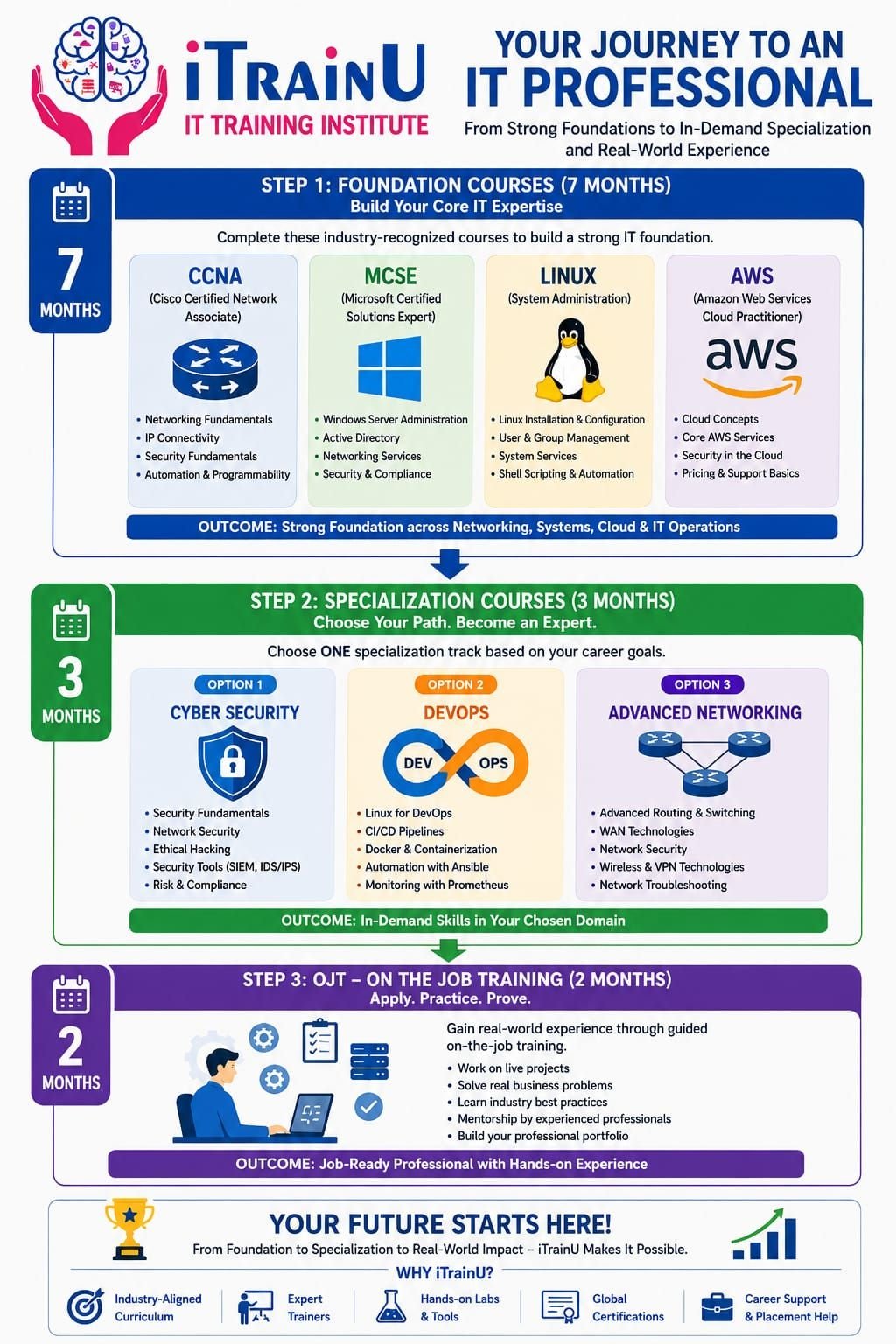
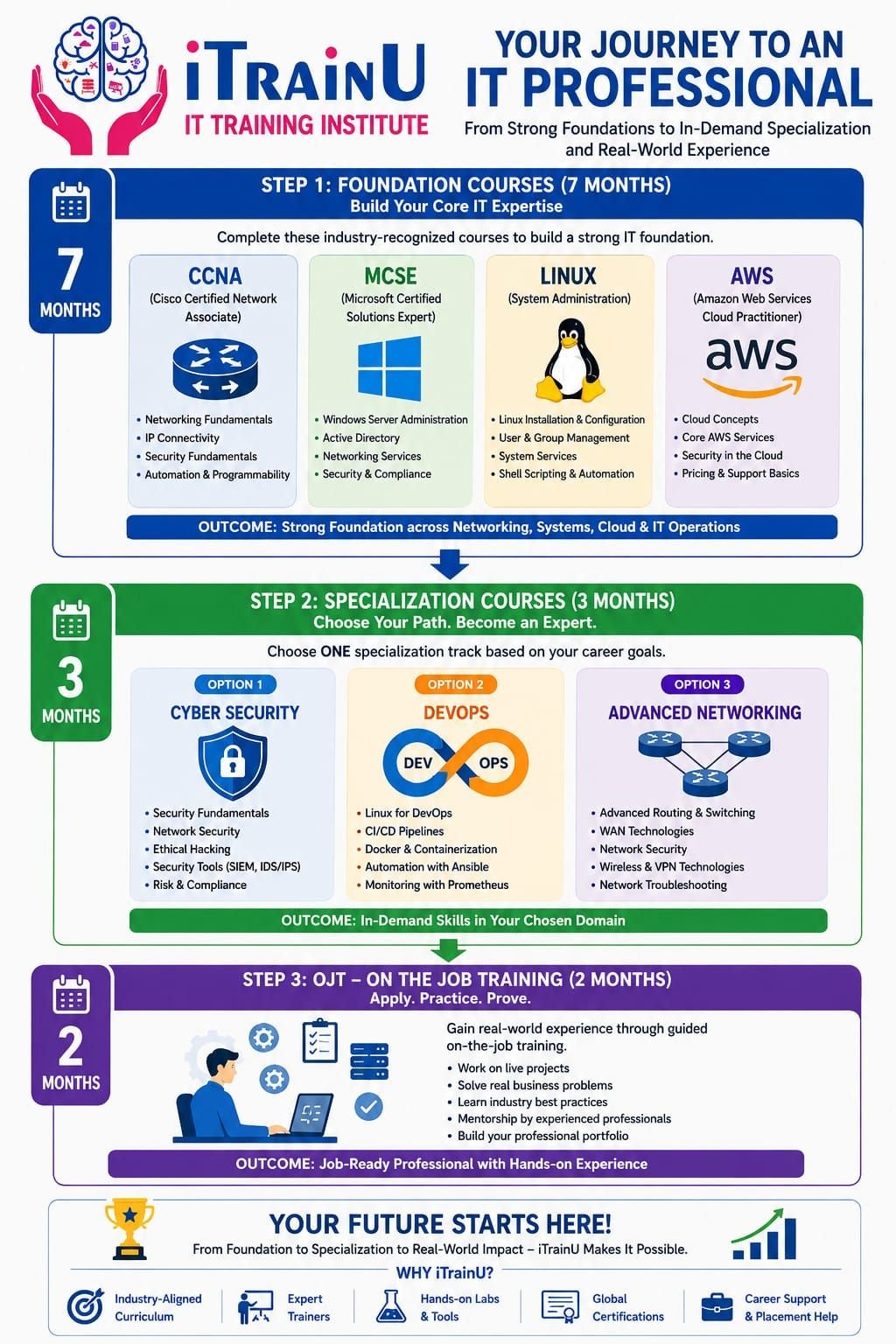
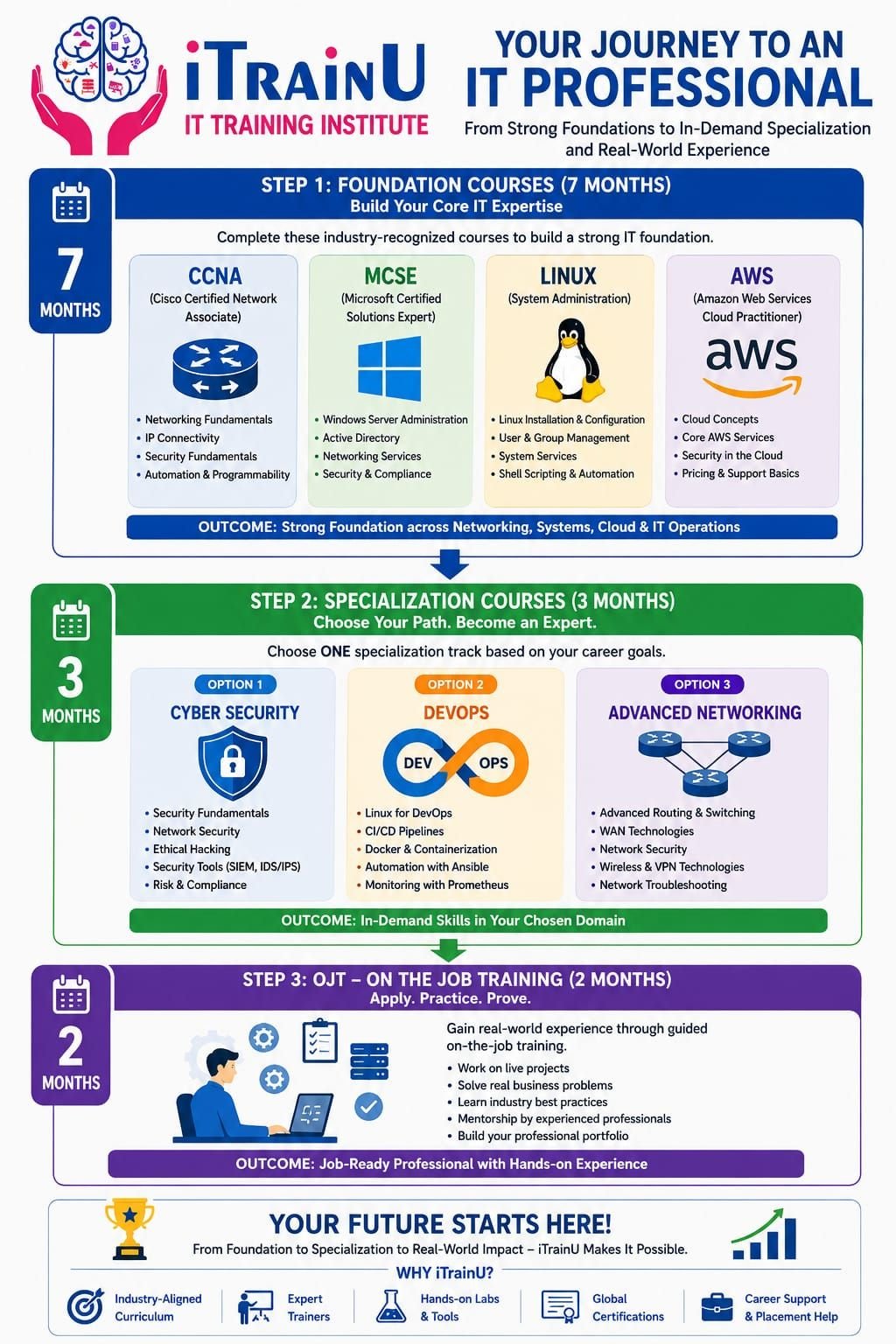
How iTrainU Gets You Job-Ready
At iTrainU, we don't just teach you definitions; we give you the keys to the engine. Our DevOps training programs are designed to take you from a total beginner to a certified professional.
- Hands-on Labs: Get access to real-world cloud environments where you can practice without breaking your own computer.
- Industry-Certified Trainers: Learn from experts who spend their days managing massive cloud infrastructures.
- Internship Opportunities: Bridge the gap between learning and earning with our DevOps Internship Program.
- Guaranteed Placement Support: We help you polish your resume and prepare for interviews so you can land your dream role. Check out our placement records for more details.

Top 5 DevOps Interview Questions
- What is the difference between Continuous Delivery and Continuous Deployment?
- Can you explain the concept of "Infrastructure as Code" and its benefits?
- What happens when you type 'google.com' in your browser from a networking perspective?
- How do you manage secrets (like API keys) in a CI/CD pipeline?
- Describe a time you automated a manual process. What tools did you use and what was the outcome?
Summary
Becoming a DevOps engineer in 2026 is a journey of continuous learning. Start with the foundations (Linux/Networking), move to the core toolchain (Git/Docker/CI/CD), and then master the Cloud and Kubernetes. With a practical, project-based approach, you can transition into this high-paying field in under a year.
Meta Title: How to Become a DevOps Engineer from Scratch: 2026 Roadmap
Meta Description: Master the DevOps engineer roadmap for 2026. Learn Linux, AWS, Docker, and Kubernetes with iTrainU's hands-on labs and placement-focused training.
FAQs
1. Do I need to be a pro at coding to learn DevOps?
No, you don't need to be a software developer, but you should be comfortable writing scripts (Python/Bash) to automate tasks.
2. How long does it take to become a DevOps engineer?
For someone starting from scratch, it typically takes 9 to 12 months of consistent, hands-on study.
3. Is DevOps still relevant in the age of AI?
Absolutely. AI is a tool that DevOps engineers use to be more efficient, but the need for human experts to design and secure these systems is higher than ever.
4. Does iTrainU provide placement support?
Yes! We offer 100% placement support, including resume building and mock interviews, through our specialized placement cell.
5. Which cloud should I learn first?
AWS is generally recommended for beginners due to its massive market share and extensive documentation.
#DevOpsRoadmap2026 #CloudComputing #iTrainU #AWSArchitect #TechCareers
Our Presence:
We provide the best training institute for azure in Agra, Ahmedabad, Allahabad, Arlington, Atlanta, Augusta, Aurangabad, Austin, Australia, Bangalore / Bengaluru, Belfast, Bhopal, Bhubaneswar, Birmingham, Boston, Bristol, Calgary, Cambridge, Canterbury, Cardiff, Chandigarh, Charlotte, Chennai, Chicago, Cleveland, Coimbatore, Columbus, Coventry, Dallas, Dehradun, Delhi, Denver, Detroit, Dubai, Durham, Edinburgh, Edmonton, Fresno, Ghaziabad, Glasgow, Gurgaon / Gurugram, Guwahati, Houston, Hyderabad, Imphal, Indore, Jacksonville, Jaipur, Jammu, Jodhpur, Kanpur, Kansas, Kochi, Kolkata, Las Vegas, Leeds, Liverpool, London, Los Angeles, Lucknow, Ludhiana, Madison, Manchester, Meerut, Miami, Mississauga, Montreal, Morrisville, Mountain View, Mumbai, Mysore, Nagpur, Nashville, New Jersey, New York City, Noida, Nottingham, Orlando, Oxford, Patna, Philadelphia, Phoenix, Pittsburgh, Pondicherry, Portland, Pune, Raipur, Raleigh, Ranchi, Redmond, Richmond, Rochester, Sacramento, San Antonio, San Diego, San Francisco, San Jose, Seattle, Sheffield, Singapore, Southampton, Sunderland, Sunnyvale, Surat, Swansea, Tampa, Thane, Thiruvananthapuram, Tirupati, Toronto, Turner, Udaipur, Vadodara, Vancouver, Vijayawada, Visakhapatnam, Washington, New Delhi, Rajkot, Gandhinagar, Jabalpur, Gwalior, Navi Mumbai, nasik, Kuwait, Bahrain, Oman, Malaysia.
We offer devops training in Agra, Ahmedabad, Allahabad, Arlington, Atlanta, Augusta, Aurangabad, Austin, Australia, Bangalore / Bengluru, Belfast, Bhopal, Bhubaneswar, Birmingham, Boston, Bristol, Calgary, Cambridge, Canterbury, Cardiff, Chandigarh, Charlotte, Chennai, Chicago, Cleveland, Coimbatore, Columbus, Coventry, Dallas, Dehradun, Delhi, Denver, Detroit, Dubai, Durham, Edinburgh, Edmonton, Fresno, Ghaziabad, Glasgow, Gurgaon / Gurugram, Guwahati, Houston, Hyderabad, Imphal, Indore, Jacksonville, Jaipur, Jammu, Jodhpur, Kanpur, Kansas, Kochi, Kolkata, Las Vegas, Leeds, Liverpool, London, Los Angeles, Lucknow, Ludhiana, Madison, Manchester, Meerut, Miami, Mississauga, Montreal, Morrisville, Mountain View, Mumbai, Mysore, Nagpur, Nashville, New Jersey, New York City, Noida, Nottingham, Orlando, Oxford, Patna, Philadelphia, Phoenix, Pittsburgh, Pondicherry, Portland, Pune, Raipur, Raleigh, Ranchi, Redmond, Richmond, Rochester, Sacramento, San Antonio, San Diego, San Francisco, San Jose, Seattle, Sheffield, Singapore, Southampton, Sunderland, Sunnyvale, Surat, Swansea, Tampa, Thane, Thiruvananthapuram, Tirupati, Toronto, Turner, Udaipur, Vadodara, Vancouver, Vijayawada, Visakhapatnam, Washington, New Delhi, Rajkot, Gandhinagar, Jabalpur, Gwalior, Navi Mumbai, nasik, Kuwait, Bahrain, Oman, Malaysia, USA, UK.