Starting a career in Artificial Intelligence (AI) and Machine Learning (ML) can feel like trying to climb a mountain without a map. In 2026, the tech landscape has shifted. It’s no longer just about writing code; it’s about building intelligent systems that solve real-world problems.
If you're a fresher or a career switcher, Python is your entry ticket. It’s the primary language for AI, and mastering it is the first step in your full stack developer roadmap for beginners. At iTrainU, we specialize in transforming beginners into job-ready professionals through hands-on labs and industry-certified training.
This guide breaks down exactly what you need to learn to become an AI specialist this year.
What is Python for AI and Why Does it Matter?
Python is a high-level, interpreted programming language known for its clear syntax and massive ecosystem of libraries. In the context of AI, Python acts as the "glue" that connects data to powerful mathematical models.
In 2026, the demand for AI skills has outpaced traditional software development. Companies aren't just looking for people who can write scripts; they want professionals who understand Generative AI (GenAI), Large Language Models (LLMs), and MLOps. Whether you're looking for a cyber security course in indore with placement or wanting to pivot into AI, Python is the foundation you can't skip.
Phase 1: Python and Mathematical Foundations
Before you can build a self-driving car or a chatbot, you need to speak the language of data.
1. Core Python Mastery
You don't need to be a competitive programmer, but you must be comfortable with:
- Data Types & Structures: Mastering lists, dictionaries, tuples, and sets.
- Control Flow: Using
ifstatements and loops to manage logic. - Functions & OOP: Writing reusable code and understanding classes (Object-Oriented Programming).
- Error Handling: Using
try-exceptblocks to build resilient applications.
2. Math for Machine Learning
AI is just "math in a fancy suit." You don't need a PhD, but you should understand:
- Linear Algebra: Vectors and matrices (the language of data).
- Statistics: Mean, median, variance, and probability distributions.
- Calculus: Understanding how models "learn" through gradients.
Phase 2: The Data Science Toolkit
Data is the fuel for AI. To handle it, you'll use three essential libraries.
- NumPy is a library for numerical computing. It allows you to perform complex mathematical operations on large arrays of data much faster than standard Python lists.
- Pandas is a data manipulation tool. It’s like "Excel on steroids," used for cleaning, filtering, and analyzing tabular data.
- Matplotlib/Seaborn are visualization libraries. They turn rows of numbers into charts and graphs so you can spot trends.
Before and After: Data Handling
- Problem: You have 1 million rows of customer data in a messy CSV file. Cleaning it manually would take weeks.
- Solution: With Pandas, you can clean, deduplicate, and analyze that data in less than 10 lines of code.
Phase 3: Machine Learning & Deep Learning
Once you can handle data, you’re ready to build models.
Core Machine Learning (Scikit-Learn)
Start with "Classical ML." This includes algorithms that predict house prices (Regression) or classify emails as spam (Classification).
- Pro Tip: Focus on Scikit-learn. It is the industry standard for traditional ML algorithms.
Deep Learning (PyTorch/TensorFlow)
Deep Learning mimics the human brain using neural networks. This is what powers image recognition and voice assistants.
- What you control: The architecture of the network and the training parameters.
- What the framework manages: The complex mathematical backpropagation and GPU acceleration.

Phase 4: The 2026 Edge – GenAI and RAG
The AI roadmap in 2026 is incomplete without Generative AI. Freshers are now expected to know how to work with LLMs like GPT-4 or Llama 3.
- Prompt Engineering: Learning how to talk to AI to get the best results.
- LangChain: A framework used to build applications that connect LLMs to your own data.
- Retrieval-Augmented Generation (RAG): A technique that lets an AI search through a private database to provide accurate, non-hallucinated answers.
If you are following an aws solution architect study guide 2026, you'll find that deploying these GenAI models on the cloud is a high-value skill.
Phase 5: Deployment and MLOps
A model sitting on your laptop is useless. You need to "deploy" it so others can use it. This is where MLOps (Machine Learning Operations) comes in.
- FastAPI: Use this to create a web interface (API) for your model.
- Docker: Containerize your application so it runs the same way on any machine.
- Cloud (AWS/Azure/GCP): Host your models at scale.
This phase is closely related to how to become a devops engineer from scratch, as it involves automation and infrastructure.
Why Choose iTrainU for Your AI Journey?
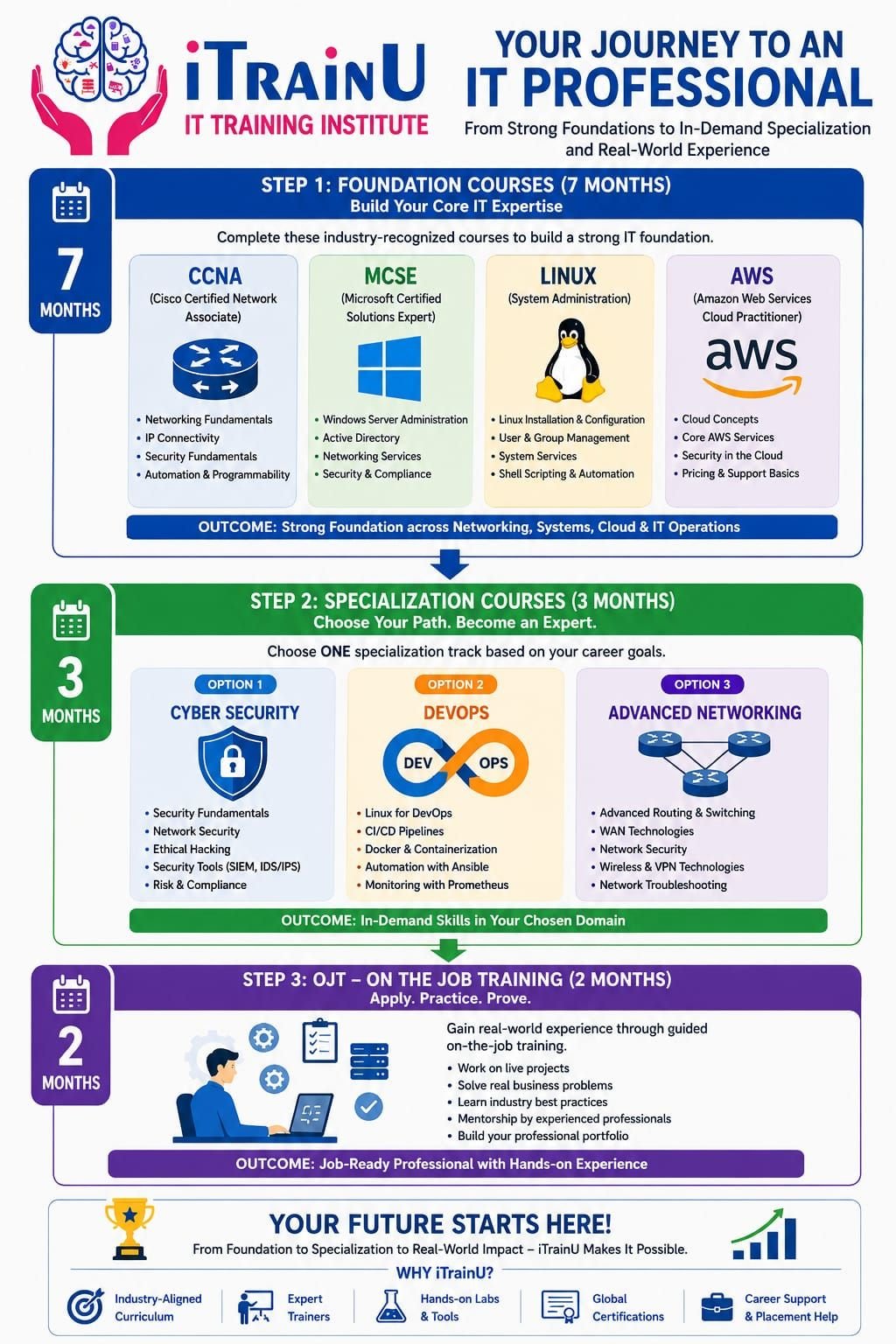
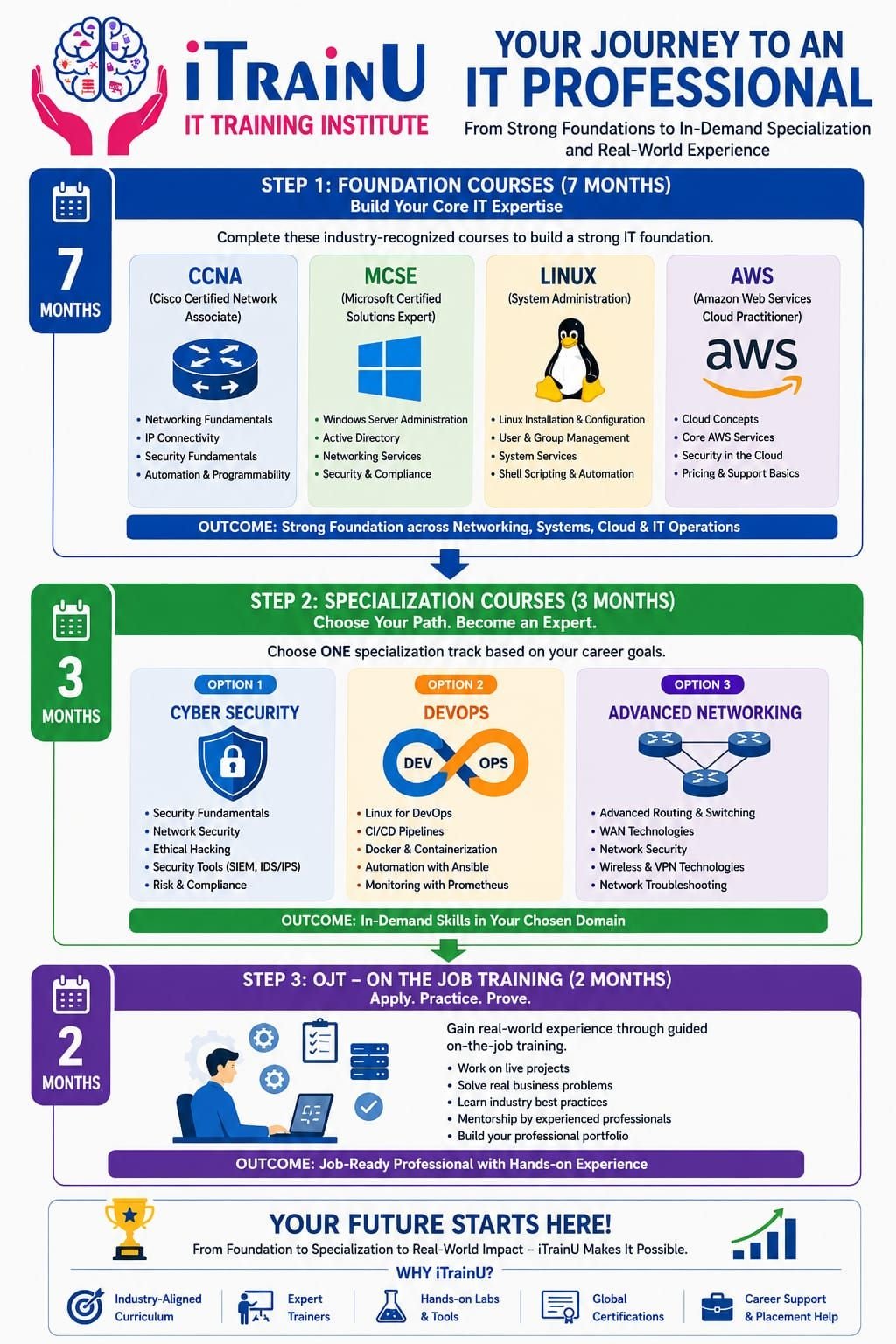
At iTrainU, we don't just teach you to code; we get you job-ready. Our programs are designed for the modern IT landscape, offering:
- Hands-on Labs: Don't just watch videos. Work on real-world projects in our state-of-the-art infrastructure.
- Industry-Certified Trainers: Learn from experts who have 30+ years of collective experience.
- Placement Support: We provide dedicated assistance to help you land your dream role in AI, Cloud, or Cyber Security.
- Internship Opportunities: Gain actual work experience while you learn.

Interview Questions to Prepare For
- What is the difference between a list and a tuple in Python? (Answer: Lists are mutable, tuples are immutable).
- Explain the concept of Overfitting. (Answer: When a model learns the noise in training data too well and performs poorly on new data).
- What are the main benefits of using Pandas over standard Python for data analysis? (Answer: Performance, built-in functions for data cleaning, and handling of large datasets).
- How does RAG improve an LLM's performance? (Answer: By providing specific, real-time context from an external knowledge base).
Frequently Asked Questions (FAQs)
Q: Do I need a math background to learn AI?
A: Basic high-school math is enough to start. You can learn the more complex parts as you go.
Q: How long does it take to become an AI engineer?
A: With dedicated study and a structured program like those at iTrainU, a fresher can become job-ready in 6 to 9 months.
Q: Can I switch from a non-tech background?
A: Yes! Python's simple syntax makes it the perfect language for career switchers.
Find the Best Training Institute Near You
We provide world-class IT training across the globe. Whether you're looking for best training institute for AI/ML in Indore or Azure training in London, iTrainU is your partner in progress.
Our Locations & Courses:
- Azure: best training institute for azure in Agra, Ahmedabad, Allahabad, Arlington, Atlanta, Augusta, Aurangabad, Austin, Australia, Bangalore, Bhopal, Bhubaneswar, Birmingham, Boston, Bristol, Calgary, Cambridge, Canterbury, Cardiff, Chandigarh, Charlotte, Chennai, Chicago, Cleveland, Coimbatore, Columbus, Coventry, Dallas, Dehradun, Delhi, Denver, Detroit, Dubai, Durham, Edinburgh, Edmonton, Fresno, Ghaziabad, Glasgow, Gurgaon, Guwahati, Houston, Hyderabad, Imphal, Indore, Jacksonville, Jaipur, Jammu, Jodhpur, Kanpur, Kansas, Kochi, Kolkata, Las Vegas, Leeds, Liverpool, London, Los Angeles, Lucknow, Ludhiana, Madison, Manchester, Meerut, Miami, Mississauga, Montreal, Morrisville, Mountain View, Mumbai, Mysore, Nagpur, Nashville, New Jersey, New York City, Noida, Nottingham, Orlando, Oxford, Patna, Philadelphia, Phoenix, Pittsburgh, Pondicherry, Portland, Pune, Raipur, Raleigh, Ranchi, Redmond, Richmond, Rochester, Sacramento, San Antonio, San Diego, San Francisco, San Jose, Seattle, Sheffield, Singapore, Southampton, Sunderland, Sunnyvale, Surat, Swansea, Tampa, Thane, Thiruvananthapuram, Tirupati, Toronto, Turner, Udaipur, Vadodara, Vancouver, Vijayawada, Visakhapatnam, Washington, New Delhi, Rajkot, Gandhinagar, Jabalpur, Gwalior, Navi Mumbai, Nashik, Kuwait, Bahrain, Oman, Malaysia.
- AWS: AWS training in USA, UK, India, and 100+ cities including Mumbai, Pune, and Bangalore.
- Cyber Security: best training institute for cyber security in Indore, Delhi, and Dubai.
- DevOps: best training institute for devops in Hyderabad, Noida, and Singapore.
- Linux & Networking: CCNA Networking training and Linux training in all major tech hubs.
Conclusion
The road to becoming an AI and Machine Learning professional in 2026 is exciting and full of opportunity. By focusing on Python fundamentals, mastering data libraries, and embracing GenAI, you’re setting yourself up for a high-paying, future-proof career.
Ready to start? Explore our courses or join our refer-and-earn program today!
#AI #MachineLearning #PythonRoadmap #iTrainU #TechCareers2026 #DataScience #MLOps