If you've spent any time looking into modern IT careers, you've likely seen the term DevOps everywhere. It's one of the highest-paying, most in-demand roles in the tech world today. But if you’re starting from scratch, the mountain of tools like Docker, Kubernetes, Jenkins, and AWS can feel overwhelming.
You might have started your journey looking for a full stack developer roadmap for beginners, only to realize that writing code is just half the battle. The other half is getting that code to run reliably for millions of users. That’s the "Ops" in DevOps.
In this guide, we’ll break down how to become a devops engineer from scratch in 2026. We'll skip the fluff and give you a direct, project-based path that takes you from "I don’t know what a terminal is" to "I can automate an entire cloud infrastructure."
What is DevOps?
DevOps is a cultural and technical bridge between two teams: Developers (who build software) and Operations (who maintain the servers where that software lives). In the old days, developers would "throw their code over the wall" to the operations team, who then struggled to make it work.
DevOps breaks that wall down using automation, continuous integration (CI), and continuous delivery (CD). Instead of manual setup, you write code to manage your servers, this is known as Infrastructure as Code (IaC).
The 2026 DevOps Roadmap: Step-by-Step
Becoming a DevOps engineer isn't about learning 50 tools at once. It's about building a solid foundation and adding layers.
Step 1: Master the Linux Command Line
Everything in the DevOps world runs on Linux. From the smallest microservice to the largest cloud server, Linux is the backbone. You don't need to be a kernel hacker, but you must be comfortable without a mouse.
- What to learn: File systems, permissions (
chmod,chown), package management (apt,yum), and process management (systemctl). - Pro Tip: Stop using the GUI on your computer. Try to do everything, moving files, editing text, checking logs, via the terminal.

Step 2: Version Control with Git
If you aren't using Git, you aren't doing DevOps. Git allows teams to track changes in code and infrastructure.
- Direct Definition: Git is a tool that saves "snapshots" of your project so you can go back in time if something breaks.
- Key Skills: Branching, merging, pull requests, and resolving merge conflicts.
Step 3: Scripting and Automation (Python or Bash)
A DevOps engineer’s job is to be "constructively lazy." If you have to do a task twice, automate it. Proficiency in Python or Bash scripting is essential for writing the "glue" that connects different tools.
# A simple Bash script to check disk usage and alert if it's over 90%
THRESHOLD=90
USAGE=$(df / | grep / | awk '{ print $5 }' | sed 's/%//g')

if [ $USAGE -gt $THRESHOLD ]; then
  echo "Warning: Disk usage is at ${USAGE}%!"
  # You could add a command here to send an email or Slack alert
fi
Step 4: Cloud Computing (AWS)
Most companies no longer buy physical servers; they rent them from the cloud. Amazon Web Services (AWS) is the market leader. If you are currently studying an aws solution architect study guide 2026, you are already building a massive part of your DevOps toolkit.
- What you control: Virtual machines (EC2), storage (S3), and networking (VPC).
- What the provider manages: Hardware maintenance, power, and physical security.

Step 5: Containers and Orchestration (Docker & Kubernetes)
Docker allows you to package an application with all its "stuff" (libraries, settings) into a single container that runs anywhere. Kubernetes is the "captain" that manages thousands of these containers at once.
Step 6: CI/CD Pipelines
This is the heart of DevOps. A CI/CD pipeline (using tools like Jenkins or GitHub Actions) automatically tests and deploys your code every time you save a change.
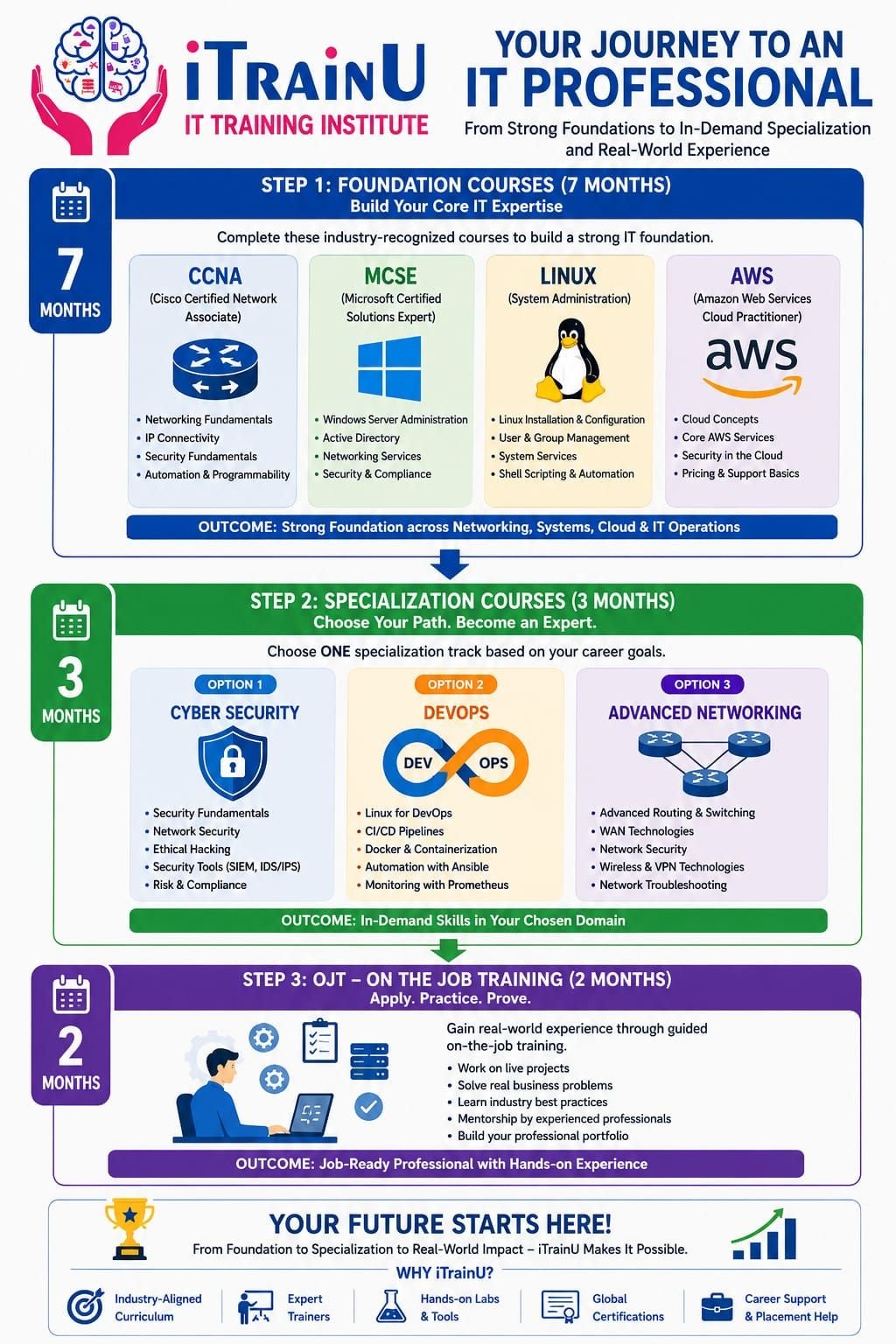
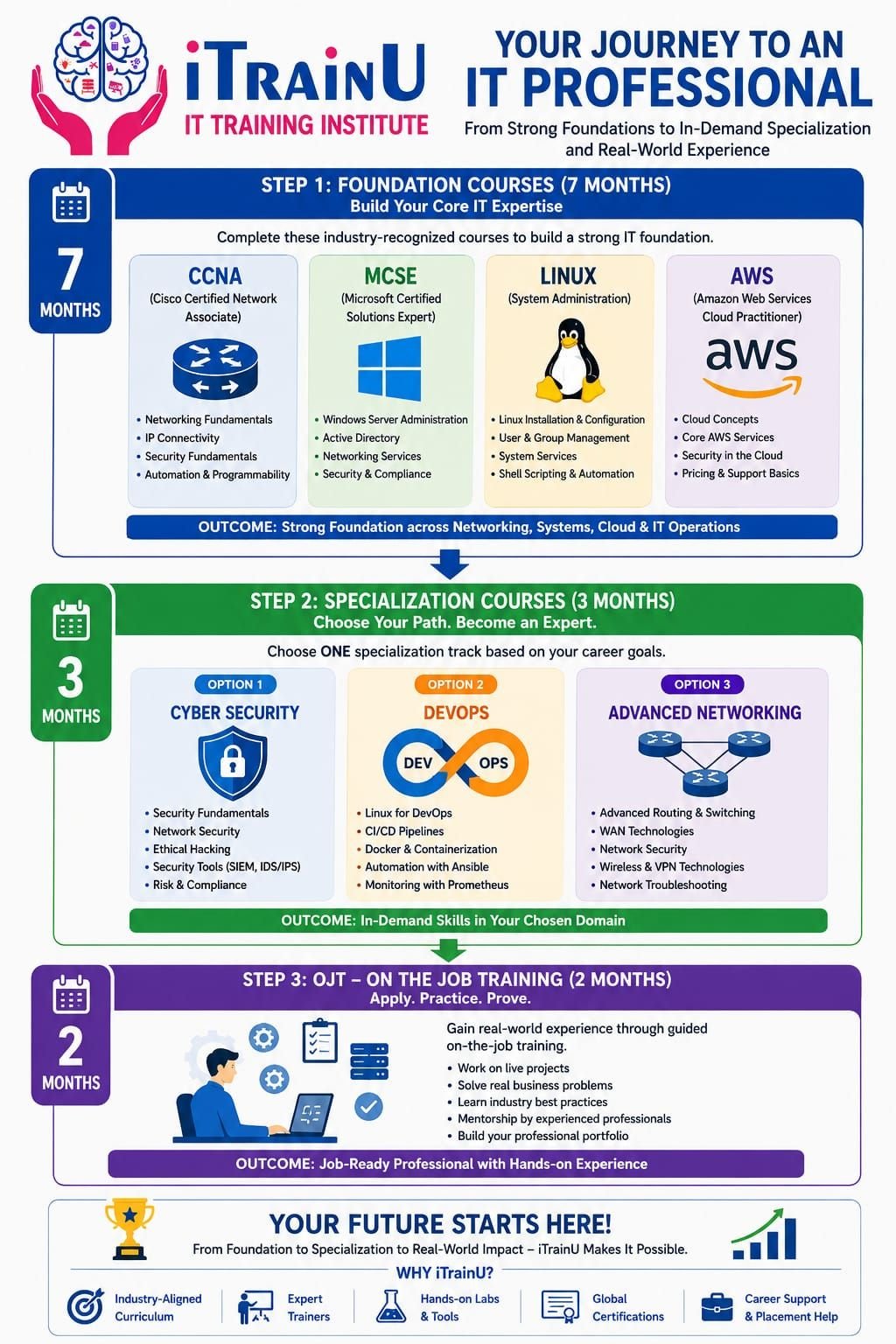
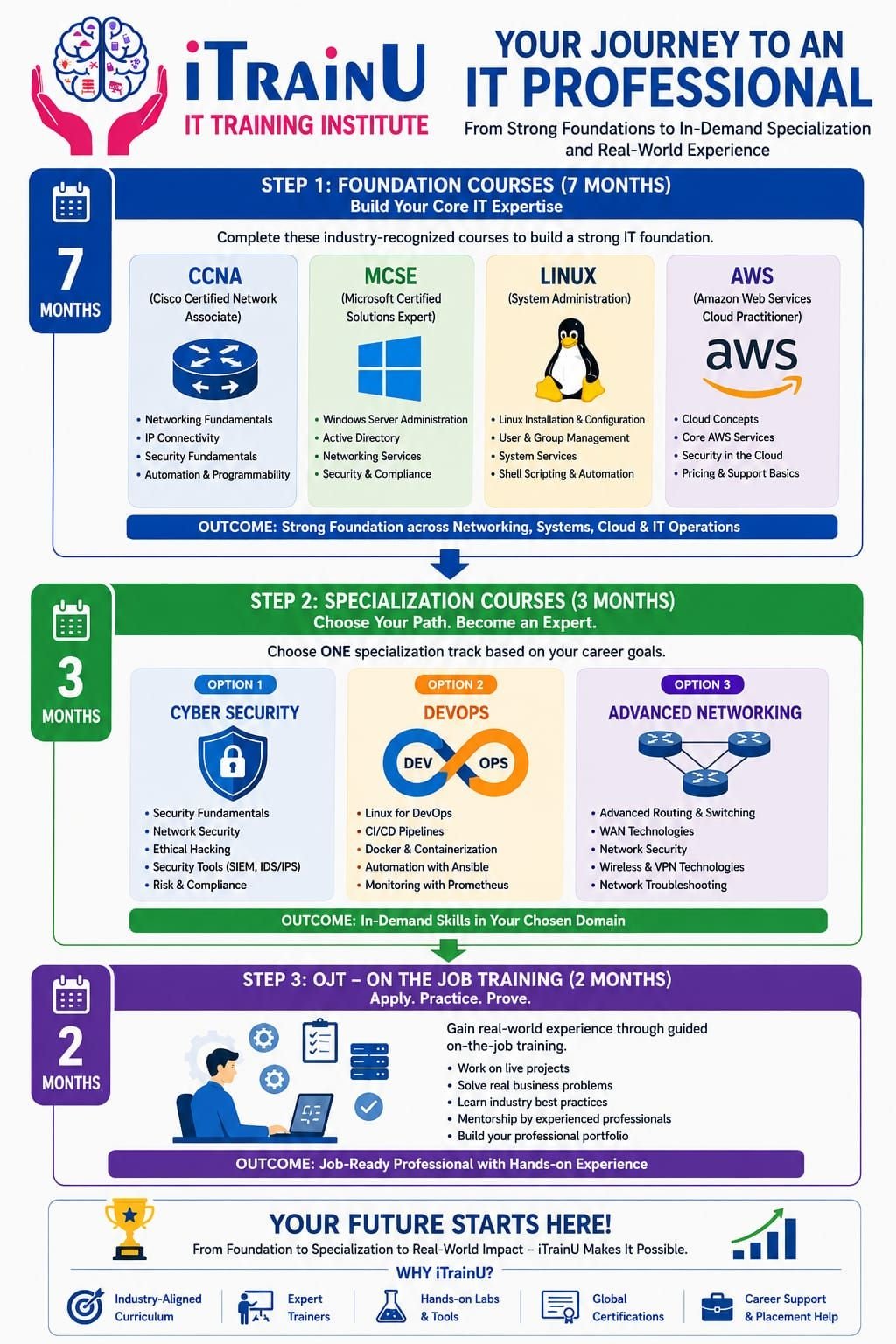
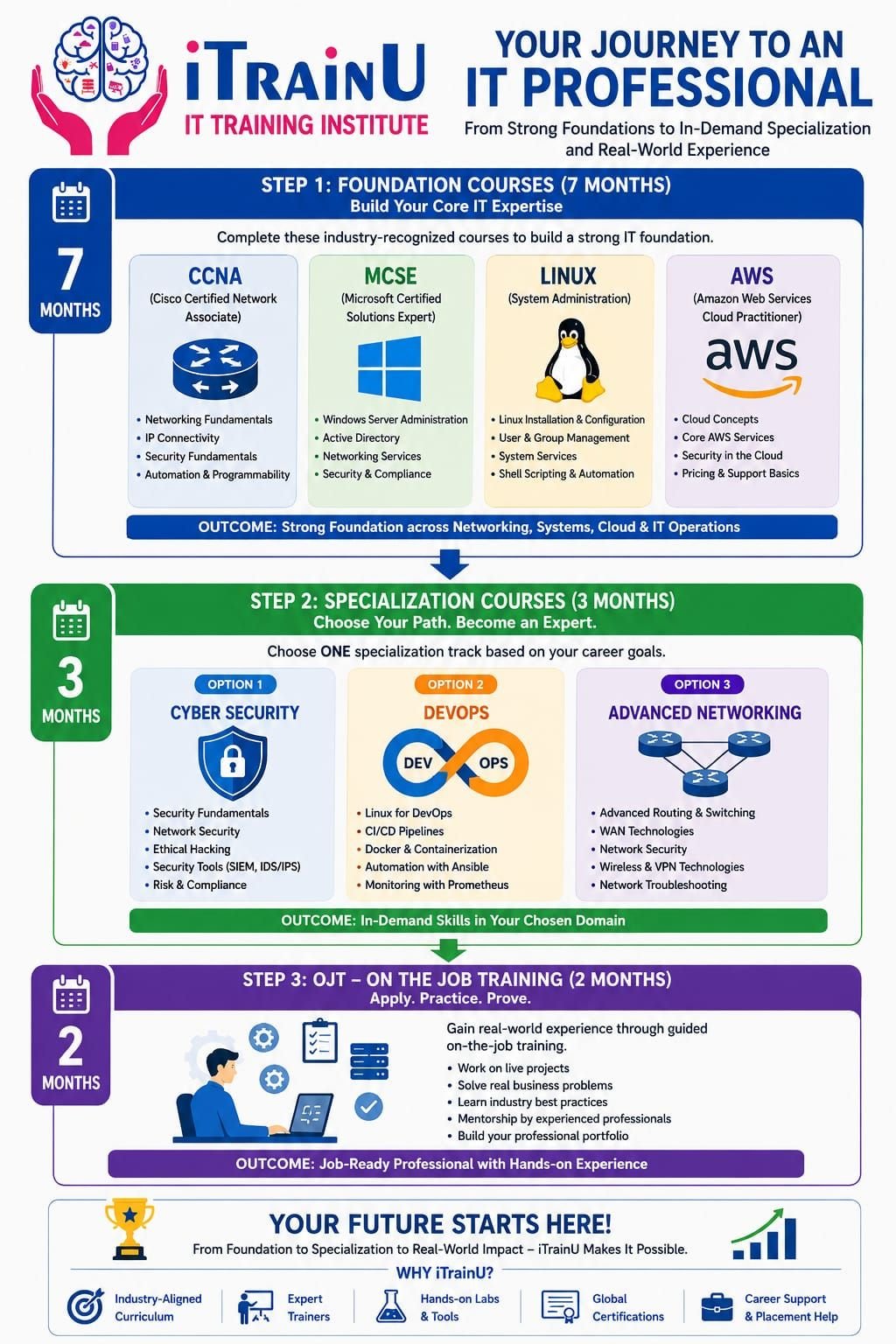
Why iTrainU is Your Best Shortcut
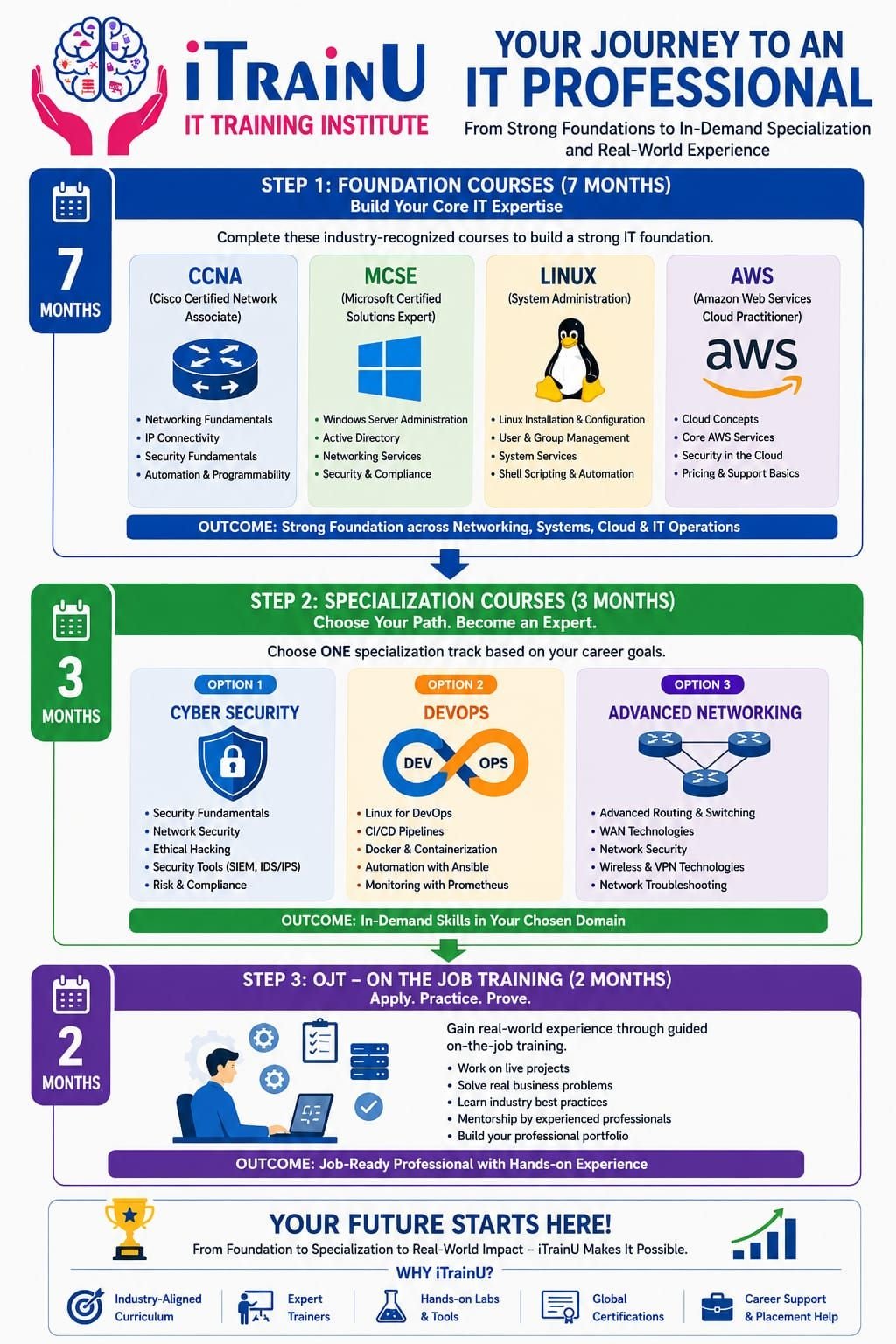
Learning all of this alone is hard. You can watch a hundred YouTube videos and still feel lost when a real server crashes. At iTrainU Institute, we focus on Project-Based Learning.
- Hands-on Labs: We don't just talk about Docker; you’ll spend hours in our labs building and breaking real clusters.
- Industry-Certified Trainers: Learn from experts with 10+ years of experience who have actually managed production environments.
- 100% Placement Support: We help with resume building, mock interviews, and direct connections to hiring partners. Whether you're looking for a cyber security course in indore with placement or a specialized DevOps role, we’ve got you covered.
- Internship Programs: Gain real-world experience through our internship track to bridge the gap between student and professional.

Pro Tips for the Aspiring DevOps Engineer
- Don't "Tool Hop": Don't try to learn Jenkins, GitLab CI, CircleCI, and Travis CI all at once. Master one (we recommend Jenkins or GitHub Actions) first. The concepts are the same across all of them.
- Build a Portfolio: Host your projects on GitHub. A recruiter would much rather see a working Terraform script than a list of "familiar tools" on a resume.
- Focus on Networking: You can't secure or automate what you don't understand. Learn how IP addresses, DNS, and Firewalls work.
DevOps Interview Questions (2026 Edition)
- What is the difference between Continuous Delivery and Continuous Deployment?
- Answer: Delivery means the code is always ready to be deployed but requires a manual click. Deployment means every change that passes tests goes to production automatically.
- What is "Infrastructure as Code" (IaC)?
- Answer: It's the practice of managing and provisioning computing infrastructure through machine-readable definition files (like Terraform), rather than manual hardware configuration.
- How does a Docker container differ from a Virtual Machine?
- Answer: VMs include a full operating system; containers share the host's OS kernel, making them much lighter and faster.
Summary
Becoming a DevOps engineer from scratch is a marathon, not a sprint. By focusing on Linux, Cloud (AWS), Containers, and Automation, you are setting yourself up for one of the most stable and high-paying careers in 2026.
At iTrainU, we provide the environment, the tools, and the expert guidance to make this transition as fast as possible. Ready to start? Contact us today or visit us in Indore!
FAQs
Q: Do I need to know how to code to start DevOps?
A: You don't need to be a software developer, but you do need to understand logic and basic scripting (Python/Bash) to automate tasks.
Q: How long does it take to become job-ready?
A: With dedicated study and hands-on practice (like our 3-month intensive program), most students are job-ready in 4 to 6 months.
Q: Is there a demand for DevOps in Indore?
A: Yes! Indore's IT sector is booming. Many local companies and MNCs are actively hiring for cloud and DevOps roles.
#DevOpsRoadmap #AWS2026 #ITrainU #CloudComputing #IndoreIT #TechCareers #HowToBecomeADevOpsEngineer