So, you’ve heard the buzz. It’s 2026, and the tech landscape has shifted. AI isn’t just a “feature” anymore: it’s the backbone of everything from your fridge to your financial advisor. If you’re a fresher looking to break into the industry, there’s one language that still wears the crown: Python.
At iTrainU, we see hundreds of students every year asking the same thing: “Where do I even start?” The field is huge, and the jargon (LLMs, RAG, Neural Nets) can feel like a brick wall.
Don’t sweat it. We’ve mapped out the ultimate, fluff-free Python for AI and Machine Learning roadmap for freshers to take you from “Hello World” to “Hired.”
Why Python for AI in 2026?
Python is a high-level, interpreted language known for its simplicity. In 2026, it remains the industry standard because:
- Readability: It reads like English. You spend less time fighting syntax and more time solving problems.
- The Ecosystem: Libraries like PyTorch 3.0 and Scikit-Learn do the heavy lifting for you.
- AI Engineering: The focus has shifted from just building models to integrating them. Python is the perfect “glue” for AI APIs and data pipelines.
Phase 1: Mastering Python Foundations
You can’t build a skyscraper on sand. Before touching AI, you need to be comfortable with core Python.
What to learn:
- Variables & Data Types: Strings, Integers, Booleans.
- Data Structures: Lists, Dictionaries, Sets, and Tuples.
- Control Flow: If-Else statements and Loops (For/While).
- Functions: Writing reusable code and understanding arguments.
Code Example: A Simple Logic Check
# A quick check to see if a student is ready for AI
def check_readiness(skill_level):
    if skill_level > 7:
        return "You're ready for Machine Learning!"
    else:
        return "Keep practicing those Python basics!"

print(check_readiness(8))
Phase 2: The Data Science Toolkit (NumPy & Pandas)
AI “eats” data. To feed it, you need to know how to clean and organize that data.

- NumPy: This is the library for Numerical Python. It helps you handle massive arrays and matrices (the math behind AI).
- Pandas: Think of this as Excel on steroids. You’ll use it for DataFrames: cleaning messy spreadsheets and filtering information.
- Visualization: Use Matplotlib or Seaborn to turn numbers into charts. In the industry, if you can’t visualize it, you can’t explain it.
Phase 3: Core Machine Learning with Scikit-Learn
This is where the “learning” happens. You’ll move from basic scripts to algorithms that make predictions.
Step-by-Step Concepts:
- Supervised Learning: Teaching the machine with labeled data (e.g., “This image is a cat”).
- Regression: Predicting a number (e.g., Predicting house prices).
- Classification: Choosing a category (e.g., Is this email spam or not?).
- Evaluation: Learning how to tell if your model is actually good using Accuracy, Precision, and Recall.
Pro Tip: Don’t try to memorize the math formulas on day one. Focus on the logic: why do we use a Decision Tree instead of Linear Regression?
Phase 4: Deep Learning & the 2026 Edge (LLMs)
In 2026, “AI” often means Generative AI and Large Language Models (LLMs).
- Neural Networks: Understanding how “neurons” (code layers) process information.
- PyTorch/TensorFlow: The frameworks used to build deep learning models.
- AI Engineering: Learning to use APIs (like OpenAI or Anthropic) and building RAG (Retrieval-Augmented Generation) systems. This is a massive hiring trend right now!
Phase 5: The iTrainU Way – Building a Portfolio
Theory is great, but companies hire for skills, not just certificates. Our Artificial Intelligence AI Course focuses on Project-Based Learning.

What your portfolio should have in 2026:
- A Real-World ML Project: Like a credit card fraud detection system.
- An AI-Powered App: A chatbot that uses an API to answer questions about a specific dataset.
- Clean GitHub Repos: Code that is documented and easy to read.
At iTrainU, we provide live sessions with certified trainers who walk you through these projects step-by-step. You aren’t just watching a video; you’re building with an expert.
Common Mistakes to Avoid
- Skipping the Math: You don’t need to be a mathematician, but you must understand basic Statistics and Linear Algebra.
- Tutorial Hell: Watching videos without typing a single line of code. Stop watching, start breaking things!
- Ignoring Deployment: A model on your laptop is useless. Learn how to put it on the web using FastAPI or Streamlit.
Interview Questions for Freshers (AI/ML)
- What is the difference between Supervised and Unsupervised learning?
- How do you handle missing values in a dataset using Pandas?
- What is “Overfitting,” and how can you prevent it?
- Explain the concept of a “Loss Function” in simple terms.
- What is a Transformer, and why is it important for LLMs?
Summary: Your Path Forward
Breaking into AI in 2026 is about being a Practical AI Builder. Start with Python basics, move into data handling, master the core ML algorithms, and finally, dive into the world of LLMs and deployment.
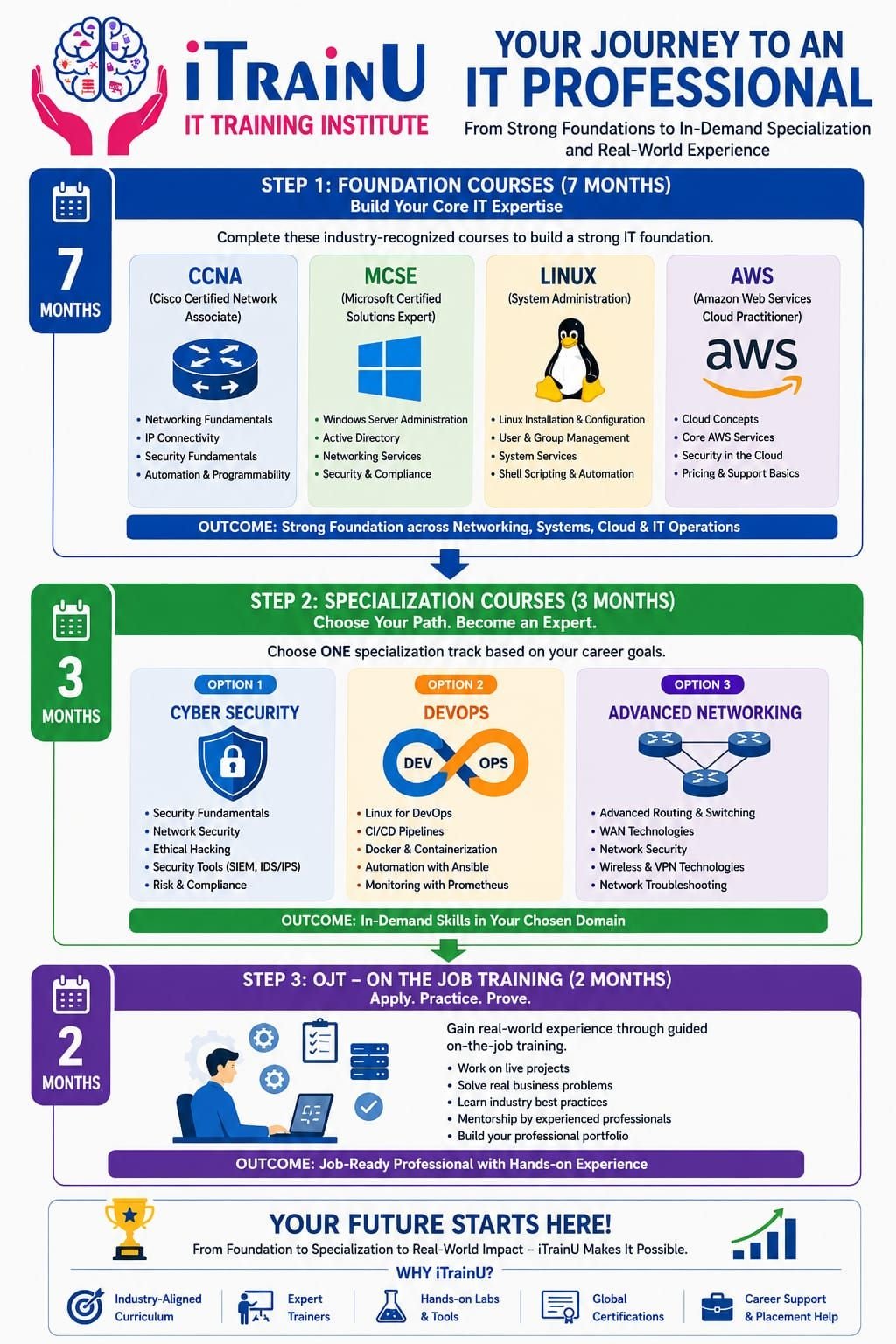
Ready to jumpstart your career? Join us at iTrainU for our 8-month industry-oriented training. We offer:
- 100% Placement Assistance (even for non-IT backgrounds!).
- Hands-on Labs and real-world projects.
- Global Certification to make your resume shine.
Explore our AI & ML Course here!
Meta Title: Python for AI and Machine Learning Roadmap for Freshers (2026 Guide)
Meta Description: Start your AI career with our 2026 Python for AI and machine learning roadmap for freshers. Learn Python basics, ML libraries, and LLM integration at iTrainU.
Hashtags: #PythonForAI #MachineLearningRoadmap #AI2026 #iTrainU #TechCareers #FreshersGuide #DataScience